




KATHMANDU: With the alliance between the Nepali Congress (NC) and the CPN-UML nearing a breaking point, uncertainty has intensified over the future of provincial governments.
As provincial lawmakers have gathered in Kathmandu, party leaders are holding consultations on possible power-sharing arrangements and the way forward.
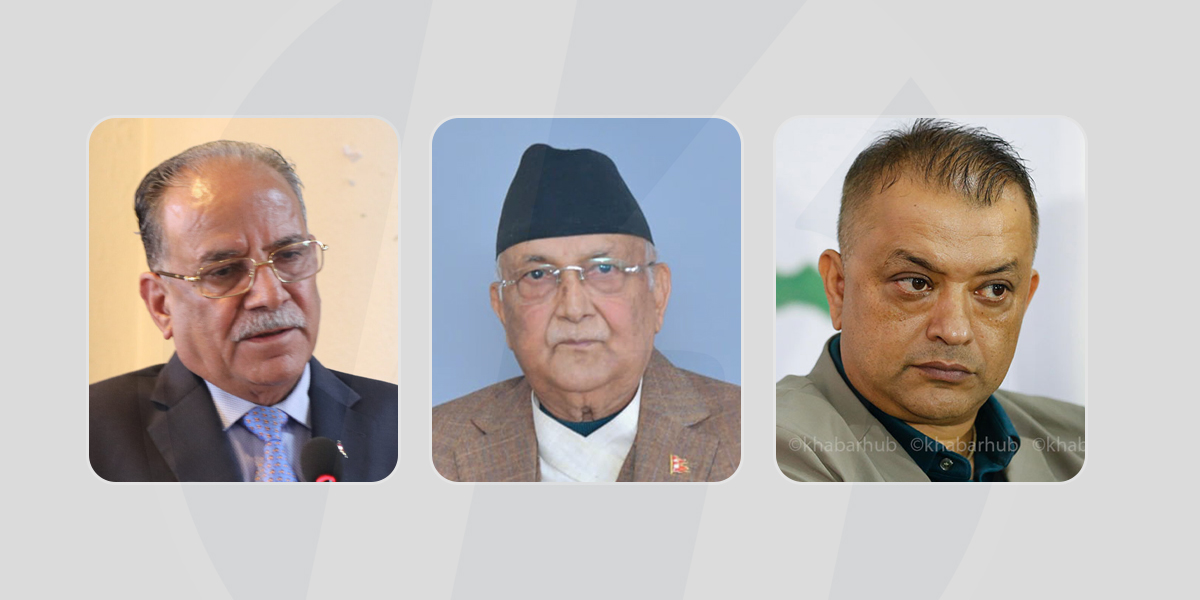
Sources say the three major parties are also discussing whether provincial units should be given greater autonomy in deciding coalition arrangements. Against this backdrop, Nepali Communist Party (NCP) Coordinator Pushpa Kamal Dahal “Prachanda” and CPN-UML Chair KP Sharma Oli held a nearly two-hour meeting on Tuesday.
According to leaders familiar with the discussions, the two explored the possibility of cooperation among democratic and constitution-supporting political forces. The secretariats of both leaders described the meeting as a preliminary discussion on bringing together parties committed to the Constitution and democracy to ensure stable provincial governments.
Prachanda’s secretariat said the meeting also focused on addressing the current political uncertainty and countering what it described as increasing pressure on democratic forces. While the leaders acknowledged that the Nepali Congress’s position could complicate coalition negotiations, they did not reach any understanding on forming a three-party provincial government.
During the meeting, Oli and Prachanda reportedly assessed that cooperation among the Nepali Congress, CPN-UML and the Maoist Centre at the provincial level could increase pressure on other political forces. However, according to Oli’s secretariat, the discussion did not extend to reviving a broader left alliance.
Both leaders are understood to have agreed that premature attempts at left unity had weakened communist forces in the past. Instead, they discussed exploring broader cooperation among parties at the provincial level and have begun internal consultations within their respective parties.
“There may have been discussions on cooperation among political forces for the sake of political stability and the national interest,” said Niru Pal, a member of Oli’s secretariat. “Dialogue among the left parties has also moved forward, and different options for cooperation may have been explored.”
Former minister and UML leader Mahesh Basnet also welcomed the meeting, saying it marked a positive step toward cooperation among communist parties. In a social media post, he argued that any collaboration should go beyond government formation and focus on safeguarding national interests and political stability.
Dialogue with Gagan Thapa on broader cooperation
The two leaders have also agreed to initiate dialogue with Nepali Congress General Secretary Gagan Thapa to explore the possibility of broader cooperation among democratic forces. According to leaders familiar with the discussions, Oli and Prachanda believe that with provincial assembly elections approaching, democratic parties should consider working together.
Sources say Oli appeared more flexible than Prachanda regarding cooperation with the Nepali Congress, although Prachanda reportedly remains cautious about Oli, citing past experiences. According to Oli’s secretariat, the discussion focused more on future political stability than on short-term political calculations.
“There has been discussion about meeting Gagan Thapa to explore the possibility of an all-party government in the provinces,” a UML leader who met Oli on Wednesday said.
“Prachanda said that if there is room for consensus, cooperation between the Nepali Congress and the UML should continue. At the same time, there is no need to rush into left unity. The priority should be broader cooperation among democratic forces, and if that proves impossible, left cooperation can still be considered.”
Although no formal decision has been announced, the Nepali Congress–UML alliance has effectively collapsed in the Far West, Karnali and Bagmati provinces. In Bagmati, six UML ministers collectively resigned after meeting party Chair KP Sharma Oli on Wednesday morning, reducing Chief Minister Indra Baniya of the Nepali Congress to a minority.
In Sudurpashchim (Far West), Congress Chief Minister Kamal Bahadur Shah has come under pressure after the UML refused to support the provincial budget. Karnali Chief Minister Yamalal Kandel is also facing political uncertainty following the Congress’s withdrawal of support.
A week ago, Nepali Congress President Gagan Thapa and Prachanda held preliminary discussions on possible political cooperation. While Prachanda has signalled openness to working with the Congress, he has simultaneously kept communication open with UML Chair Oli, indicating that he is weighing both a broader democratic alliance and renewed left cooperation. Sources say Prachanda is expected to meet Thapa today (Thursday).
“The Nepali Congress has political advantages in staying out of provincial governments, but we do not want instability,” Nepali Congress leader Pradeep Poudel said. ” Informal discussions are already taking place, but we have made it clear that the Nepali Congress, UML and Maoist Centre will not form a three-party provincial government together.”
NC rejects all-party provincial government
Internal differences within the Nepali Congress remain visible, with the establishment and reformist factions observing B.P. Memorial Day through separate programmes on Wednesday. Former Prime Minister Sher Bahadur Deuba’s camp is seen as favouring continued cooperation with the UML, while the faction led by party President Gagan Thapa has taken a firmer position.
Leaders close to Thapa say the Congress is prepared to contest provincial politics independently rather than participate in what they describe as an opportunistic power-sharing arrangement.
Thapa has publicly ruled out the possibility of an all-party provincial government. Speaking at a recent public event, he said the Congress had no intention of forming governments without a credible opposition and rejected any proposal for a three-party alliance involving the Congress, UML and Maoist Centre.
“The Congress may choose to stay out of government altogether,” Thapa said. “But it will not participate in a three-party government. We have already conveyed this position to the concerned leaders.”
NC Vice-President Bishwaprakash Sharma also confirmed that discussions with various political parties are ongoing but dismissed the prospect of the Congress, UML and Maoist Centre jointly forming provincial governments.
“The party president has already made it clear that we do not envision governments without an opposition,” Sharma said. “Our doors remain open for dialogue with the Maoist Centre and other smaller parties. Democratic forces should cooperate to safeguard democracy and the republic, but that does not necessarily mean sharing power. If others form the government, we are prepared to sit in the opposition.”
Congress General Secretaries Guru Ghimire and Pradeep Poudel similarly said the likelihood of a three-party provincial government is minimal, maintaining that the Congress has no interest in power-sharing arrangements that undermine the role of the opposition.
Despite the Congress’s public position, political observers remain focused on the expected meeting between Thapa and Prachanda, as it remains unclear whether the Maoist Centre will ultimately align with the Congress or revive cooperation with the UML. Prachanda’s secretariat has indicated that no final decision has been made.
Meanwhile, senior NCP leader Jhalanath Khanal argued that a renewed left alliance under the leadership of Oli and Prachanda is unlikely. He said meaningful left unity would require a new generation of leaders to take the initiative.


Comment