




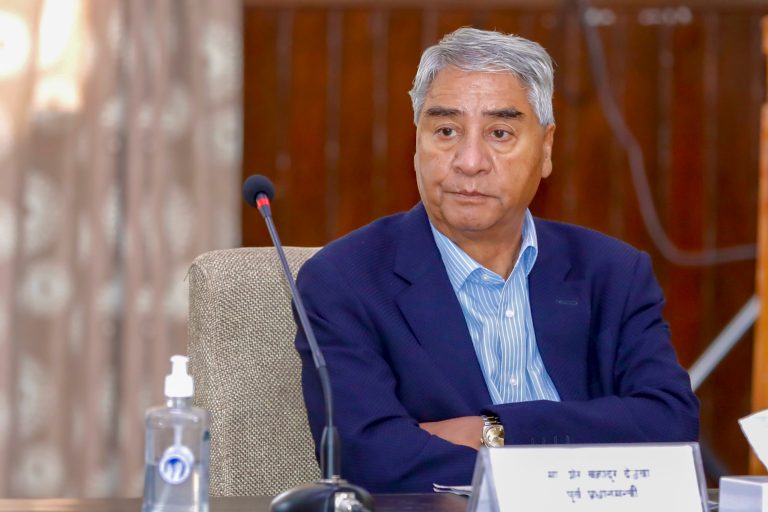
KATHMANDU: When BP Koirala began taking a young Sher Bahadur Deuba along on nationwide political tours, student leaders of the time objected. Responding to their concerns, BP famously defended Deuba, saying the young man from far-western Nepal was honest, eager to learn, and more attentive than others.
“I see strong potential in him,” BP had said, a remark that would later be cited as prophetic.
That faith helped shape one of the longest and most consequential careers in Nepal’s parliamentary politics.
After Krishna Prasad Bhattarai lost the party leadership due to internal sabotage, Girija Prasad Koirala swiftly emerged as the centre of power. In 1991, when Ram Chandra Paudel, Sher Bahadur Deuba and Shailaja Acharya, all from the same political generation, won parliamentary seats, Girija asked them to choose their ministries. Deuba unhesitatingly chose the Home Ministry, while Acharya took Agriculture and Paudel Local Development.
While others hesitated or recalculated in the race for power, Deuba never looked back. When Girija began to dominate party affairs, Deuba did not submit. He was prepared to split the party rather than bend. Ironically, it was Girija himself who later reunited the party and handed over the legacy of the four-star flag and the tree symbol to Deuba before exiting politics.
From there, Deuba’s ascent never paused. He remains an exception in Nepali politics, becoming a groom while serving as home minister, with media buzz at the time even linking the US ambassador as a matchmaker.
To be elected continuously for more than three and a half decades through ballot politics is a global rarity. Even in adverse circumstances, when his political presence was barely visible nationally, voters in Dadeldhura consistently endorsed Deuba. This, analysts say, reflected a deep reservoir of trust and faith. By that measure, Deuba stood as a central pillar of Nepal’s parliamentary system.
Yet climbing Everest is one challenge; staying at the summit is another.
After six decades in active politics, Deuba’s journey, from principle-driven beginnings to an apparent obsession with power, has drawn sharp criticism. When he rose in the 1990s, many of today’s influential global leaders were not even on the political horizon. Narendra Modi was unknown beyond local circles, Vladimir Putin was still far from the Kremlin, China’s current leadership was in training grounds, and Donald Trump was immersed in real estate.
Deuba entered power politics when George H. W. Bush was US president. During Deuba’s five terms as prime minister, six different US presidents served two full terms each. In India, leadership changed hands multiple times; in Russia, Boris Yeltsin gave way to a new era; in Britain, the Thatcher–Major period ended. Many leaders of that generation either passed away, withdrew from politics, or reinvented themselves. Deuba, however, persisted.
Critics argue that persistence eventually turned into stagnation.
Following pressure from his own grandchildren’s generation, Deuba’s political dominance began to unravel. The September 2025 Gen-Z movement spilled blood on the streets, and the Special General Convention in January struck at the party’s core power structure. Once destined for a revered place in history, Deuba, they argue, was recast as a villain.
Yet observers caution against placing sole blame on Deuba. Nepali Congress politics has long thrived on informal networks rather than institutional processes. Leaders rose or fell not by records and files, but by proximity and access. Decisions were often shaped by flattery rather than principle.
Historical parallels abound. Even during the so-called “golden era” after the 1959 election, internal feuds weakened the party. BP himself later acknowledged how trusted colleagues drifted toward the palace. Power, critics say, repeatedly turned into arrogance.
Deuba’s career, too, is marked by contradictions. Supporters credit him with loyalty, decisiveness, and an ability to win without speaking much. Critics point to his readiness to make both justified and unjustified compromises for power, his lack of intellectual depth despite formal education, abrasive temperament, and reliance on patronage.
Party workers, analysts note, also share responsibility, often elevating leaders beyond accountability and turning political mistakes into ideological virtues.
It took six decades of collective party, societal and national investment to build Sher Bahadur Deuba. Seen positively, he remains one of South Asia’s longest-serving democratic leaders. Whether that legacy is preserved or allowed to corrode now lies in the hands of the new leadership.
History, after all, produces foundations, not flawless monuments. The challenge before the Nepali Congress is not to erase Deuba’s era, but to extract strengths from its flaws, and ensure that the rust does not consume the iron.





Comment