





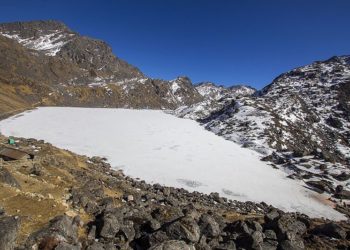
RASUWA: Gosaikunda, a renowned religious and tourist destination in the high Himalayas of Nepal’s Rasuwa district, is increasingly attracting domestic and foreign visitors throughout the year.
Situated at an altitude of 4,380 metres above sea level, Gosaikunda was traditionally visited mainly during special religious occasions and festivals. However, improved accessibility and the expansion of accommodation facilities along trekking routes have encouraged more visitors to explore the area in different seasons.
Local tourism entrepreneurs say travelling to Gosaikunda has become easier with the expansion of road networks and the availability of hotels and lodges along the trekking trails. Travellers can reach Dhunche, the district headquarters of Rasuwa, from Kathmandu by road and complete the trek to Gosaikunda in approximately two days. Alternatively, trekkers can take routes through Sundarijal in Kathmandu or Samundratar in Nuwakot.
Srijana Ghale, a hotelier from Khendi, said improved food and accommodation facilities along the trekking routes have contributed to the growing number of visitors throughout the year. Previously, tourists mainly visited the area during religious fairs, but domestic and international visitors now arrive in other seasons as well, she said.
According to Bishal Ghale, a hotelier in Dhunche, around 100 tourists visit the area daily under normal circumstances, with numbers increasing on some days. He said tourist arrivals were temporarily affected after floods on August 26 damaged roads and other infrastructure, but normal life and tourism activities were gradually returning to normal.
Sita Devkota, who operates a hotel, also said tourism businesses had experienced a temporary setback following the floods. However, the arrival of domestic and foreign tourists has gradually recovered. She noted that attractions along the route, including Dhaibung’s Dahichiura, the hospitality and accommodation facilities in Dhunche, and the natural beauty of the area’s sandalwood forests, add to the trekking experience.
Gosaikunda also holds great religious significance among Hindu devotees. According to local social worker Dawafinjo Tamang, religious belief holds that deities from across the universe reside in the sacred lake and that pilgrims can receive the blessings of all gods and goddesses by taking a holy bath there.
According to Hindu mythology, Lord Shiva created Gosaikunda by striking the ground with his trident after consuming poison churned from the ocean. Seeking relief from the burning sensation caused by the poison, Shiva struck the mountain with his trident, releasing water from the earth. He then drank the water and rested in the lake. The lake is believed to have originated from this water, and devotees believe that Lord Shiva continues to reside there.
Local priest Tanka Prasad Dhakal said devotees traditionally visit Niladri Mountain to worship Lord Shiva and take a holy bath in Gosaikunda, believing that the ritual helps cure illnesses and brings happiness and prosperity to their households.
The lake also has historical significance. According to priest Dhakal, national figure Amar Singh Thapa spent his final days in a cave on the southern slope of Gosaikunda. Historical accounts associate his final days with his disappointment over the outcome of the Sugauli Treaty, signed following the Nepal-British War.
More than 10,000 devotees and trekkers visit the Gosaikunda region annually. Before beginning the pilgrimage, religious visitors traditionally seek permission from their family deities and perform hair-cutting rituals and Ganga Puja at the Betravati River.
During the journey, pilgrims also climb Suladri Mountain, commonly known as Lauribinayak, chanting ‘Om Namah Shivaya’ and carrying or offering lauris as part of their religious observance.
Although trekking to Gosaikunda is possible in different seasons, the high-altitude terrain above Lauribinayak poses health risks. Limited vegetation and lower oxygen levels can cause altitude-related illnesses among visitors.
Local people advise trekkers to stay adequately hydrated, carry glucose and essential medicines prescribed by healthcare professionals, and take necessary precautions against altitude sickness. Traditional remedies involving ginger, garlic and lemon are also commonly used by local people.
With its combination of religious significance, historical heritage and spectacular Himalayan landscapes, Gosaikunda continues to develop as an important destination for pilgrimage, trekking and nature-based tourism.



Comment