




The conclusion of the 18th BRICS Summit in New Delhi marks a watershed moment in contemporary global governance. Positioned at a historical juncture—marking exactly two decades since the bloc’s inception—the summit catalyzed a profound shifting of tectonic plates in international diplomacy.
For the host nation, India, the event was a masterclass in “multi-alignment,” demonstrating an ability to bridge the gap between Western security architectures and Eurasian economic realities. However, the truest test of the summit’s legacy lies not within the halls of the global superpowers, but across the landscape of South Asia. For the region’s smaller nations, the New Delhi Declaration has fundamentally rewritten the rules of economic survival, financial sovereignty, and diplomatic leverage.
BRICS has emerged as an important platform for the Global South, which encompasses more than 100 countries. Within this broader grouping, the 11 BRICS members represent key players whose diverse political, economic, and regional perspectives reflect a significant cross-section of the Global South.
Collectively, the 11 BRICS countries account for a majority of the world’s population and approximately 41 percent of global GDP, demonstrating that BRICS represents a substantial share of global economic and demographic weight. This is therefore not a grouping that can be overlooked; its growing influence needs to be taken seriously by the wider international community.
Beyond its economic and demographic significance, BRICS also provides considerable diplomatic and political value. The participation of heads of state and government from BRICS members, alongside observers and invited leaders at the presidential and prime-ministerial level, enhances the prestige and international visibility of the grouping.
More importantly, the ability to bring together such a diverse range of countries demonstrates significant diplomatic convening power. This capacity to assemble major political leaders from different regions and strategic perspectives strengthens BRICS’s relevance on the global stage and contributes to its growing role in shaping debates on international governance, development, and the emerging multipolar world order.
India’s Strategic Equilibrium: Balancing the Great Powers
At the heart of the summit was India’s sophisticated diplomatic balancing act. Faced with an increasingly convinced China, a heavily sanctioned Russia, and a confrontational Iran, New Delhi resisted intense structural pressure to let BRICS devolve into a rigid, anti-Western geopolitical front. Prime Minister Narendra Modi’s public insistence that “BRICS is not against anyone” served as a calculated reassurance to the West, protecting India’s vital technological, capital, and defense ties with the U.S. and Europe.
Simultaneously, India used its host status to engineer a pragmatic, bilateral thaw with Chinese President Xi Jinping, cooling border tensions that have simmered since 2020. Yet, this diplomatic easing did not signal economic capitulation. Instead, India insistently championed its own open-source Digital Public Infrastructure (DPI)—such as the Unified Payments Interface (UPI)—positioning it as a transparent, democratic alternative to China’s state-monopolized Digital Silk Road.
India’s advancement of the decentralized “BRICS Pay” network alongside China and Russia represents a masterclass in geoeconomic hedging and strategic autonomy. By engineer-linking its domestic UPI/RuPay architecture directly with Russia’s Mir and China’s CIPS/UnionPay rails, New Delhi has constructed a resilient technical shield against Western financial weaponization without formally adopting an adversarial geopolitical posture.
However, the newly established Rahman administration—wary of domestic political sensitivities following the 2024 ouster of Sheikh Hasina and facing renewed strains in India-Bangladesh ties—interpreted the plurilateral “BIMSTEC Chair” invitation as a diplomatic side door that avoided full state-level honors.
This structural decoupling allows India to insulate its vital trade corridors from secondary sanctions while adroitly sidestepping U.S. President Donald Trump’s immediate 100% tariff warnings. By strategically advocating for decentralized, local-currency interoperability rather than endorsing a revisionist, unified BRICS currency, India avoids an overt ideological assault on the U.S. dollar.
This calculated nuance enables India to neutralize Washington’s economic leverage, deny Beijing sole custody of the alternative financial order, and maintain its critical equilibrium between Eurasian integration and its security partnerships with the West.
India’s presence within the Russia-India-China (RIC) Troika and BRICS formats acts as a crucial diplomatic buffer. By taking a leading role in designing these decentralized networks, India prevents China from fully weaponizing BRICS into an overtly anti-Western geopolitical bloc. New Delhi maintains its leverage, using platforms like the QUAD for Indo-Pacific security while utilizing the RIC framework to guarantee its own economic resilience against Western economic coercion.
The South Asian Theater: A Nexus of Competition and Opportunity
For the smaller nations of South Asia—including Nepal, Bhutan, Maldives, and Sri Lanka—this shifting dynamic presents a high-stakes landscape. For years, these states have served as the primary geopolitical arena where Indian and Chinese ambitions clash. The New Delhi summit has intensified this competition, forcing these nations to navigate a complex matrix of infrastructure options, financial systems, and technological platforms.
However, the diplomatic de-escalation between New Delhi and Beijing provides a brief moment of relief. With the immediate threat of a binary regional conflict reduced, smaller South Asian capitals are successfully adopting India’s playbook of “strategic autonomy.” By participating in the BRICS Plus and outreach sessions—organized largely through the Bay of Bengal Initiative for Multi-Sectoral Technical and Economic Cooperation (BIMSTEC) framework—states like Nepal and Sri Lanka are signaling that they are no longer passive bystanders in great-power politics.
They are actively leveraging their geopolitical position to secure competitive development assistance, infrastructure funding, and favorable loans from both the Western-dominated World Bank and the BRICS New Development Bank.
As the region navigates the post-New Delhi landscape, the ability to balance competing global powers will dictate the economic stability and sovereignty of South Asia for decades to come.
The calculated absence of Bangladesh’s Prime Minister Tarique Rahman from the BRICS Summit in New Delhi underscores the limits of this regional playbook and Dhaka’s own “strategic autonomy” in a post-uprising regional landscape. Despite two distinct invitations to PM Rahman from New Delhi—one for a formal bilateral visit and another for the BRICS Summit specifically in his capacity as the Chair of BIMSTEC—Tarique Rahman boycotted the forum due to an unresolved diplomatic protocol dispute over bilateral state honors.
However, the newly established Rahman administration—wary of domestic political sensitivities following the 2024 ouster of Sheikh Hasina and facing renewed strains in India-Bangladesh ties—interpreted the plurilateral “BIMSTEC Chair” invitation as a diplomatic side door that avoided full state-level honors. For a newly established administration in Dhaka navigating volatile domestic politics and strained post-uprising relations with India, skipping the summit was a calculated exercise in strategic leverage. Rather than acting as a passive participant in India’s regional showcase, Bangladesh chose to signal its diplomatic independence.
This calculated boycott demonstrates that for smaller states, strategic autonomy is not just about institutional participation—it is also about the tactical leverage of absence, ensuring its refusal to be passively absorbed into India’s regional script. Dhaka chose instead to prioritize diplomatic recalibration, demonstrating that for some South Asian capitals, exercising strategic autonomy means knowing when to walk away from the table to prevent over-dependence on a dominant neighborhood agenda dictated entirely by New Delhi or Beijing.
The De-Dollarization Dilemma: Risk vs. Reward
The most immediate and tangible impact on South Asia lies in the realm of international finance. Plagued by chronic foreign exchange shortages and fluctuating commodity prices, smaller regional economies have long been vulnerable to the domestic monetary policy of the U.S.
The summit’s formal backing of local-currency trade settlements and the integration of regional payment tools under BRICS Pay offers a crucial macroeconomic safety valve. For a landlocked nation like Nepal or an island economy recovering from financial distress like Maldives and Sri Lanka, the ability to bypass the U.S. dollar for regional trade eases the burden on scarce foreign reserves.
Yet, this financial lifeline comes with a severe warning. The aggressive stance of the Trump administration regarding alternative payment frameworks means that adopting BRICS financial tools could invite punitive American tariffs. For export-reliant South Asian economies, the strategic calculation is precarious: the domestic benefits of local-currency trade must be continuously weighed against the risk of losing vital access to Western consumer markets.
Amplifying the Global South
Beyond the immediate economic calculations, the 18th BRICS Summit offered these smaller nations a rare platform for collective bargaining on the global stage. Individually, the micro-economies of South Asia lack the structural power to influence international institutions. Collective alignment with an expanded BRICS bloc—which now commands a massive share of the world’s population and economic output—amplifies their voice in demanding structural reforms within the IMF, the World Bank, and the United Nations.
Ultimately, the 18th BRICS Summit proved that the era of absolute, unipolar dominance is giving way to a more complex, fragmented world order. For India, the summit solidified its role as an indispensable, independent global pivot.
The episode illustrates how protocol, representation, and the architecture of regional diplomacy can themselves become consequential signals in an evolving Bangladesh-India relationship and in the wider BIMSTEC–BRICS interface.
For the smaller nations of South Asia, the event served as a definitive reminder that survival in the modern geopolitical era requires agility, diversification, and the calculated pursuit of national interest above ideological alignment. As the region navigates the post-New Delhi landscape, the ability to balance competing global powers will dictate the economic stability and sovereignty of South Asia for decades to come.
The BIMSTEC Pivot: Restructuring Regional Integration
Central to India’s strategy at the summit was the deliberate elevation of the BIMSTEC framework as the primary vehicle for its BRICS Plus outreach. By inviting the leadership of BIMSTEC, New Delhi effectively killed two birds with one stone: it bypassed the structurally paralyzed SAARC—and, by extension, an excluded Pakistan—while locking its immediate neighbors into a rapidly evolving Eurasian economic orbit.
For these smaller Bay of Bengal nations, the BIMSTEC integration at BRICS transforms them from landlocked or isolated economic pockets into vital transit corridors. Sub-regional initiatives like the BBIN-MVA (Bangladesh, Bhutan, India, Nepal-Motor Vehicles Agreement) and cross-border electricity transmission grids are no longer just localized bilateral projects; they are now being linked to the grand logistics architecture of the Global South, including the International North–South Transport Corridor (INSTC).
By anchoring their economic futures to BIMSTEC, smaller South Asian states gain an institutional shield, allowing them to collectively negotiate infrastructure terms with economic giants like China and India rather than facing them in asymmetrical, one-on-one bilateral settings.
The Diplomatic Disparity: 2016 vs. 2026
A notable diplomatic contrast has emerged between the 2016 Goa and September 2026 New Delhi BRICS summits in the way India’s regional outreach through BIMSTEC was structured. At the 8th BRICS Summit in Goa in October 2016, India invited the leaders of all six BIMSTEC member states—Bangladesh, Bhutan, Myanmar, Nepal, Sri Lanka, and Thailand—for a dedicated BRICS–BIMSTEC Outreach Summit. Bangladesh’s then-Prime Minister Sheikh Hasina participated directly, alongside the other BIMSTEC leaders, and the summit’s official outcome document recorded their collective engagement.
In September 2026, however, the regional outreach format was markedly different. Bangladesh’s Prime Minister Tarique Rahman did not attend the New Delhi BRICS Summit after Dhaka objected to the invitation being extended to him in his capacity as BIMSTEC Chair, rather than through a separate invitation as Bangladesh’s Prime Minister. Dhaka maintained that Rahman’s first official visit to India should take place as a standalone bilateral engagement.
The contrast is significant: whereas Goa in 2016 brought the full BIMSTEC leadership into the BRICS outreach framework, the New Delhi summit did not reproduce that broad South Asian format. Thailand attended in its capacity as a BRICS partner country, while India participated as host; Bangladesh was absent following the protocol dispute, and Nepal, Bhutan, Myanmar, and Sri Lanka were not part of the 2026 outreach format.
Nepal can turn humanitarian experience into regional leadership and vulnerability into diplomatic agency. The strategic objective should be clear: preserve national room for manoeuvre by diversifying partnerships, strengthening domestic resilience, and engaging all major powers from a position of institutional credibility and national confidence.
The episode illustrates how protocol, representation, and the architecture of regional diplomacy can themselves become consequential signals in an evolving Bangladesh-India relationship and in the wider BIMSTEC–BRICS interface.
Conclusion
The 18th BRICS Summit in New Delhi underscores a fundamental reality of South Asian geopolitics: strategic autonomy is no longer simply a matter of choosing between competing powers, but of creating sufficient diplomatic, economic, and institutional space to engage with all of them. India’s calibrated engagement with both the West and the Eurasian powers demonstrates the possibilities of strategic equilibrium, while the contrasting experiences of Bangladesh and other smaller South Asian states illustrate that regional autonomy also depends on how countries manage protocol, representation, economic dependence, and diplomatic leverage.
For South Asian nations, the emerging BRICS–BIMSTEC interface offers opportunities in trade, connectivity, finance, and collective bargaining, but it also demands careful diversification to ensure that new forms of economic integration do not create new forms of strategic dependence. The lesson of New Delhi is therefore not to align with one bloc against another, but to convert geography into agency, competition into opportunity, and regional institutions into instruments of sovereign choice.
For Nepal, this means pursuing strategic diversification rather than alignment—expanding access to markets, investment, energy, digital connectivity, and development finance while maintaining balanced and credible relationships with China, India, the United States, and other middle-power development partners. Nepal should also look beyond conventional economic and geopolitical diplomacy. Disaster and climate diplomacy could become a distinctive pillar of its future foreign policy.
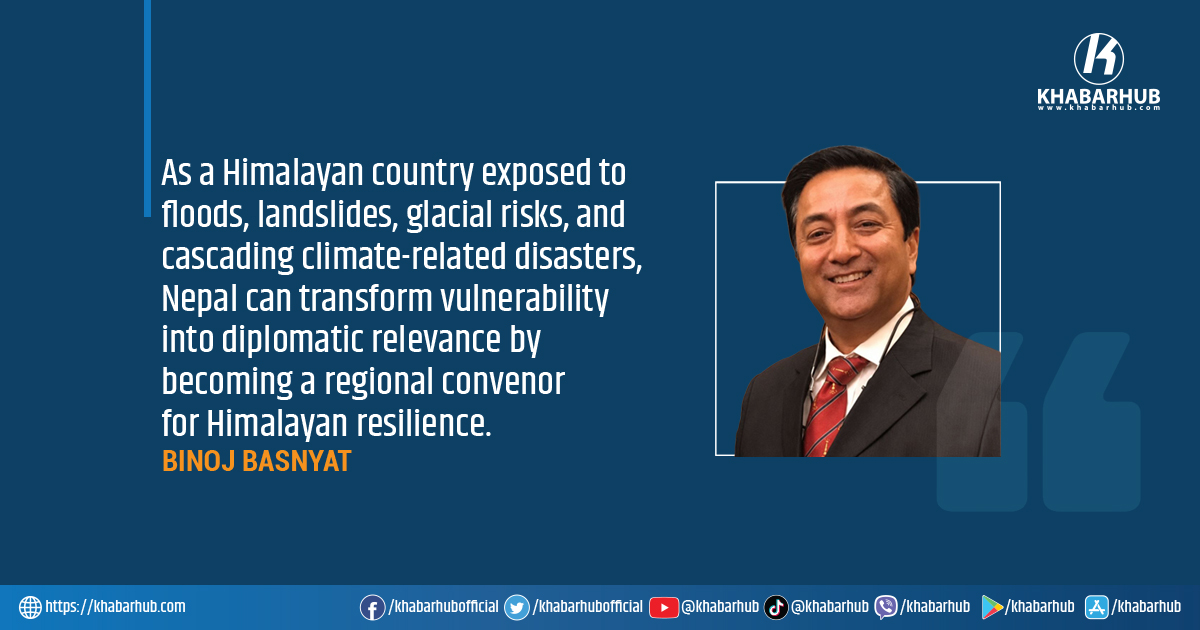
As a Himalayan country exposed to floods, landslides, glacial risks, and cascading climate-related disasters, Nepal can transform vulnerability into diplomatic relevance by becoming a regional convenor for Himalayan resilience. It can use its experience and geography to promote early-warning systems, hydrological and climate-data sharing, disaster-response cooperation, resilient infrastructure, and greater access to climate finance through regional and multilateral platforms.
The opportunity emerging from the BRICS–BIMSTEC interface and the wider evolution of a multipolar economic order should therefore be approached not as a choice between blocs, but as an opportunity to widen Nepal’s strategic options. Nepal can turn humanitarian experience into regional leadership and vulnerability into diplomatic agency. The strategic objective should be clear: preserve national room for manoeuvre by diversifying partnerships, strengthening domestic resilience, and engaging all major powers from a position of institutional credibility and national confidence.
(Basnyat is a Maj. Gen. (Retd.) of the Nepali Army and an independent strategic affairs analyst examining international relations, geopolitics, national security, regional power dynamics, statecraft, and geopolitical change.)






Comment