




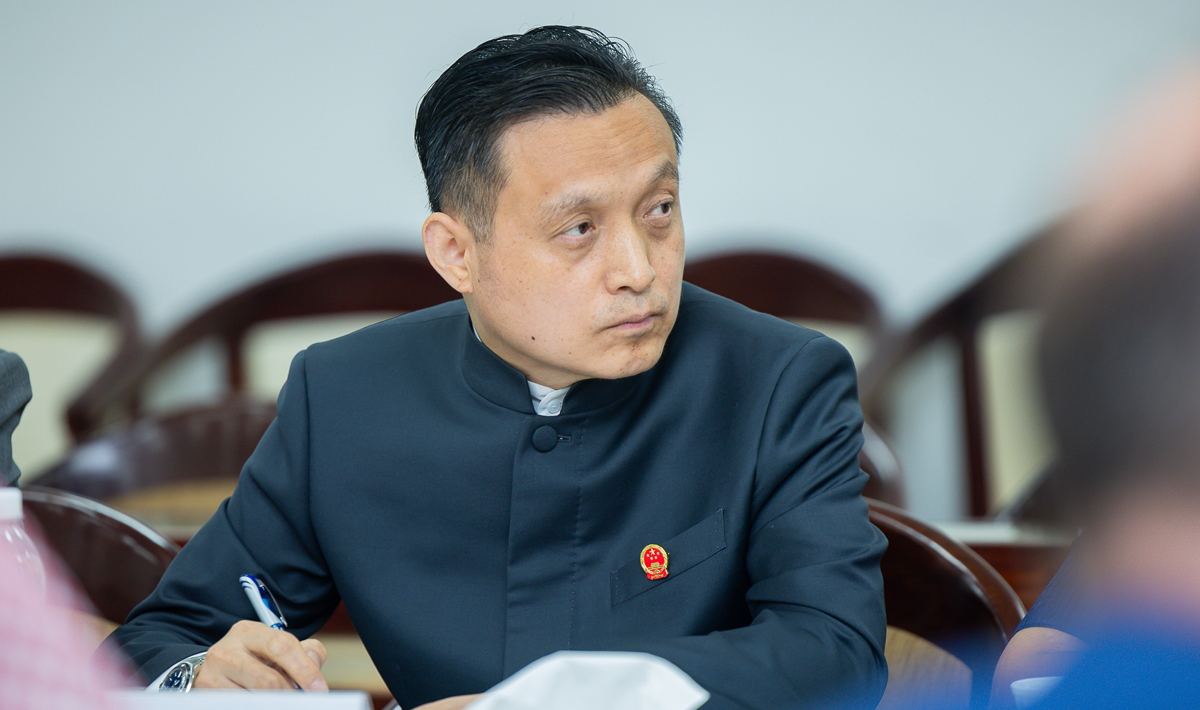
KATHMANDU: Chinese Ambassador to Nepal Zhang Maoming has said that China is committed to supporting Nepal’s economic development and prosperity, describing the neighbouring country as a longstanding priority in Beijing’s foreign policy.
Ambassador Zhang made the remarks during an interaction with editors of media outlets in Kathmandu on Thursday. The discussion covered contemporary regional and international affairs, including the 20th meeting of the Communist Party of China’s Central Committee held in Beijing last month and the 33rd Asia-Pacific Economic Cooperation (APEC) meeting in Shenzhen, China.
The ambassador said China would continue to extend priority support to Nepal in key sectors such as health, education, road infrastructure, industry, trade and energy.
Recalling the devastating floods in the Bhotekoshi River on August 26, which caused significant loss of life and property on both sides of the border, Zhang said Nepal and China had worked together in rescue operations, relief distribution, rehabilitation, reconstruction and humanitarian assistance.
On the operation of the Tatopani border crossing along the Araniko Highway, which he described as an important symbol of Nepal-China friendship, the ambassador said preparations were underway to resume limited operations from next week, despite the area’s challenging geographical conditions.
“Regular operation of the checkpoint is not possible at present. Preparations are being made to operate it one or two days a week until an alternative arrangement is put in place,” he said.
Zhang also said that the road connecting the Korala border crossing with Jomsom was being upgraded and blacktopped. Regarding the Rasuwagadhi border crossing, which offers a shorter route to Kathmandu, he said China would move forward with the necessary process once it received a formal proposal from the Government of Nepal.
Commenting on Nepal’s political and economic situation, the ambassador said the country had recently established political stability under a strong government. He noted that the government’s efforts to curb corruption and promote good governance had created a favourable environment for development and prosperity.
He also praised the government’s clear development agenda and efforts to gain public trust through effective governance, adding that Nepal had placed greater emphasis on expanding its international relations.
Stressing the need to further strengthen bilateral ties, Zhang said Nepal and China should deepen cooperation not only at the government level but also among political parties and their respective peoples.
In this connection, he noted that a parliamentary delegation comprising leaders of Nepal’s ruling Rastriya Swatantra Party (RSP), along with representatives of civil servants, professional organizations and civic groups, was currently visiting China to exchange experiences and learn from each other’s practices.
Referring to the recent meeting of the Communist Party of China’s Central Committee, Zhang said the discussions had focused on seven major principles, including a people-centred approach, democratic practices within the party, anti-corruption efforts, good governance and effective democratic centralism.
He added that the meeting had underscored the importance of development and prosperity through balanced diplomacy, strict discipline, efficient management, political commitment, sustained efforts and the effective use of knowledge, information and technology.
The ambassador also highlighted the significance of the 33rd APEC meeting, which concluded in Shenzhen on Thursday, saying its outcomes were particularly important amid growing geopolitical tensions and economic uncertainties worldwide.
Referring to international developments, including the role of the United States in global affairs, the Russia-Ukraine war and tensions involving Israel and Iran, he said these developments had far-reaching economic and social consequences.
Zhang expressed confidence that the APEC meeting, attended by leaders of major global economies, including China, the United States and Russia, would contribute to strengthening international cooperation and serve as an important milestone for global peace, stability and prosperity.






Comment