




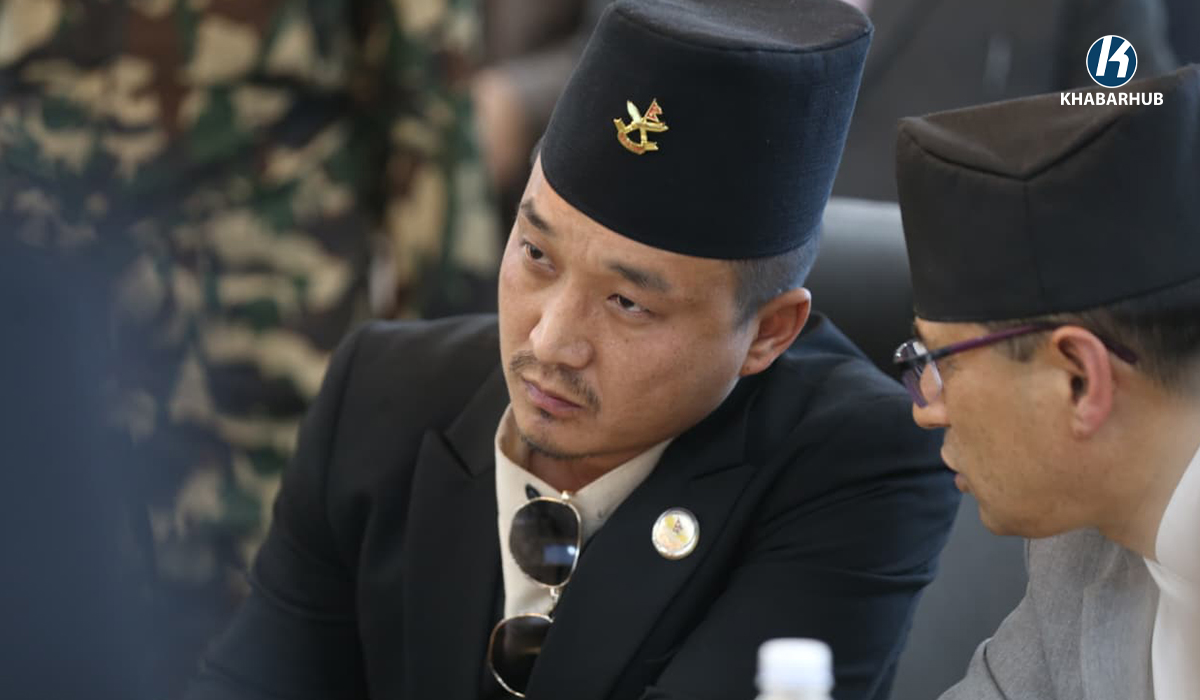
KATHMANDU: Home Minister Sudan Gurung, who initially made headlines for ordering swift arrests of high-profile individuals shortly after taking office, is now seen moderating his once aggressive approach amid growing legal and judicial constraints.
What began as a strong action-first image, marked by rapid decisions and immediate enforcement, has recently faced setbacks due to court orders and procedural limitations.
During a recent interaction with journalists at the Ministry of Home Affairs, Gurung himself admitted, “I ordered arrests, but the court released them,” a statement that has now become central to the debate over his enforcement-driven leadership style.
The development highlights how the government’s early action mode has increasingly come into conflict with judicial oversight and legal boundaries.
Arrest orders and swift release
The controversy traces back to events linked with September 8, 2025, when Gurung, soon after assuming office, directed the arrest of then Prime Minister KP Sharma Oli and then Home Minister Ramesh Lekhak.
Following a Cabinet decision and recommendations from an investigation commission, both leaders were taken into custody. However, the move was short-lived.
The Supreme Court later ordered their release through a habeas corpus petition within around two weeks, marking the first major legal setback to the government’s early enforcement strategy.
Shift in tone and legal challenges
Following the court’s intervention, Gurung has reportedly softened his stance and acknowledged the need to reassess his approach. He described himself as someone who learns from mistakes and indicated a shift toward greater reliance on legal procedures.
However, he also raised concerns about procedural delays in investigations, particularly the limited timeframe allocated for serious criminal probes.
According to him, the 25-day limit for investigating homicide-related cases is insufficient. “A significant amount of time is spent on paperwork, approvals, and correspondence. In such conditions, how can a deep investigation be possible?” he questioned.
Court scrutiny and procedural concerns
The judiciary has also begun scrutinizing police procedures more closely. In a habeas corpus case involving former Energy Minister Deepak Khadka, the Supreme Court observed procedural irregularities in the arrest and ordered that the investigation be conducted without detention.
This ruling has been interpreted as a signal that the government’s “arrest first, investigate later” approach may face legal challenges if due process is not strictly followed.
Expanding role and rising criticism
Since taking office, Gurung has also been actively involved in inspections ranging from crusher industries to road projects. However, his involvement in matters under other ministries has drawn criticism for possible overreach.
His social media posts and public remarks have further fueled debate, with critics pointing to indirect messaging and politically charged statements.
Questions have also been raised over issues such as encroachment around Fewa Lake and his own property disclosure, where clear responses have been limited.
A recent press briefing at the Home Ministry also attracted controversy after journalists were restricted from carrying mobile phones, only limited questions were allowed, and the minister dominated the interaction with lengthy explanations.
Balancing action and legality
Overall, the Home Minister, once known for his swift and forceful decision-making, now appears to be adjusting his strategy within the boundaries of legal and constitutional constraints.
Observers say Gurung’s challenge going forward will be transforming an aggressive enforcement style into a legally sustainable and institutionally balanced approach.






Comment