




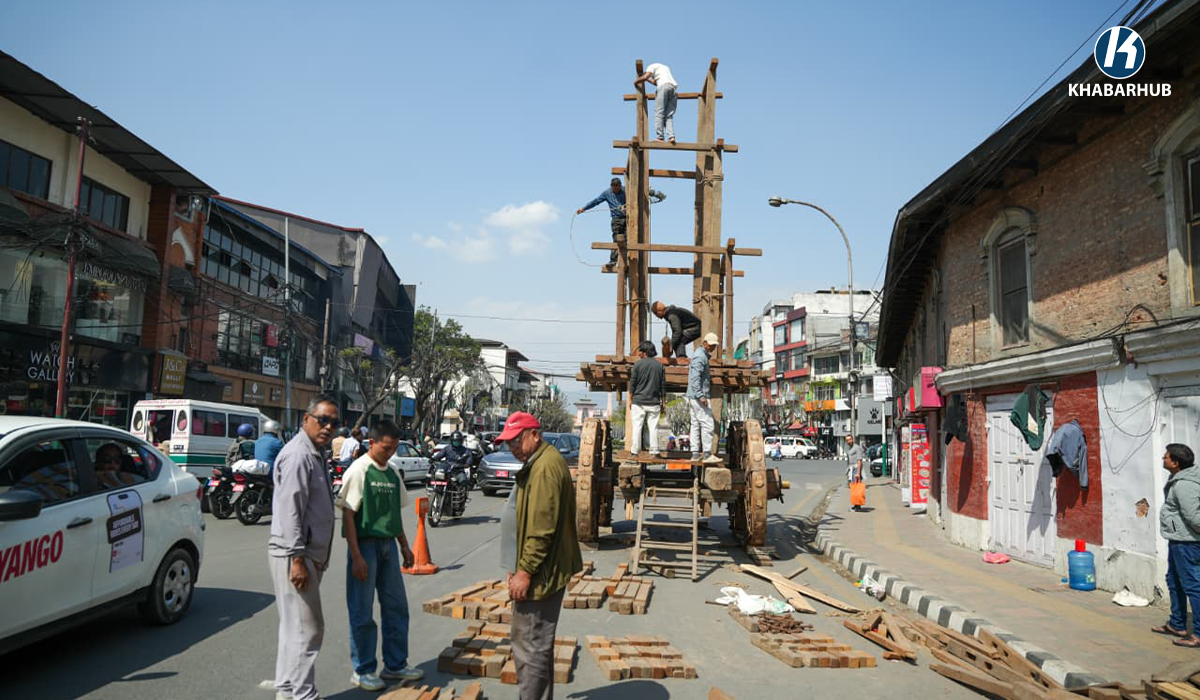
KATHMANDU: Construction of the chariot for the annual Seto Machhindranath Jatra has begun at the Tindhara Pathshala in Jamal, according to the Seto Machhindranath Management Committee.
The festival, one of the important cultural traditions of the Kathmandu Valley, involves a chariot procession carrying the idol of Arya Avalokiteshvara (Karunamaya), who is worshipped as the deity of rain and prosperity.
Traditionally, the chariot is paraded through different parts of the city so that elderly people and devotees who cannot travel far can receive the deity’s blessings.
As the chariot festival is scheduled to begin on March 26 this year, construction started from Tritiya in line with tradition.
According to custom, the chariot is tied with cane, locally known in the Newari language as pau.
During the festival, the idol of Karunamaya is taken from the temple at Janabahal Temple and carried on a palanquin to Tindhara Pathshala, where it is installed on the chariot. The chariot is then pulled around the city in a ceremonial procession.
On the final day, the chariot is taken to Lagan Tole, where it circles a site symbolizing Machhindranath’s mother three times, marking the conclusion of the festival.
According to legend, the idol of Seto Machhindranath was discovered long ago by a farmer while ploughing a field in the Jamal area. The idol was taken home and placed in a grain storage container, but the rice inside never seemed to run out. Believing it to be a divine sign of abundance, the idol was later installed at Janabahal.
Because the idol was discovered in Jamal, the tradition of constructing the chariot in the same area continues to this day.
Apart from Kathmandu, the worship of Seto Machhindranath is also practiced in Banepa and Nala, while the worship of Rato Machhindranath is prominent in Bungamati and Chobhar of Lalitpur.




Comment