




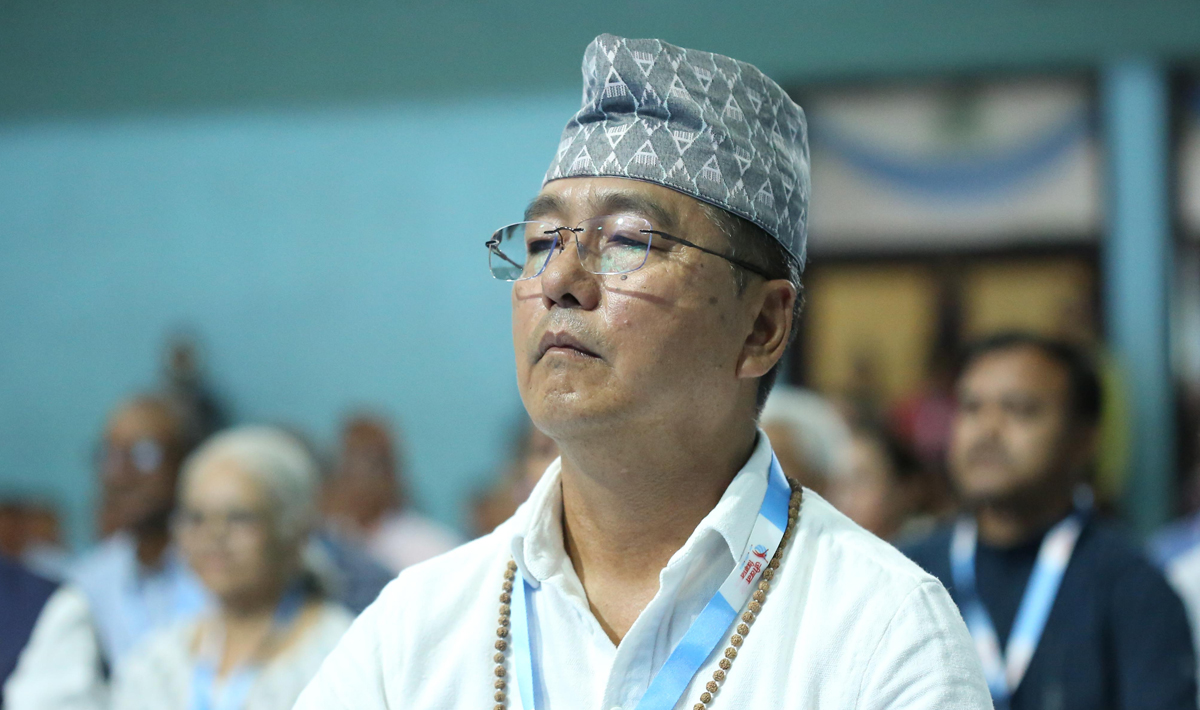
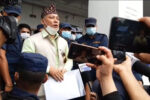
KATHMANDU: Rajendra Lingden of the Rastriya Prajatantra Party (RPP), who has filed his candidacy from Jhapa Constituency-3 for the House of Representatives (HoR) election to be held on March 5, is seeking a third consecutive victory.
Lingden won both the 2074 BS and 2079 BS elections with the support of the CPN-UML. In 2079 BS, he defeated Democratic-Left Alliance candidate Krishna Prasad Sitaula with UML backing. Earlier, in the 2070 BS election, Sitaula had defeated Lingden.
Lingden secured 44,614 votes in 2074 BS and 40,648 votes in 2079 BS. His closest rival in 2079, Nepali Congress (NC) leader Krishna Prasad Sitaula, garnered 37,372 votes.
After nearly 12 years, the UML has fielded its own candidate in Jhapa-3. Despite this, there has been speculation about possible coordination between UML Chairman KP Sharma Oli and Lingden. However, Lingden appears dissatisfied with Oli and has firmly denied any possibility of collaboration.
He stated that the RPP will not enter into any electoral alliance in Jhapa-3 or Jhapa-5 under any circumstances. Reflecting on past arrangements, Lingden described the previous alliance as a mistake.
“The talk of collaboration is absurd. I have closed all doors for collaboration in Jhapa-5 and 3,” he told Khabarhub. “In the last election, we could have won even without an alliance. I agreed after friends requested support, and that was a mistake.”
While hinting that UML Chairman Oli may have proposed coordination, Lingden declined to disclose details publicly. Reiterating his stance, he said, “Please note that there is no coordination of any kind in Jhapa-5 and 3.”
On whether the agenda of restoring the monarchy would be validated or rejected by voters in this election, Lingden said such issues cannot be settled by a single electoral outcome. “We are clear about our agenda and will continue to present it to the people. We will not abandon it under any circumstances. The current system is not right,” he said.
The RPP, which secured 14 seats through direct and proportional representation in the 2079 BS (2022) election, is contesting this time in coordination with Kamal Thapa’s RPP Nepal. Lingden claims the party will increase its representation threefold in the House of Representatives.
There are claims that Lingden is on the defensive in Jhapa-3 this time. However, local observations suggest that voters do not express strong dissatisfaction with him. Some voters appear divided between supporting the RPP and the Rastriya Swatantra Party.
Lingden, who asserts that he has not misled his constituents and famously remarks that “corruption is like drinking one’s mother’s blood,” is confident of securing victory in Jhapa-3. Nevertheless, he faces competition from 17 other candidates.
The Nepali Congress has fielded Rajendra Kumar Ghimire in place of Krishna Prasad Sitaula. The UML candidate is former Constituent Assembly member Hari Bahadur Rajbanshi. Other contenders include RSS District President Prakash Pathak and Nepali Communist Party candidate Dilliram Ghimire.
Despite the crowded field, Lingden is aiming for a hat-trick of victories.
We spoke with Lingden about the electoral situation in his constituency, the RPP’s prospects in the House of Representatives, and the question of coordination with other parties, including the UML.
Do you think you will win for the third time from Jhapa-3?
I have no doubt about winning. I am confident that I will secure victory comfortably. In the last election, my opponent benefited from an alliance. This time, there is no alliance among the parties, which makes the contest even more comfortable for me. I see no difficulty in winning.
Voters here have seen the old faces many times. Some say it’s time to try someone new, don’t they?
What do you mean by “old”? Should ideas be new, or is it only about the person? The voters in my constituency are aware and thoughtful. They understand that what truly needs to be new are the ideas. The same republic, secularism, federalism, and what I consider a failed system cannot be presented as something new. Those who defend the current system cannot claim to represent change.
New ideas must genuinely be new. The country cannot move forward under this leadership and within this system. The people’s condition will not improve unless the system itself changes. Voters will not be misled merely by new faces if the underlying policies remain the same.
The people of my constituency are clear about this. It is the Rastriya Prajatantra Party that has consistently raised the agenda of real change in Nepali politics. We have fielded candidates across the country, and in many areas, our candidates are winning comfortably.
Some ask: What more is left for Rajendra Lingden to do, and why should he win again?
When I first assumed leadership in this area eight years ago, there was not a single blacktopped road. The Mechi and Biring rivers frequently flooded and eroded the land, displacing residents. Today, the flooding problem has largely been controlled.
You can now travel across all local levels on blacktopped roads within an hour. While there is still much to accomplish, the region has made unprecedented progress in physical infrastructure and development. The Rastriya Prajatantra Party has also won at the local level. Drinking water and education services have been made free.
Our local government has become a model in Nepal. MBBS doctors have been appointed in local health facilities, and 24-hour health services are now available. People are enthusiastic. They believe that if they help Rajendra Lingden win and take on greater national leadership, they will witness transformative change within their lifetime. That belief is motivating them to work energetically for my victory.
But despite what is being said publicly, there are claims that Lingden will support Oli in Jhapa-5, aren’t there?
That is baseless speculation. We have fielded our own candidates. After the 2079 BS election, the Rastriya Prajatantra Party clearly stated that it would not form alliances with any party in the 2084 BS election. We have already acknowledged that aligning with the UML in the past was a mistake.
Although elections were initially expected in 2027, they were held in 2082. Even so, our position remains unchanged, we will not form alliances in this election. While various parties may be coordinating elsewhere in the country, the RPP will not enter into any alliance in Jhapa-5 or Jhapa-3. I have personally declared that I will contest independently, without coordination.
Votes are not someone’s private property. Ultimately, voters decide freely. There must be political morality. This is not a hypothetical matter. We are contesting this election in coordination with the people, not with political parties. Any talk of alliance now is meaningless. I have closed all doors to coordination or electoral alliance in Jhapa-5 and Jhapa-3. In the previous election, we were in a position to win even without coordination, but I agreed to it at the request of friends. That was my mistake.
Why have you specifically ruled out coordination in Jhapa-3 and 5?
There is not much more to add. In Jhapa-3 and 5, this election is a battle between truth and falsehood. In Jhapa-3, I stand firmly for truth and fairness. Some have suggested that without coordination, I cannot win. Let the results decide that. I am not in favor of any form of alliance.
UML Chairman Oli reportedly called and suggested a meeting. Why bring that up publicly?
It is normal for leaders of different political parties to meet and talk. I do not see why such routine interactions should be highlighted in an interview. Leaders speak to each other during elections and at other times as well. If he called, that is not unusual.
When Oli reached out regarding cooperation, did you respond?
Is that something to discuss in the newspapers? Whether calls were made, answered, or missed is beside the point. Political leaders often discuss the situation with one another. Sometimes it is about the political environment; sometimes it is about general matters. Conversations happen regularly.
If I spoke with Oli, or if he called me, that is normal. I also speak with leaders like Gagan Thapa, Sher Bahadur Deuba, Pushpa Kamal Dahal Prachanda, and Rabi Lamichhane. There is nothing unusual about such communication. However, as I have already stated clearly, there will be no coordination or electoral support this time. I will contest on my own strength, and the candidate in Jhapa-5 will also contest independently.
So, does this mean there will be no coordination with the UML under any circumstances?
There will be no coordination whatsoever. Please make it clear that the Rastriya Prajatantra Party will not coordinate in any way in Jhapa Constituency No. 3 or No. 5. I will win in Jhapa-3 on my own strength, without aligning with anyone.
What results do you expect for the RPP, which won 14 seats in 2079 BS?
As we travel across the country, we are receiving strong public support from various regions. There is an undercurrent in favor of the Rastriya Prajatantra Party nationwide. In the past, we were unable to field candidates everywhere, partly due to internal divisions within the party.
This time, we have nominated candidates across the country. After visiting Jhapa, Kailali, and Kanchanpur, I am now heading to Madhesh Province. We are gaining attention and visibility among the public. I believe the RPP will achieve unexpectedly strong results in a peaceful and democratic manner.
Will the results of this election determine whether the monarchy should return or not?
Whether our agenda is right or wrong cannot be determined by a single election. Even when we had very few votes and were not recognized as a national party, we continued to uphold this agenda. The validity of our agenda does not depend on one electoral outcome.
What matters is how effectively we have been able to present our vision to the people and how much public support we can mobilize. We are receiving encouraging support. Previously, we had only one seat; in 2079, we secured 14 seats.
Now, we are in a position to multiply that representation by three or even four times. People are gradually moving toward our agenda and engaging with it seriously. We believe our agenda is strong, and we will not abandon it. We continue to maintain that many aspects of the current system are flawed and require correction.
There are also claims that former King Gyanendra Shah supports the RPP. What is the reality?
It is not a question of whether the former king supports us or not. Naturally, as the only political party advocating for the restoration of the monarchy, there may be goodwill. However, we are not suggesting that he belongs to or endorses a single party.
We do not seek a “party king.” Our vision is of a monarch for the entire nation. If there is to be a monarchy, it must be above partisan politics. We are clear that the monarchy, as an institution, should not be involved in the electoral politics of this election.
Do you believe the Rastriya Prajatantra Party will emerge as a national force?
The RPP can become the first or second largest political force in the country, depending on the public wave and the prevailing political climate. Support for our party is increasing across the country. Even many in the younger generation have begun expressing the view that the monarchy should be restored.


Comment