




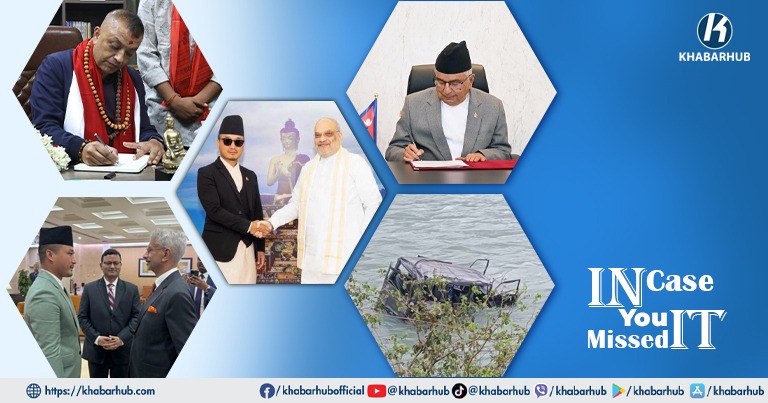
KATHMANDU: Nepal’s political developments over the past week highlighted a central challenge facing the country: translating promises of good governance, political renewal and public accountability into tangible results. From Prime Minister Balendra Shah’s appeal for solidarity with disaster-hit families to the Nepali Congress’s leadership reshuffle, an internal investigation within the ruling Rastriya Swatantra Party (RSP), and renewed diplomatic engagement with India, the week offered a snapshot of a political system under pressure to demonstrate that change can deliver more than rhetoric.
The developments also exposed the competing demands confronting the government and political parties. Citizens expect effective disaster recovery, economic opportunities and cleaner public institutions, while parties face growing pressure to demonstrate internal democracy, represent diverse communities and ensure that allegations of misconduct are addressed transparently. Meanwhile, Nepal’s relationship with India remains central to its security, economic connectivity and disaster preparedness.
Taken together, these events suggest that Nepal’s political credibility will depend less on announcements and more on institutional performance, measurable outcomes and the consistency with which leaders apply their stated principles.
Disaster solidarity must lead to sustained recovery
Prime Minister Shah’s Dashain message came amid grief following deadly incidents in Rasuwa, Nuwakot and Gorkha. His condolences to bereaved families, concern for the injured and pledge to prioritise the rehabilitation of displaced people placed disaster recovery at the centre of the government’s public commitments.
The government’s commitment to good governance will be measured by whether accountability mechanisms function impartially and produce legally sustainable outcomes.
The message was significant because major festivals often expose the social and economic inequalities that persist beneath national celebrations. While Dashain traditionally brings families together, disaster-hit households may face destroyed homes, lost livelihoods and uncertain futures. For displaced people, the immediate priority is not the symbolism of a festival but access to shelter, food, healthcare, education and a realistic path towards rebuilding their lives.
The government must therefore ensure that expressions of solidarity translate into practical support. This requires transparent beneficiary identification, timely compensation, adequate temporary housing and reconstruction plans that account for future disaster risks. Coordination among federal, provincial and local authorities is equally important, particularly where damaged roads, bridges and public infrastructure restrict access to affected communities.
There is also a broader governance lesson. Disaster response is a test of state capacity. Delays, duplication and unclear responsibility can undermine public trust even when political leaders express genuine concern.
Shah’s emphasis on rehabilitation and good governance will carry weight only if affected families can see improvements in their daily lives. The coming weeks should be judged by the speed and fairness of relief distribution, the restoration of essential services and the government’s ability to prevent vulnerable communities from being left behind.
Economic opportunity remains the foundation of political credibility
The prime minister’s acknowledgement that many Nepalis are compelled to seek employment abroad because of limited opportunities at home touched on one of Nepal’s most persistent structural problems. Migration has become a source of household income and national foreign exchange, but it also separates families and leaves the domestic economy dependent on opportunities created elsewhere.
Shah’s assertion that Dashain should not become an economic burden for anyone framed prosperity as a social objective rather than simply a matter of economic growth. Yet the challenge is to turn this principle into policy.
Expanding productive employment requires a more reliable environment for private investment, better access to finance, skills development and stronger links between education and the labour market. Agriculture, tourism, hydropower, manufacturing and information technology offer potential avenues for employment, but they need predictable policies and effective implementation.
Good governance is central to this effort. Businesses are less likely to invest when administrative procedures are cumbersome, regulations unpredictable or public procurement vulnerable to political influence. Likewise, young people are less likely to remain in Nepal if they see limited opportunities for professional advancement.
The government’s credibility will therefore depend on whether it can improve the conditions that drive migration, rather than treating overseas employment solely as a problem of family separation. The prime minister’s festival message established a political aspiration; delivering on it requires sustained economic reform and demonstrable results.
Nepali Congress leadership change creates an opportunity for renewal
The election of Gagan Thapa as president of the Nepali Congress, alongside a new team of 18 other office bearers, marked another important development in the country’s party politics. Thapa’s decisive victory over Shyam Krishna Khadki, with 6,584 votes against 375, gives the new leadership a strong mandate within the convention process described in the report.
The outcome offers the party an opportunity to address concerns about organisational renewal, public confidence and its political relevance. A new leadership team can bring fresh energy to policy development, internal organisation and engagement with younger voters. However, leadership change alone does not guarantee institutional transformation.
The composition of the new team also deserves attention. The election of office bearers representing women, Indigenous nationalities, Dalit, Madhesi, Tharu, Muslim and other communities indicates an effort to incorporate Nepal’s social diversity into party leadership. Such representation can strengthen a party’s understanding of different communities’ concerns and broaden participation in decision-making.
Nevertheless, representation must be substantive rather than symbolic. Office bearers need meaningful authority, influence over policy and opportunities to shape the party’s organisational priorities. The effectiveness of the new team will depend on whether its members can contribute independently and whether internal decision-making becomes more open and accountable.
The decisive test for Thapa is whether he can turn his electoral mandate into a coherent political programme. That means clarifying the party’s position on economic reform, corruption, public services, federalism and employment, while establishing credible mechanisms for internal accountability.
The Nepali Congress also needs to demonstrate that competition within its ranks can produce stronger institutions rather than merely rearrange existing power structures. A successful transition would give members greater confidence in internal democracy and offer voters a clearer alternative based on policies and performance.
RSP’s disciplinary inquiry tests its commitment to accountability
The RSP’s decision to investigate controversial audio recordings involving lawmaker Khagendra Sunar presents a particularly important test for a party that emphasises good governance and political accountability.
The allegations reported in connection with the recordings include possible misconduct, threats, insults to women’s dignity and suspicious financial transactions. These are serious claims, but they remain allegations until established through a fair and credible investigation. Protecting the rights of the accused is as important as ensuring that complaints are properly examined.
The party’s decision to refer the matter to its Central Disciplinary Commission and restrict Sunar from participating in official programmes while the inquiry proceeds indicates an attempt to prevent the controversy from being treated as inconsequential. Its call for an independent investigation by relevant state agencies is also appropriate.
However, an internal inquiry cannot substitute for an impartial investigation by competent authorities where potential criminal conduct is involved. Nor should a party’s disciplinary process become a means of controlling the narrative, protecting influential members or reaching conclusions before evidence has been examined.
The RSP has an opportunity to establish a clear standard: allegations against its representatives should be handled consistently, regardless of their political importance. That standard requires a transparent process, protection against interference, respect for due process and appropriate action based on verified findings.
The issue extends beyond one lawmaker. Political parties are essential institutions in a democracy, and their internal conduct affects public confidence in the wider political system. If the RSP applies its stated principles consistently, it can strengthen its credibility. If the process appears selective or opaque, it risks undermining the very reformist identity on which its appeal depends.
The party’s decision to open applications for its Municipal Candidate Club is relevant in this context. Recruiting new candidates could broaden political participation and create opportunities for capable local leaders. Yet an open application process alone is not sufficient. Candidate selection must also assess integrity, competence, community engagement and respect for democratic values.
The party will ultimately be judged by the quality of the people it nominates, the fairness of its selection procedures and the standards it applies once its candidates enter public office.
Arrest of former investment board chief raises questions about institutional integrity
The arrest of former Investment Board Nepal chief executive officer Sushil Bhatta for investigation into an alleged offence under the Nepal Rastra Bank Act added another dimension to the week’s accountability debate.
According to the report, police detained Bhatta in connection with a financial transaction allegedly linked to Inam Sapkota. Investigators reportedly examined information obtained from Sapkota’s mobile phone and statements made while he was in custody. The report also mentions Bhatta’s family connection to Deepak Bhatta, who is facing a money-laundering case.
These details warrant careful scrutiny, but they must not be confused with proof of wrongdoing. An arrest is a procedural step, not a finding of guilt. The investigation must establish the relevant facts, while the accused must retain the right to due process.
For Kathmandu, the challenge is to maintain constructive engagement with New Delhi while pursuing national interests through clear priorities and consistent diplomacy.
The wider significance lies in the need for credible financial oversight and consistent enforcement of the law. Institutions responsible for investment promotion, financial regulation and public administration depend on public confidence. Allegations involving former senior officials can deepen suspicions about the relationship between political influence, business interests and state institutions.
Restoring confidence requires more than high-profile arrests. Investigators must follow evidence wherever it leads, explain the legal basis for their actions and ensure that cases are not influenced by political pressure. Equally, authorities must avoid selective enforcement that targets some individuals while overlooking comparable allegations against others.
The government’s commitment to good governance will be measured by whether accountability mechanisms function impartially and produce legally sustainable outcomes.
India engagement underscores the importance of practical diplomacy
Home Minister Sudan Gurung’s meetings with Indian Home Minister Amit Shah and his brief encounter with Indian Foreign Minister S. Jaishankar highlighted the continuing importance of Nepal–India relations.
Discussions with Amit Shah reportedly covered border management, cross-border crime, security cooperation and disaster preparedness. Gurung also thanked India for its assistance following Nepal’s recent floods and landslides.
These are practical priorities for two neighbouring countries with an open border, extensive social ties and interconnected economic interests. Effective coordination can help combat trafficking and other cross-border offences, improve information-sharing and strengthen responses to emergencies that affect communities on both sides.
Disaster cooperation is especially relevant for Nepal, where floods and landslides regularly damage infrastructure, disrupt transport and threaten lives. Better forecasting, timely information exchange and coordinated emergency planning can reduce the consequences of such events.
The central question is whether these measures will strengthen public institutions over time or remain announcements without adequate implementation.
However, security cooperation must be pursued alongside respect for sovereignty, mutual trust and the rights of citizens. Nepal and India have an interest in making bilateral mechanisms more effective and less vulnerable to political fluctuations.
India’s appointment of Sudhakar Dalela as its next ambassador to Nepal offers another opportunity to advance this relationship. His diplomatic experience, including work on South Asian affairs and Nepal-related matters, could support engagement on trade, energy, connectivity and regional cooperation.
Yet diplomatic appointments and ministerial meetings are only starting points. Their value depends on whether discussions lead to concrete agreements, improved border infrastructure, more reliable energy trade and faster implementation of mutually beneficial projects.
For Kathmandu, the challenge is to maintain constructive engagement with New Delhi while pursuing national interests through clear priorities and consistent diplomacy.
Institutional reform must go beyond announcements
Other developments during the week also pointed to the importance of institutional capacity. President Ram Chandra Paudel issued ordinances relating to science, technology, innovation, forests and land, while authenticating legislation concerning the establishment and operation of the National Forensic Science Laboratory.
These measures touch on areas with long-term implications for governance and development. Scientific research and innovation can strengthen productivity and public services, while a properly equipped forensic laboratory can improve the quality of criminal investigations and the administration of justice.
Nepal does not lack declarations of good governance, prosperity or reform. What it needs is a sustained record of delivery.
However, legislation and ordinances must be assessed not only by their stated objectives but also by their implementation, institutional safeguards and practical outcomes. Scientific development requires sustained investment, qualified personnel and research institutions capable of operating independently. Forensic services require reliable procedures, adequate resources and safeguards against political interference.
The use of ordinances also raises a broader institutional consideration. Although the Constitution provides for ordinances under specified circumstances, legislation affecting important policy areas benefits from parliamentary scrutiny, public discussion and clear accountability. Executive action should complement, rather than unnecessarily bypass, democratic deliberation.
The central question is whether these measures will strengthen public institutions over time or remain announcements without adequate implementation.
The real test begins after the headlines
The week’s events brought together several defining issues in Nepal’s current political landscape: disaster recovery, economic opportunity, party renewal, accountability, diplomatic cooperation and institutional reform.
Each offers a potential opportunity for progress, but each also carries risks. Disaster relief can lose credibility if assistance is delayed or distributed unfairly. A new party leadership can disappoint if it fails to translate electoral victories into policy reform. Disciplinary inquiries can become exercises in damage control unless they are transparent and evidence-based. Diplomatic engagement can produce little if commitments are not followed by implementation.
The common thread is the need to narrow the gap between political promises and public experience.
For Prime Minister Shah, that means making rehabilitation visible in affected communities and advancing economic policies that create opportunities at home. For the Nepali Congress, it means demonstrating that leadership renewal can produce meaningful organisational and policy change. For the RSP, it means applying accountability standards consistently, including to its own representatives. For the state, it means ensuring that investigations, legislation and public administration operate according to law rather than political convenience.
Nepal does not lack declarations of good governance, prosperity or reform. What it needs is a sustained record of delivery. The developments of the past week have placed those aspirations back in the public debate. Whether they become milestones of political progress or simply another cycle of announcements will depend on what institutions and leaders do next.






Comment