




South Asia is once again at a moment of political inflection. From Kathmandu to Dhaka, youth-driven mobilization, interim governance experiments, and electoral realignments are reshaping the region’s internal political orders and external strategic orientations.
The upcoming 5th March election in Nepal and Bangladesh electoral outcome demonstrate that regime change alone does not guarantee stability; consolidation depends on institutional restraint, economic delivery, and strategic clarity.
It can be argued that electoral victory of Bangladesh National Party (BNP) with two thirds is merely the starting point. Stability must be earned through governance performance, not just declarations of triumph. Nepal’s upcoming elections without a broad strategic outlook for national destiny may turn out to be merely an election with no strategic results.
Both Nepal and Bangladesh today present parallel nations of transition. Both have witnessed popular mobilization against entrenched political structures. Both have relied on interim or transitional mechanisms to manage volatility.
Both must now reconcile domestic reform with external strategic pressures in an increasingly competitive Indo-Pacific environment. Together, their trajectories illuminate a broader lesson for South Asia: political consolidation and strategic autonomy are mutually reinforcing, and neither can endure without the other.
Youth-Driven Political Change: Catalyst, Not Conclusion
Nepal’s 8-9 September 2025 Gen Z–led mobilization marked a dramatic rupture in conventional party dominance. The uprising dismantled the coalition of the Nepali Congress and the Nepal Communist Party (Unified Marxist–Leninist), ushering in a non-partisan interim arrangement after parliament was dissolved. Youth networks, digitally coordinated, decentralized, and largely leaderless, transformed political frustration into systemic pressure.
Bangladesh witnessed a parallel surge in July 2024, when student protests evolved into a nationwide movement demanding accountability and structural reform. On 5 August 2024, after security forces declined to suppress demonstrators, Prime Minister Sheikh Hasina resigned and departed for India. A transitional administration led by Nobel laureate Muhammad Yunus sought to stabilize governance and initiate reform.
Consensus transforms transition from elite contestation into a shared national project. It aligns internal governance with external strategic positioning—particularly vital in a region where great-power competition increasingly shapes economic and security landscapes.
The February 2026 elections returned the BNP, led by Tarique Rahman, with a decisive parliamentary majority, while the Awami League (AL) was barred from contesting. A concurrent referendum on the July Charter reforms passed by a wide margin, reflecting broad public endorsement of structural change.
In both Nepal and Bangladesh, youth activism acted as a force multiplier. It reshaped the national conversation, delegitimized complacent elites, and accelerated institutional turnover. Yet youth-driven upheaval is only the beginning of political transformation. Without institutional absorption, through policy participation, governance reform, and economic inclusion, the energy of protest risks mutating into disillusionment.
The central insight is clear: generational legitimacy must be institutionalized, not merely celebrated.
Transitional Governance: Preventing the Vacuum
Transitional arrangements are pivotal in preventing post-uprising volatility. No transition occurs on a blank slate. Entrenched parties, bureaucratic networks, and security institutions retain influence long after electoral defeat. The period between regime collapse and institutional consolidation is historically prone to factional contestation, security drift, and economic uncertainty.
Nepal’s interim government — technocratic and non-partisan — managing the way out for an election that came about with the uprising in the newly federal secular republic. It created political breathing space for negotiation among the established, new and the recent stakeholders.
Bangladesh confronts a comparable challenge. The interim phase following the 2024 upheaval similarly prioritized electoral credibility and institutional stabilization. The Yunus-led administration sought to restore confidence, manage civil–military equilibrium, and prepare the ground for competitive elections. The BNP’s subsequent victory now marks the transition from interim legitimacy to electoral authority.
The Awami League’s institutional imprint—across civil administration, local governance, and security apparatus—cannot simply be erased. A BNP-led government must calibrate accountability mechanisms to uphold rule of law without triggering administrative paralysis or political vendetta.
Yet electoral authority carries risk. A supermajority can encourage centralization and retributive impulses. For Bangladesh, the management of this post-electoral phase will determine whether the transition matures into consolidation or slides into renewed polarization.
The lesson for Nepal is equally salient. Non-partisan interim mechanisms are essential in post-crisis environments where competing power centres coexist. They provide procedural legitimacy and reduce zero-sum incentives. But they must evolve into durable institutions rather than remain temporary scaffolds.
Electoral Outcome of Bangladesh
Bangladesh’s latest parliamentary composition reflects one of the central mandates of the 2024 uprising: political renewal through generational and leadership change.
Out of 300 seats, 209 lawmakers—more than two-thirds of the House—are new faces in national politics. This significant turnover signals a structural shift rather than a routine electoral cycle.
A striking feature of the new cohort is its professional background. Of the 300 members, 178 come from the business community, underscoring the growing interface between commerce and governance and suggesting a legislature shaped heavily by private-sector experience.
Party-wise distribution of the 209 newcomers is as follows: The Bangladesh Nationalist Party (BNP) contributes 132 new members. Jamaat-e-Islami has 59 new faces among its 68 representatives. The newly formed National Citizens Party (NCP/NCC) has all six of its members entering parliament for the first time as well as among Seven independents, six 6 are first-time lawmakers.
In total, eight political parties are represented in the new parliament, and five party leaders themselves are new—further reinforcing the theme of political transition.
New faces bring new hopes. The scale of renewal suggests a public mandate for reform, accountability, and a reset of political culture. Yet the broader strategic conditions remain largely unchanged. Governance challenges, economic pressures, institutional fragility, and regional geopolitical competition continue to shape the operating environment.
Moreover, seeds of instability persist. The restriction and marginalization of the Awami League and other excluded political actors risk deepening polarization and embedding a politics of exclusion. Democratic consolidation requires competitive pluralism; narrowing political space may generate short-term equilibrium but can foster long-term volatility.
An additional structural concern lies in representation. The presence of women and members of minority communities appears limited or insignificant within the new composition. Such underrepresentation risks weakening social legitimacy and reinforcing perceptions of exclusion. In deeply plural societies, stability is sustained not merely by electoral turnover but by inclusive participation across gender, ethnic, and religious lines.
Bangladesh thus stands at a delicate juncture: a parliament energized by fresh entrants and business-sector leadership, yet constrained by enduring structural pressures and representational gaps. Renewal alone does not guarantee stability. Without inclusive politics—across party lines, gender, and communities—the promise of transformation may coexist with latent instability.
Bangladesh First in a Heartland–Rimland Contest
Bangladesh’s recalibrated foreign policy under a “Bangladesh First” doctrine must be understood within the broader geopolitical competition between continental and maritime power.
Classical geopolitical theorists such as Halford Mackinder and Nicholas Spykman conceptualized global politics as a tension between the Eurasian Heartland and the surrounding Rimland. In contemporary South Asia, this dynamic manifests in the interplay between China’s continental consolidation and maritime outreach, India’s regional primacy, and the USs’ maritime dominance.
Situated along the Bay of Bengal, adjacent to India’s northeast, and economically connected to China, Southeast Asia, and Western markets, Bangladesh is not peripheral. It is a maritime gateway state occupying a sensitive Rimland position.
A Bangladesh First policy under the BNP would likely represent strategic hedging rather than ideological alignment.
trategic Autonomy as Core Principle
In a competitive Rimland environment, smaller states preserve leverage through diversification. Bangladesh would likely: Avoid excessive structural dependence on India. Two, continue economic engagement with China while scrutinizing financial sustainability. Third, maintain strong export and security ties with the US and lastly, engage Pakistan pragmatically without deep security alignment.
Autonomy over alignment, diversification over dependency, and economic pragmatism over ideological positioning define this approach.
Managing India: Reciprocity Without Subordination
India remains Bangladesh’s geographic reality. Trade corridors, transit rights, water-sharing, and border management are structural issues that cannot be bypassed.
A Bangladesh First posture would emphasize reciprocity in trade agreements, institutionalized water-sharing frameworks, and firm management of border incidents—while preserving economic interdependence. In geopolitical terms, Bangladesh would resist asymmetrical absorption while maintaining functional cooperation.
Engaging China: Economic Leverage Without Strategic Capture
China’s infrastructure outreach intersects directly with Bangladesh’s development ambitions. Under Bangladesh First, Dhaka would likely continue cooperation under Belt and Road frameworks but insist on transparency, sustainable financing, and civilian-commercial framing of port development.
The objective is connectivity without strategic capture.
Leveraging the United States: Maritime Counterweight
The US remains a dominant maritime actor and a major export destination for Bangladesh. Selective engagement with Washington enhances bargaining leverage within the broader strategic triangle. Such engagement would expand trade and investment cooperation while avoiding bloc alignment.
Maritime Centrality and the Bay of Bengal
Bangladesh’s most significant asset lies in the Bay of Bengal. Ports, blue economy initiatives, and shipping corridors position it centrally within Indo-Pacific calculations. By investing in maritime infrastructure through multi-partner frameworks and promoting economic connectivity over militarization, Bangladesh can transform geography into opportunity.
Strategic Implications for Nepal
Nepal, though landlocked, confronts a parallel structural dilemma. Its geography situates it between India and China—between maritime access dependency and continental connectivity. Like Bangladesh, Nepal must practice calibrated balancing.
The Nepali lesson is that strategic autonomy depends on domestic coherence. Political fragmentation weakens bargaining power. Transitional instability invites external influence. Only a consolidated, consensus-based governance framework enables credible strategic hedging.
Nepal’s experience also underscores the importance of linking domestic reform with foreign policy recalibration. Economic revival, infrastructure development, and youth employment are prerequisites for effective external positioning. Without domestic delivery, strategic rhetoric rings hollow.
National Consensus: The Pillar of Consolidation
Both Nepal and Bangladesh reveal that transitions succeed when anchored in broad-based consensus.
In Nepal, federalism and post-conflict integration advanced because negotiations incorporated diverse political and identity groups. In Bangladesh, the legitimacy of the July Charter referendum suggests public appetite for institutional reform. Yet sustainability will require inclusion of minorities, opposition voices, and marginalized constituencies.
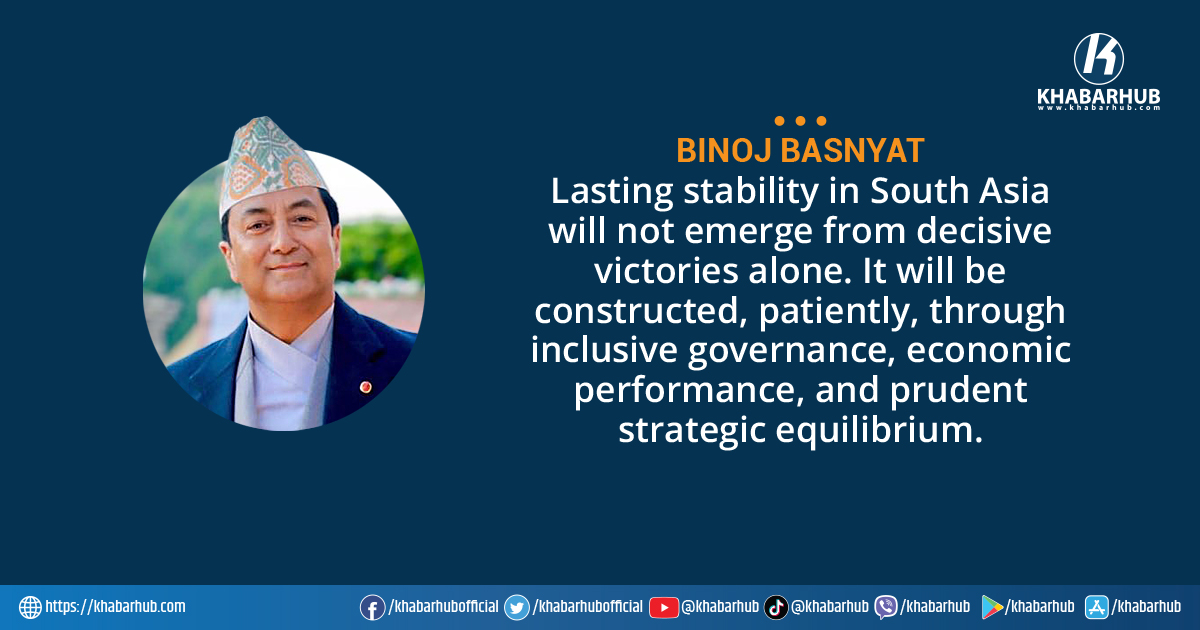
Lasting stability in South Asia will not emerge from decisive victories alone. It will be constructed—patiently—through inclusive governance, economic performance, and prudent strategic equilibrium.
Consensus transforms transition from elite contestation into a shared national project. It aligns internal governance with external strategic positioning—particularly vital in a region where great-power competition increasingly shapes economic and security landscapes.
Delivery as the Ultimate Test
Ultimately, both cases converge on a fundamental truth: legitimacy must translate into performance.
For Bangladesh, the BNP government faces daunting challenges—reviving economic growth, stabilizing inflation, strengthening security, and managing external pressures. For Nepal, post-transition governance must overcome chronic instability and policy inertia.
Youth mobilization created opportunity. Transitional governance preserved order. Strategic recalibration offers leverage. But only economic delivery and institutional credibility will sustain stability.
Conclusion: Balancing Change and Continuity
Nepal and Bangladesh illustrate the delicate interplay between popular mobilization, interim governance, legacy management, and geopolitical balancing. Bangladesh’s emerging Bangladesh First doctrine exemplifies how a Rimland state can pursue calibrated hedging—extracting benefit from competing powers while preserving sovereign manoeuvrability. Nepal’s experience underscores that domestic consensus and institutional consolidation are prerequisites for strategic autonomy.
What Nepal should learn from Bangladesh is meaningful for strategic stability. A referendum would have assisted Nepal that includes all stakeholders’ differences for the mass or the voters to consider. Unfortunately, it did not occur.
New faces bring new hopes as Nepal did but Bangladesh did not lean.
The scale of renewal suggests a public mandate for reform, accountability and a reset of political culture. Yet the broader national and regional strategic surroundings remain largely unchanged. Governance challenges, economic pressures, institutional fragility, and regional geopolitical competition continue to shape the operating environment.
Moreover, seeds of instability persist. The restrictions and marginalisation of the Awani League and other excluded political actors risk deepening polarisation and embedded a politics of exclusion.
Democratic consolidation requires competitive pluralism; narrowing political space may generate short-term equilibrium but can foster long-term volatility.
An additional structural concern lues in representation. The presence of women and members of minority communities appears limited or insignificant within the new composition.
Such underrepresentation risks weakening social legitimacy and reinforcing perceptions of exclusion.
Bangladesh like Nepal thus stand at a delicate juncture. Nepal still has both time and opportunity but Bangladesh has an opportunity.
In a twenty-first century Great Game defined less by territorial conquest and more by infrastructure corridors, maritime routes, and financial leverage, smaller South Asian states cannot afford rigid alignments. Their comparative advantage lies in balance.
Lasting stability in South Asia will not emerge from decisive victories alone. It will be constructed—patiently—through inclusive governance, economic performance, and prudent strategic equilibrium.
(Basnyat is a strategic affairs analyst and is associated with Rangsit University, Thailand.)





Comment