




Balendra Shah (Balen) took the oath of office as Prime Minister on March 27, taking on the responsibility of determining Nepal’s present and future course. Prime Minister Balendra—backed by a sizable mandate secured in the elections that followed last year’s ‘Gen Z’ revolt in Nepal—is scheduled to make his first official bilateral visit to India next week. Preparations for Balen’s visit to India have visibly accelerated since Indian Foreign Secretary Vikram Misri visited Nepal two weeks ago.
Since 2014, Narendra Modi has consistently served as India’s Prime Minister. During this period, he has held direct meetings with four Nepali prime ministers, both in formal bilateral settings and on the sidelines of other events. He also had a direct telephone conversation with Sushila Karki, the interim prime minister, who thanked him for India’s assistance in ensuring the successful conduct of the elections.
Prime Minister Modi has visited Nepal five times. Immediately following the latest election results, and on the very day Balen took the oath of office, Prime Minister Modi telephoned him to offer his congratulations. This official visit by Balen—following the humanitarian assistance provided by India to Nepal during the Bhote Koshi disaster—is bound to attract the attention of global powers.
During the visit, Nepal is expected to prioritize major infrastructure development, hydropower projects, improved rail and air connectivity, and economic support. In fact, the Rastriya Swatantra Party’s (RSP) commitment to growth and good governance formed the foundation for the government’s formation.
In 2020, under the initiative of UML leader and then-Prime Minister KP Sharma Oli, and within a nationalist political narrative, Nepal amended its constitution to incorporate a new political map. Since then, the issue has effectively remained at a standstill.
Nepal’s economy has been caught in a cycle of prolonged political instability, excessive dependence on remittances, and structural stagnation for the past few decades. For many years, India has been Nepal’s largest source of foreign direct investment (FDI), accounting for more than one-third of total FDI in the country. Furthermore, with approximately 62.3 percent of Nepal’s total merchandise trade, India continues to be the country’s largest trading partner.
Speaking in Maithili at the Rastriya Swatantra Party’s (RSP) “Proclamation of Change” assembly at Tirhutia Gachhi in Janakpur on January 19, 2026, Balen Shah stated that he believed Janakpur should become a global “destination wedding hub.”
Speaking at the same venue, Tirhutia Gachhi, on November 4, 2016, then-President of India Pranab Mukherjee announced that the Indian government would construct two dharmashalas along the Parikrama Path of Janakpur Dham to accommodate pilgrims visiting this historic city. One wonders why construction of the dharmashalas announced during the former Indian President’s visit to Janakpur has yet to move forward.
The timing is opportune, as preparations are underway for the inauguration of a train service between Janakpur and Ayodhya. If an initiative could be taken now to implement President Mukherjee’s announcement, it would not only give concrete shape to Balen’s vision of transforming the Janakpur region into a ‘wedding destination’ but also reinforce the significance of the Janakpur-Ayodhya railway connection.
Nepal-India relations are deeply rooted in history. The border, established following the 1816 Treaty of Sugauli, came to be recognized as an international boundary after India gained independence. Today, Nepal shares an approximately 1,850-kilometre border with five Indian states. The relationship between the two nations is deeply intertwined through shared civilization, culture, and lifestyles.
Contemporary diplomacy and geopolitics are increasingly shaped by investment, production, and markets. Nepal has a population of fewer than 30 million, with more than 50 percent residing in the Terai region. Every district in the Terai shares a border with one Indian state or another. The Nepal-India border is rooted in shared civilization and the ethos of friendship. Relations between Nepal and India predate the establishment of modern diplomatic ties by several centuries.
However, the Terai region, often regarded as Nepal’s “breadbasket,” remains economically weak. Interest in agriculture is declining, industrial investment remains low, and foreign direct investment (FDI) is virtually negligible. Prime Minister Balen should seize this opportunity to engage with the Indian side and seek its support for a special industrial package for the Terai region. After all, a foundation for genuine prosperity cannot be established in Nepal without substantial investment from major Indian industries.
Unless successful examples of Indian industrialists investing in Nepal emerge, the world’s perception of the country will remain one of mere pity. Amid the growing “unstable equilibrium” in South Asia, the two nations—sharing a land where Siddhartha attained Buddhatva—can work together to promote “development with peace” for their citizens. While it is essential to preserve the strengths of the open Nepal-India border and ensure the smooth functioning of border crossings, border security will remain a challenge for both countries until the people living in border regions achieve economic stability.
During official visits by Nepali leaders, certain issues are discussed extensively in Kathmandu. These include, among others, the review of the 1950 Treaty, the EPG report, and the Kalapani and Lipulekh dispute.
Regarding the review of the treaty, several joint statements issued by Nepal and India during high-level meetings over the past few decades have allowed their foreign secretaries to examine every aspect of the agreement. These include statements made during the tenures of Prime Ministers G.P. Koirala in August 2000, Sher Bahadur Deuba in 2002 and 2004, Pushpa Kamal Dahal in 2008, Baburam Bhattarai in 2012, and Indian Prime Minister Narendra Modi during his visit to Nepal in 2014.
There is little doubt that the time has come to amend and update the treaty in line with the requirements of the 21st century. There is no reason why this cannot be done, as the Indian government has repeatedly expressed its openness to the idea. (Page 88, Jayant Prasad, Shared Bonds, Strategic Interests.)
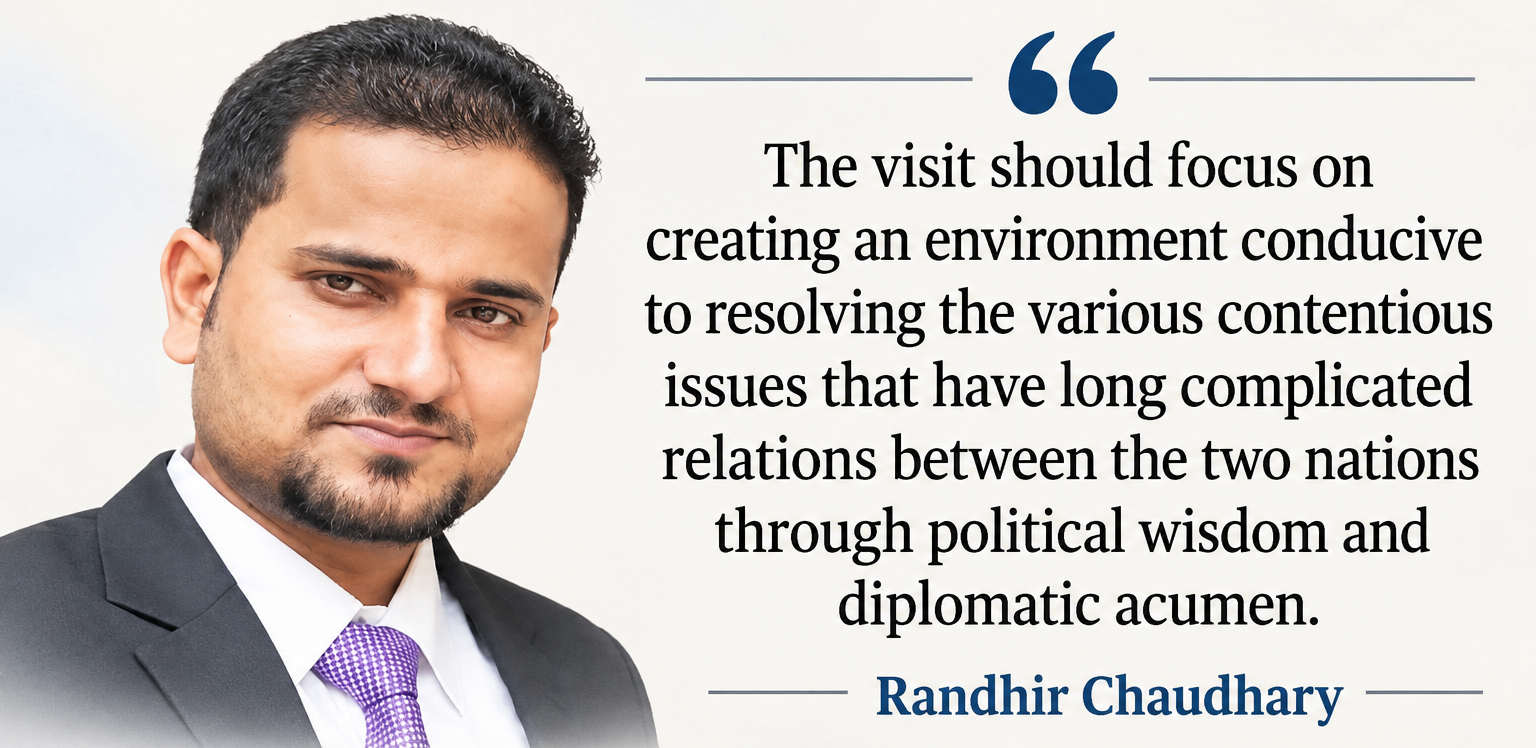
Furthermore, the visit should focus on creating an environment conducive to resolving the various contentious issues that have long complicated relations between the two nations through political wisdom and diplomatic acumen.
Public interest in the EPG report is currently declining because of its enigmatic nature. Drawing on his own experience, Dr. Shankar Sharma, who served two terms as India’s ambassador, has stated in several interviews that there is virtually no possibility of India formally accepting the EPG report.
Since 1962, the Kalapani and Lipulekh issue has remained a subject of public debate. Over the decades, Nepal has undergone various political transformations, while political relations between Nepal and India have experienced numerous ups and downs. Within Nepal, the Kalapani-Lipulekh issue has become a subject of intense discussion, resonating everywhere from the streets to Parliament.
In 2020, under the initiative of UML leader and then-Prime Minister KP Sharma Oli, and within a nationalist political narrative, Nepal amended its constitution to incorporate a new political map. Since then, the issue has effectively remained at a standstill. The current Prime Minister, having recently assumed leadership of Nepali politics, now faces the challenge of addressing a decision made without the necessary diplomatic clearance. Despite India’s firm position, it has consistently expressed its willingness to engage in diplomatic dialogue. One can hope that Balen will pursue an approach different from that of recent leaders—one that is both clear and pragmatic.
Ultimately, the mandate Balen commands, combined with his youthful leadership, has strengthened his political stature and equipped him with the capacity to engage in political dialogue with India and develop new understandings. If he chooses to do so, Balen has the potential to leave a historic mark on the Indian establishment.
It is often said that effective foreign policy is one that serves a country’s own interests. The daily needs of its people, many of which depend on the outside world, must be addressed as effectively as possible. Although it is unlikely that long-standing and intractable issues will be resolved during this maiden visit, matters that directly affect the lives of ordinary citizens could potentially be addressed.
Furthermore, the visit should focus on creating an environment conducive to resolving the various contentious issues that have long complicated relations between the two nations through political wisdom and diplomatic acumen.






Comment