




KAVREPALANCHOK: The ‘Buddha Circuit’ is set to be developed as a trekking route connecting major historical, religious and tourist destinations in the southeastern part of Kavrepalanchok.
The federal government has allocated Rs 250 million for the project, which will connect the historic towns of Panauti, Namobuddha and Temal. The project will be implemented in phases using the allocated budget, Kavrepalanchok MP Madhu Chaulagain said.
In the first phase, Rs 100 million will be spent on constructing physical and cultural heritage structures related to Buddhism along both sides of the road from Dabili in Panauti to Namobuddha. Information boards will be installed at various locations, along with Mane walls, chaityas and Laughing Buddha statues. Thangka paintings and other informational displays will also be featured.
Chaulagain said the existing traditional road will itself be developed as the ‘Buddha Circuit’. A master plan for the circuit has already been prepared.
According to him, the aim is to transform the approximately eight-kilometre Panauti-Namobuddha road into an attractive tourist route featuring Buddhist heritage.
A Ratuwa Deer Park will be constructed in the Bokse Community Forest in Dapcha, along the Namobuddha-Bhakunde road section of the Buddha Circuit. Chaulagain said the process of approving the plan has been advanced at the Ministry of Forests of Bagmati Province.
“The location for the deer park has been selected, and the provincial government is also positive,” he said.
Similarly, a ‘Cultural Sangam Gate’ will be constructed at Chardobato in Bhakundebesi along the BP Highway. Symbols and figures representing various religions and cultures will be incorporated into the gate, which will be visible from all sides.
According to Chaulagain, physical and cultural heritage related to Buddhism will be constructed along both sides of the approximately 25-kilometre road from Namobuddha to Temal via Bhakundebesi. Mane walls, chaityas and Laughing Buddha statues will be installed at various locations, along with informational boards and Thangka displays.
A plan is also underway to build a large statue of Guru Rinpoche at Yangbel in Temal. The process of acquiring land for the project has been initiated.
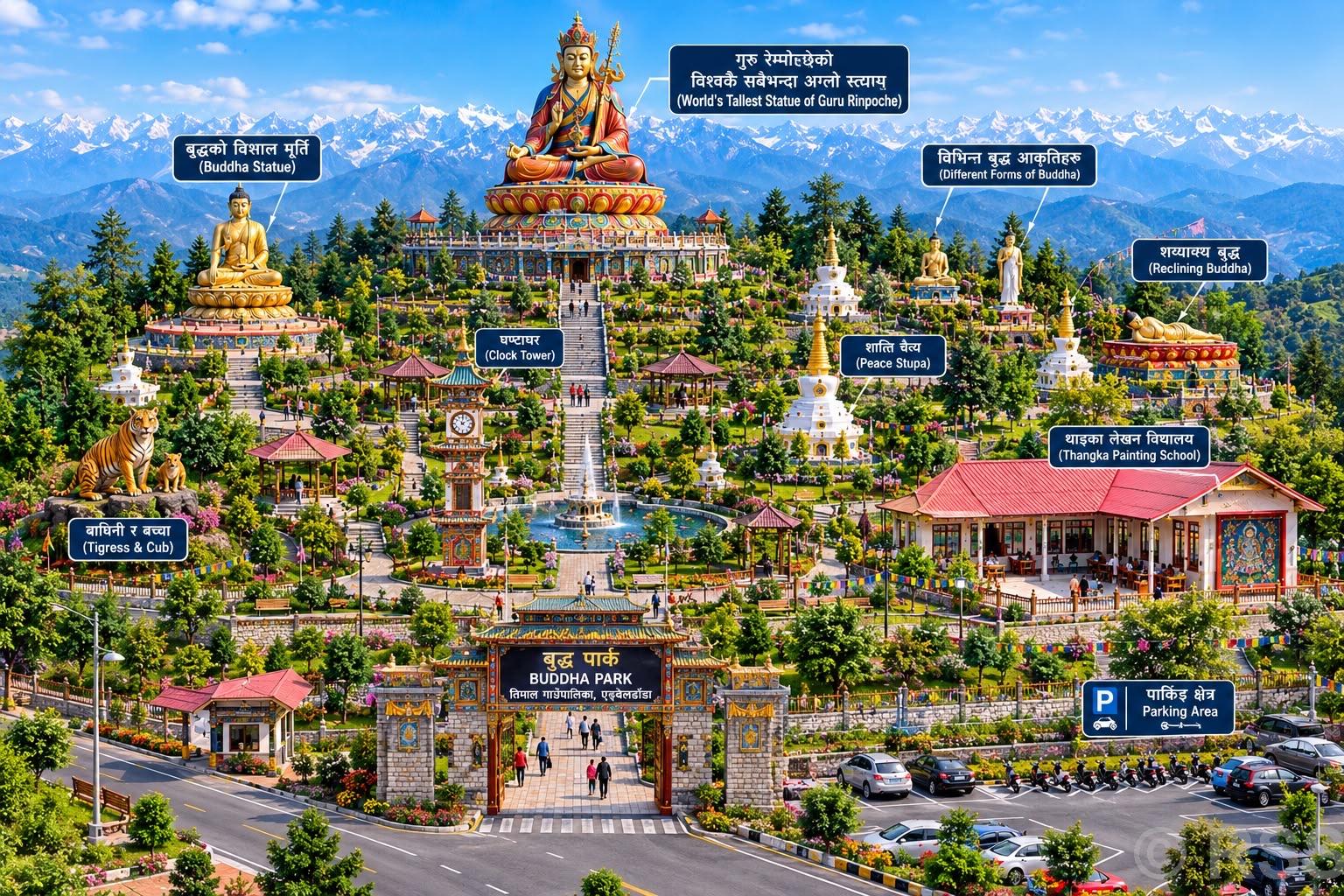
Chaulagain said plans are also in place to develop a ‘Buddha Park’ at Yangbel featuring what is described as the world’s largest statue of Guru Rinpoche, a large Buddha statue and various other Buddhist figures, a clock tower, a statue of a tiger with a cub, a Shanti Chaitya, a Thangka painting school and a parking lot.
“Once the Thangka school is established in Temal, people will no longer have to travel to cities to learn the art. Students will be able to study here and teach Thangka painting to others. Temal will be introduced to domestic and international visitors through Thangka art,” he said.
According to historians, an inscription from the time of King Pratap Malla states that after the construction of Rani Pokhari in 1727, water from Trivenighat in Panauti was also stored for various pilgrimage sites.
Trivenighat, the confluence of three rivers, is believed to be the meeting point of the Punyamata and Roshi rivers and the secretly flowing Padmavati River. Similar to the belief that the Saraswati River joins the Ganges and Yamuna at Prayag in India, the Roshi is considered Rudravati, the Punyamata is considered Lilavati, and the river believed to flow secretly beneath the Brahmayani Temple is regarded as Padmavati.
Namobuddha is a historically and religiously significant tourist destination in Kavrepalanchok. It is associated with a legend in which a prince, believed to have been a previous incarnation of Gautam Buddha, sacrificed his own blood and flesh to save a starving tigress and her cubs.
According to legend, the prince was the youngest of the three sons of King Maharath and Queen Satyavati of the ancient Panchaladesha, identified with the Panauti Kingdom. The legend says he encountered the starving tigress while hunting in the forests of Gandhaman Mountain and sacrificed himself to save her.
The Namobuddha area is home to Lama and Mahayana monasteries, large stone Buddha statues and numerous chaityas.
The saying, “If you want to find Tamang history and civilization, go to Temal,” reflects the area’s historical and cultural significance. It is believed that Guru Padmasambhava attained enlightenment while meditating in Temal on his journey from India to Tibet during the reign of Rinzen Dorje Bal, before the unification of Nepal.
Various structures and figures reflecting the history, civilization and culture of Temal have also been constructed in the area.





Comment