




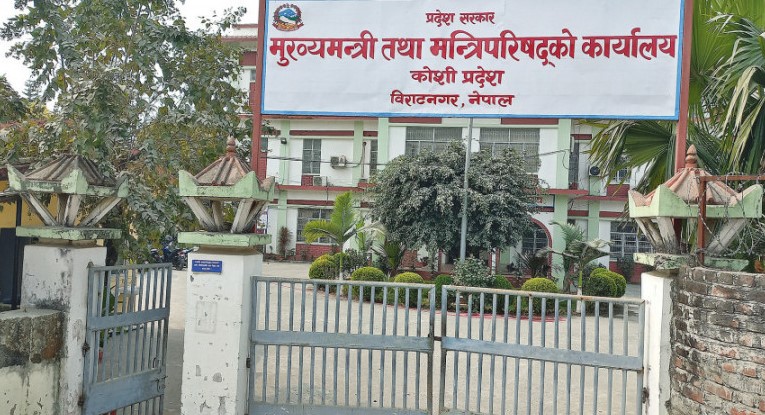
BIRATNAGAR: The accumulated amount of irregularities, or beruju, recorded by the Koshi provincial government rose to Rs5.87 billion by the end of fiscal year 2024/25, according to the Office of the Auditor General’s Eighth Annual Report 2026.
Although the amount of new irregularities has declined in recent years, the continued failure to settle previously recorded cases has pushed the cumulative figure higher. Koshi’s total outstanding beruju stood at Rs22.34 million in fiscal year 2017/18.
Annual irregularities declined from Rs1.67 billion in 2018/19 to Rs1.32 billion in 2022/23, Rs868.19 million in 2023/24 and Rs586.68 million in 2024/25.
Of the irregularities recorded in the latest fiscal year, Rs151.70 million needs to be recovered, while Rs403.84 million requires regularisation. Another Rs31.14 million remains outstanding in advances.
Infrastructure ministry accounts for largest share
The Ministry of Physical Infrastructure Development recorded the highest amount of irregularities among provincial ministries, at Rs294.4 million. This accounts for more than 56 percent of the total beruju recorded at the ministry level.
The Ministry of Water Supply, Irrigation and Energy followed with Rs126.9 million, or 24.18 percent. The ministry responsible for tourism recorded Rs47.3 million, while other ministries and agencies accounted for around Rs56.2 million.
The high concentration of irregularities in the infrastructure sector is largely linked to the province’s substantial expenditure on roads, bridges and public buildings. Weaknesses in contract management, payments, documentation and advance settlement have contributed to audit observations.
Rs52.38 billion in transactions audited
The Office of the Auditor General audited transactions worth Rs52.38 billion involving 208 provincial entities during fiscal year 2024/25. These included 182 government offices and committees and 26 other institutions.
However, transactions worth Rs288.09 million could not be audited after some offices said they were unable to provide the required records during the Gen-Z protests.
The Auditor General has called for stronger internal controls, more effective internal audits and regular monitoring to ensure the timely clearance of beruju. The provincial government’s own monitoring report has also pointed to discrepancies between its records and those maintained by the Office of the Auditor General.
Milan Acharya, secretary at the Ministry of Physical Infrastructure Development, said the ministry was prioritising measures to prevent new irregularities while working to clear those accumulated in previous years.
He acknowledged that the ministry’s large budget and extensive project implementation made it more vulnerable to audit observations.






Comment