




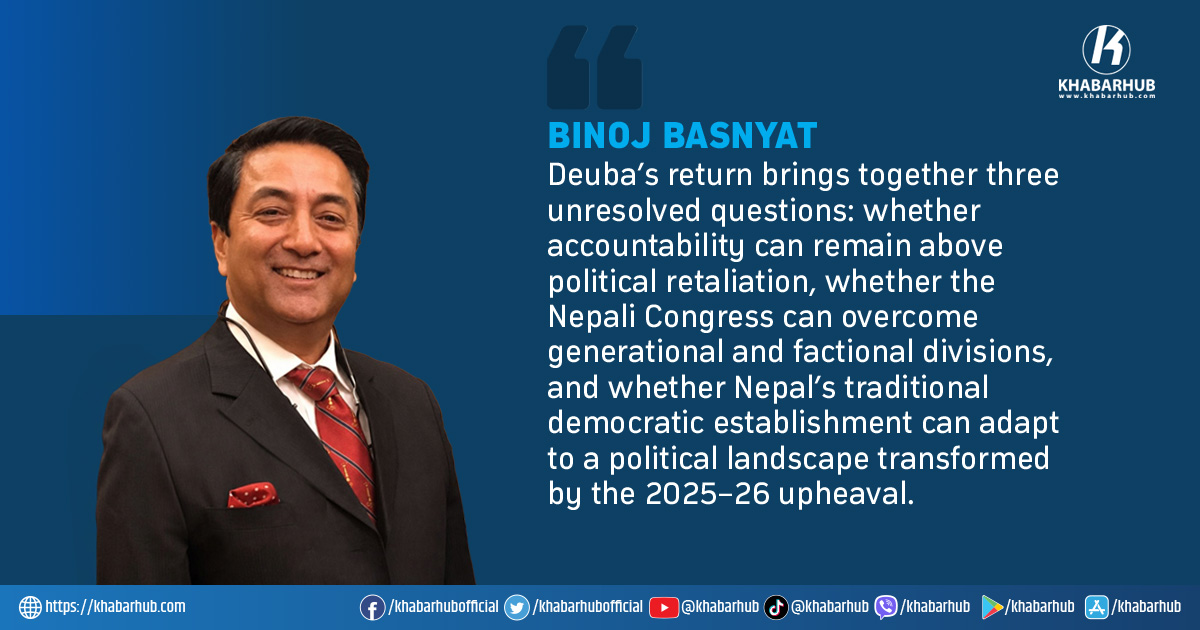
Sher Bahadur Deuba’s return to Nepal on 13 August 2026 is more than the return of a former five-time prime minister and veteran leader of the Nepali Congress (NC). It is a moment that brings together three larger questions about Nepal’s democratic future. Can accountability remain above political retaliation?
Can the Nepali Congress overcome its internal factionalism and generational divide? And can Nepal’s traditional democratic establishment adapt to a political landscape fundamentally transformed by the upheavals of 2025 and the electoral mandate of 2026? These questions are interconnected.
Deuba has returned at a very different historical moment from the one in which he built his political career. Nepal has experienced a profound political rupture. The September 2025 Gen-Z uprising challenged the legitimacy and credibility of the established political class. The March 2026 election then translated that public frustration into an electoral mandate for a new generation of political leadership.
The rise of Balendra Shah and the Rastriya Swatantra Party (RSP) was therefore not simply an electoral change. It represented a deeper public demand for accountability, competence, generational renewal and a different relationship between citizens and the state.
Deuba’s return has to be understood against that backdrop.
A Return in a Different Historical Moment
Upon returning, Deuba invoked national unity and the tradition of B.P. Koirala’s 1976 return to Nepal and his call for national reconciliation. The historical reference is significant, but the circumstances are fundamentally different. B.P. Koirala returned to confront an authoritarian political order. Deuba returns to a constitutional democratic system in which the electorate has already expressed its dissatisfaction with the established political class through an extraordinary political transition.
The 2026 election was, in significant measure, a rejection of established political practices. That message cannot be ignored.
The challenge today is therefore not simply to restore democracy. It is to renew it. That distinction matters. Deuba’s appeal for unity among nationalist and democratic forces can be interpreted in two ways. It can become an attempt by an established political generation to recover lost political space. Or it can become a bridge between institutional experience and a new generation seeking political renewal. The difference will depend on what follows the rhetoric.
The Nepali Congress Test
Deuba’s return also comes at a critical moment for the NC. The party remains divided by competing leadership claims and organizational factions. The dispute between the Deuba camp and the leadership associated with Gagan Thapa raises a larger question than who controls the party.
It raises the question of whether the Nepali Congress can reinvent itself. There are several possibilities. The first is limited reconciliation: competing factions agree on a practical accommodation, preserve party unity and gradually facilitate a generational transition.
The second is prolonged fragmentation: factional competition continues, organizational structures become increasingly divided, and the party loses further political relevance.
The third is deeper democratic renewal: the party uses the current crisis to reform its organization, strengthen internal democracy, embrace generational change and redefine its role as a modern democratic opposition.
The third would be the most constructive outcome, not merely for the NC, but for Nepal’s democratic system.
A democracy requires more than a strong government.
It also requires a credible opposition capable of scrutinizing power, offering alternatives and defending institutions without seeking to restore an older political order.
The Legal Test: Accountability Without Retaliation
The most sensitive dimension of Deuba’s return is the ongoing money-laundering investigation.
This must remain a legal matter, not become another front in Nepal’s political contestation. Deuba has denied the allegations and has consistently argued that his property declarations were properly submitted. His legal strategy has included challenging the earlier arrest process, asserting procedural and jurisdictional deficiencies, demonstrating a willingness to cooperate with investigators and returning to Nepal after medical treatment abroad.
The Supreme Court’s intervention concerning the earlier arrest warrant was an important reminder that even politically significant investigations must comply with law and procedure. The underlying investigation, however, remains a separate matter. The critical principle is simple: Procedural protection does not establish innocence, just as investigation does not establish guilt.
Evidence must determine the outcome.
For the Shah government, this creates a difficult political and institutional balance. If the government retreats from the investigation because Deuba is a senior political figure, it risks accusations of selective justice.
If it pursues the case aggressively in ways that appear politically motivated or procedurally weak, it risks strengthening Deuba’s argument that the process is retaliatory.
The strongest position for the government is therefore neither political leniency nor political confrontation. It is institutional distance.
The government must therefore demonstrate that accountability applies equally to friends and opponents. It must allow independent institutions to function.
Investigate on the basis of evidence. Prosecute where the evidence meets the legal threshold. Respect judicial decisions. Provide due process. And allow the courts to determine guilt or innocence. A government committed to ending impunity must demonstrate that accountability is stronger than politics. That is ultimately the best protection against the charge of political revenge.
The Larger Political Reality
Deuba’s return also illustrates a larger contradiction in contemporary Nepal. The country still needs the institutional memory of the political generation that built and defended multiparty democracy. But the electorate has also made clear that it does not want a simple return to the politics of the past.
The 2026 election was, in significant measure, a rejection of established political practices. That message cannot be ignored. Traditional parties cannot rebuild their relevance simply by criticizing the new government, invoking their historical contribution or forming defensive alliances against a new political force.
They must answer a much harder question: Why should a younger generation believe that the old political parties have genuinely changed?
The answer will have to come through action. Organizational reform. Generational transition. Internal democracy. Credible economic policies. Institutional accountability. And a new relationship between political parties and citizens.
The political transformation of 2025–26 has changed the baseline. The old political establishment cannot assume that historical legitimacy alone will translate into contemporary political legitimacy.
Beyond Deuba: Three Possible Futures
Deuba’s return could therefore lead Nepal toward several different political trajectories. One, managed reconciliation. The competing factions of the NC reach an accommodation. Deuba assumes an elder-statesman role while younger leaders increasingly take responsibility for the party’s future.
This could preserve institutional continuity while allowing generational transition.
Second, prolonged fragmentation. Factional disputes continue, possibly producing parallel structures or a formal organizational rupture. Such fragmentation would weaken the traditional democratic opposition and could allow the RSP to consolidate its political dominance.
Sher Bahadur Deuba’s return should therefore not be viewed simply as the comeback of a veteran politician. It is a test of Nepal’s ability to manage political transition. It tests whether accountability can be pursued without retaliation.
Finally, democratic realignment. The more consequential possibility is that the traditional political parties recognize that the political environment has fundamentally changed. Rather than attempting to restore the old order, they could compete to build a new democratic order, one based on competence, transparency, institutional integrity, economic delivery and generational leadership.
That would transform the current political crisis into an opportunity for democratic renewal.
The Government Has a Test Too
The responsibility does not rest with Deuba or the NC alone. The Shah government is also being tested. Its mandate is based heavily on accountability and political transformation. But political transformation becomes sustainable only when institutions become stronger than personalities.
The government must therefore demonstrate that accountability applies equally to friends and opponents. It must allow independent institutions to function. It must respect judicial processes even when decisions are inconvenient. And it must distinguish between legitimate political opposition and obstruction of reform. The temptation in a period of political transition is to treat the previous establishment as an obstacle to be permanently dismantled. That would be a mistake.
A mature democracy does not eliminate its political opponents.
It institutionalizes competition. The new government therefore has an opportunity to demonstrate that Nepal’s political transformation is not merely a change of political actors but a transition toward stronger institutions.
Experience and Renewal Are Not Opposites
There is also a broader lesson in Deuba’s return. Nepal should not confuse generational renewal with the rejection of experience. Nor should it confuse political experience with a permanent entitlement to political leadership. The two must be reconciled. Veteran leaders possess institutional memory, historical perspective and an understanding of Nepal’s complex political evolution. Younger leaders bring different expectations, new technologies, different approaches to governance and a stronger demand for accountability.
Nepal does not need the old political order restored. Nor does it need the old political establishment permanently excluded. Nepal needs a democratic system capable of renewal.
The challenge is to connect the two. Deuba’s most significant contribution at this stage may therefore not be another political comeback. It may be to facilitate a responsible transition between generations. That would be a different kind of political legacy.
Conclusion: From Political Replacement to Democratic Renewal
Sher Bahadur Deuba’s return should therefore not be viewed simply as the comeback of a veteran politician. It is a test of Nepal’s ability to manage political transition. It tests whether accountability can be pursued without retaliation.
It tests whether opposition politics can remain constructive without becoming an attempt to restore the past. It tests whether the NC can transform experience into renewal. And it tests whether the new government can convert its electoral mandate into institutional change rather than merely political dominance.
The behavior of major states and political leaders is increasingly characterized by aggressive self-interest. This tension is best understood through the philosophical lenses of Niccolò Machiavelli and Immanuel Kant. The Machiavellian framework views politics as an uncompromising, zero-sum struggle for survival and dominance, where the ends justify the means and moral considerations are secondary to power.
Conversely, the Kantian framework champions a universal moral duty, international law, and the “categorical imperative”, the principle that actors must behave according to rules they would want universally applied, treating others as ends in themselves rather than as disposable tools.
Today, this philosophical friction is playing out not only on the grand stage of global great-power competition but also within the internal political fabric of developing nations like Nepal.
Nepal does not need the old political order restored. Nor does it need the old political establishment permanently excluded. Nepal needs a democratic system capable of renewal. The significance of Deuba’s return will ultimately depend not on how many supporters welcome him, how many factions rally around him, or how forcefully he re-enters political debate.
It will depend on whether his generation can help create space for the next one. The central question, therefore, is not whether Sher Bahadur Deuba can return to politics. The larger question is whether Nepal’s democratic establishment can renew itself without becoming captive to its past.
That is the real test of democratic renewal in post-2026 Nepal.
(Basnyat is a Maj. Gen. (Retd.) of the Nepali Army and writes on international affairs and geopolitical strategy. He is also a researcher affiliated with Rangsit University in Thailand.)






Comment