





KATHMANDU: Economic Digest offers a concise yet comprehensive overview of significant business happenings in Nepal, presented in easily digestible summaries.
Nepal’s economic landscape reflects a mixed but cautious trajectory, where financial market weakness contrasts with policy reform efforts and steady real-sector activity. The decline in NEPSE alongside rising fuel prices suggests mounting cost pressures and subdued investor confidence, even as modest increases in gold and silver hint at a shift toward safer assets.
At the same time, strong FDI commitments and ongoing infrastructure expansion indicate underlying growth potential, supported by government initiatives to reform the energy sector and attract private investment. However, structural inefficiencies—such as low capital expenditure, weak financial health in microfinance institutions, and governance disputes in business bodies—continue to constrain momentum.
Increased regulatory enforcement, from customs to market monitoring and financial oversight, signals a push for greater transparency and control, while improvements in agriculture and rural infrastructure highlight gradual progress in the real economy. Overall, the outlook suggests an economy balancing reform and investment opportunities against persistent institutional and market challenges.
NEPSE falls 1.18 percent as all sectors close in red
The Nepal Stock Exchange (NEPSE) dropped by 33.83 points, or 1.18 percent, on Thursday to settle at 2,833.03. The Sensitive Index declined by 0.91 percent to 477.46, while the float and sensitive float indices recorded gains. A total of 20.74 million shares from 342 companies were traded through 111,607 transactions, generating a turnover of Rs 9.312 billion. All 13 sector indices posted losses, with finance, hydropower, and others leading the decline. Despite the overall downturn, two companies hit the upper circuit limit.
Country secures Rs 41.798 billion in FDI commitments in nine months
The country attracted foreign direct investment (FDI) commitments worth Rs 41.798 billion across 615 projects during the first nine months (July 17, 2025, to April 13, 2026) of fiscal year 2025/26. According to the Department of Industry, the agriculture and forest-based sector received the largest share, with Rs 22.088 billion committed to 16 projects. The tourism sector followed, securing Rs 11.462 billion for 164 projects. These investments, including 599 small-scale industries, are expected to generate 23,316 jobs for local residents.
Gold and silver prices edge up slightly
Gold and silver prices saw a modest increase today. Gold rose by Rs 100 per tola (11.66 grams), while silver increased by Rs 30. The Federation of Nepal Gold and Silver Dealers’ Association set the price of fine gold at Rs 302,800 per tola and silver at Rs 5,250 per tola. On Wednesday, gold was priced at Rs 302,700 per tola and silver at Rs 5,220 per tola.
NOC raises diesel and kerosene prices by Rs 30
The Nepal Oil Corporation (NOC) has increased the prices of diesel, kerosene, and domestic aviation fuel effective Thursday. Diesel and kerosene prices rose by Rs 30 per liter, while domestic aviation fuel increased by Rs 5 per liter. As a result, diesel and kerosene now cost Rs 234.50 per liter in Category 1 regions. Aviation fuel is priced at Rs 256 per liter, up from Rs 251, while petrol prices remain unchanged.
Minister Shrestha issues 32-point directive for energy reform
Minister for Energy, Water Resources, and Irrigation, Biraj Bhakta Shrestha, introduced a 32-point directive on Thursday aimed at structural reform and greater transparency in the energy sector. The directive instructs the Electricity Regulatory Commission to set wheeling charges within 30 days to enable an “open access” system for competitive electricity trading. It also requires the Nepal Electricity Authority to submit a report on all power purchase agreement (PPA) disputes and classify projects based on operational risks. Additionally, the Department of Electricity Development must publish details of all hydropower licenses and their progress within 60 days to improve accountability.
License period for reservoir projects extended to 50 years
The Ministry of Energy, Water Resources, and Irrigation has extended the license period for reservoir-based hydropower projects to 50 years to encourage private sector investment. The move is intended to address high costs and long payback periods associated with such projects. Under the 32-point directive issued Thursday, the Department of Electricity Development has 45 days to implement the change. The Electricity Regulatory Commission is also required to establish a wheeling charge framework within one month to break the Nepal Electricity Authority’s monopoly and allow competitive private power trading.
Department to act against illegal passport annotations for UAE-bound travelers
The Department of Immigration has begun action against individuals making unauthorized remarks on the passports of Nepali citizens traveling to the United Arab Emirates (UAE) on visit visas. An internal probe is underway to identify and penalize those involved in activities outside legal provisions and official procedures. The department clarified that no law permits additional departure restrictions beyond those already defined. It also highlighted ongoing efforts to prevent fraud and exploitation faced by travelers. Following a Government of Nepal decision dated October 30, 2025, departure procedures have been simplified. Travelers on visit visas can now leave through self-declaration if they possess a passport valid for at least six months, a confirmed flight ticket, and a valid visa.
Nepal embassy rescues 46 citizens from Cambodia
The Nepali Embassy in Bangkok rescued 46 Nepali nationals from Cambodia who were reportedly forced into illegal activities. All individuals have been safely repatriated to Nepal with support from the Cambodian government. Data shows a sharp increase in Nepalis traveling to Cambodia for work, rising from 101 in 2021 to 9,676 in 2025. Authorities have issued a strong warning advising citizens not to travel to Cambodia, Laos, Myanmar, or Thailand for employment without proper labor permits to avoid exploitation.
Sudurpashchim records lowest capital expenditure at 16.42 percent
The Sudurpashchim Province government recorded its lowest capital spending in recent years, utilizing only 16.42 percent of its development budget by April 13. Of the total Rs 19.838 billion allocated, just Rs 3.258 billion has been spent. The Ministry of Physical Infrastructure Development, which holds the largest share, used only Rs 2.659 billion. Delays in contract awards and internal disputes within ministries have been cited as key reasons, leaving Rs 25.666 billion to be spent within the remaining three months.
Nawalparasi transport office collects Rs 235.4 million in nine months
The Transport Management Office in Nawalparasi (Bardaghat Susta Purba) collected Rs 235.4 million in revenue during the first nine months (July 17, 2025, to April 13, 2026) of fiscal year 2025/26. Vehicle taxes accounted for the largest portion at Rs 191.2 million, while driving license and registration fees contributed Rs 40.9 million. A special enforcement drive in mid-March alone generated Rs 48 million. The increased collection effort aligns with provincial plans to enhance transparency and efficiency in transport services.
Kathmandu police file Rs 227.5 million in money laundering claims
The District Police Range Kathmandu registered 1,166 cases between March 15 and April 13, covering major financial and serious crimes. In two money laundering cases, claims worth Rs 227.5 million were filed against three accused. Additionally, seven individuals were arrested in three separate hundi cases involving Rs 15.6 million. Police also detained a Chinese national in Thamel for illegal virtual currency transactions amounting to Rs 177.9 million and recovered 159 missing persons during the same period.
Customs enforcement tightened on goods above Rs 100 in Bhairahawa
The Bhairahawa Customs Office has strictly enforced mandatory customs duties on all household goods valued above Rs 100 brought in from Indian border markets. Security personnel, including the Armed Police Force, are using megaphones at the Belahiya and Farenia crossings to inform the public. While the Siddhartha Chamber of Commerce and Industry has supported the move to protect domestic businesses, some consumers have raised concerns about the low threshold. Officials say the measure is aimed at reducing revenue leakage and curbing illegal imports, despite challenges for low-income groups.
Department inspects 56 commercial firms in single-day monitoring drive
The Department of Commerce, Supplies, and Consumer Protection carried out inspections of 56 commercial firms across Kathmandu on Wednesday. The monitoring focused on essential food products and everyday consumer goods to ensure adherence to billing and price display regulations. Officials checked whether businesses were issuing invoices, clearly displaying price lists, and complying with tax requirements. Several firms were given corrective instructions, and the department noted that involving consumer rights activists in such inspections helps enhance market transparency and safeguard consumer interests.
Rs 146.1 million Talam-Dhorpatan road project enters blacktopping phase
Blacktopping has begun on the Talam section of the Darbang–Muna–Dhorpatan road in Myagdi as part of a key infrastructure upgrade. The 6-kilometer stretch from Dharapani to Jhindanda is being developed by Ram Sagar BK S KBS Dhaulagiri JV under a contract worth Rs 146.1 million. The project has reached 84 percent physical progress and serves as a vital connection for residents in five wards. Another 11-kilometer section has been awarded a Rs 588 million contract, which is expected to reduce travel distance to Pokhara and Kathmandu by 50 kilometers once completed.
Two new bridges completed in Rishing rural municipality
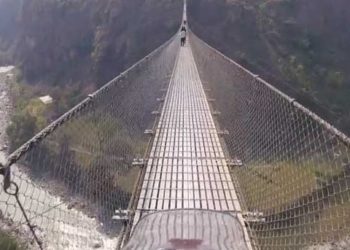
An iron bridge and a suspension bridge have been completed in Rishing Rural Municipality of Tanahun, improving local connectivity. The iron bridge, linking wards 5 and 7, was constructed at a cost of Rs 3.2 million, while the suspension bridge connecting wards 4 and 7 cost Rs 3.4 million. Built through NGO Network Tanahun, the projects aim to reduce risks associated with river crossings during the monsoon. The new infrastructure is expected to improve access to markets, healthcare, and education by shortening travel times between communities.
Jumla produces over 18,245 metric tons of apples this season
Jumla has recorded apple production of 18,245 metric tons this year, with high-density Fuji and Gala varieties becoming increasingly popular among farmers. Apple farming now spans 4,497 hectares, with 2,165 hectares currently productive. Around 16,000 of the district’s 19,000 households are engaged in apple cultivation. Although orchards are in full bloom, farmers remain concerned about black frost, which frequently damages blossoms between mid-March and mid-May.
Jumla exports Rs 35 million worth of Marshi rice in five months
Between mid-October 2025 and mid-March 2026, Jumla exported 175 tons of indigenous Marshi rice, earning approximately Rs 35 million. The crop, cultivated at high altitude in Chhumchaur, has seen growing demand in domestic and international organic markets. Marshi rice is grown on 1,068 hectares, representing 37 percent of the district’s total paddy land. However, production faces challenges from river erosion and crop diseases. The Agriculture Research Center has recommended improved varieties such as Chandanath-1 and 3 to ensure sustainable output.
Spring maize cultivation expands to 56 hectares in Banke
Farmers in Banke are increasingly adopting spring maize as a profitable cash crop, with cultivation now covering more than 56 hectares. Most commercial farming is concentrated in Raptisonari Rural Municipality (46 hectares) and Khajura Rural Municipality (10 hectares). The Agriculture Knowledge Center is supporting farmers with seeds, technical assistance, and machinery to manage pests like the fall armyworm. The crop’s lower water and labor requirements, along with strong demand from poultry feed industries, have made it an attractive option.
Capital adequacy ratios of five microfinance institutions fall below requirement
According to Nepal Rastra Bank (NRB), five microfinance institutions have failed to maintain the required minimum capital adequacy ratio of 8 percent as of January 14, 2026. Matribhumi Microfinance reported the lowest ratio at 4.78 percent, followed by Community Microfinance (6.27 percent), Forward Microfinance (6.77 percent), Unique Nepal Microfinance (7.35 percent), and NADEP Microfinance (7.70 percent). These institutions now face restrictions on dividend distribution and expansion until they improve their capital base through recovery or additional investment.
Eighteen associations warn of protests over FNCCI membership dispute
At least 18 business associations have submitted a formal petition to the Federation of Nepalese Chambers of Commerce and Industries (FNCCI), warning of phased protests if their voting rights are not reinstated. The dispute follows an interim order by the Patan High Court on April 8, which suspended the general assembly until membership issues are resolved. The associations argue that moving forward without granting them membership, as directed by a mandamus order, would amount to contempt of court. They have urged FNCCI to implement the court’s decision before announcing a new date for its annual general meeting.
Insurance authority seeks clarification from Himalayan reinsurance CEO
The Nepal Insurance Authority has issued a seven-day clarification notice to the Chief Executive Officer (CEO) and four senior officials of Himalayan Reinsurance. The notice questions why they should not face suspension over alleged failures in financial crisis management and inadequate oversight of promoter activities. CEO Upasana Poudel and Deputy CEO Mukesh Kumar Kapur have been asked to explain delays in payments to non-life insurance companies. Failure to respond satisfactorily within the deadline could result in their removal, as the authority reviews the company’s financial condition.
SOPAN pharmaceuticals launches Rs 347.4 million IPO
Sopan Pharmaceuticals Limited has opened its initial public offering (IPO) to the general public, issuing 3.4 million shares worth Rs 347.4 million. This follows an earlier allocation of 429,000 shares to Nepali workers abroad. The company’s authorized capital stands at Rs 1.716 billion. Investors can apply for a minimum of 10 shares and up to 11,000 shares until April 19. The issue is being managed by NMB Capital and is available through C-ASBA member banks and the Mero Share platform.





Comment