




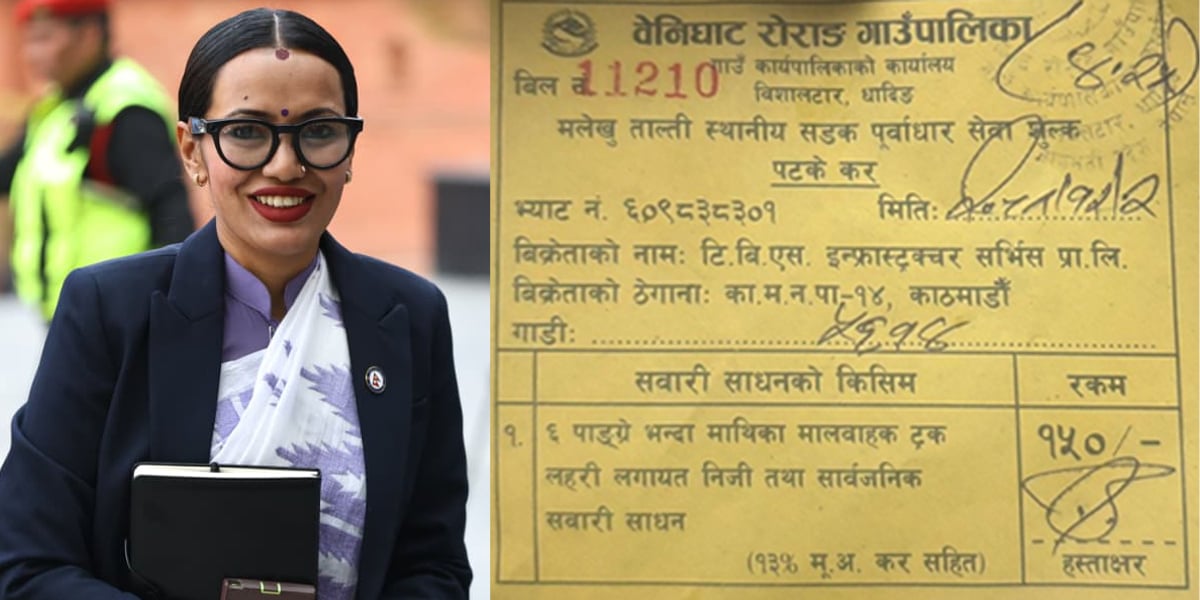
KATHMANDU: A directive issued by Ashika Tamang, a lawmaker from the Rastriya Swatantra Party (RSP), regarding local taxation has sparked controversy and raised questions about constitutional boundaries.
Tamang, elected from Dhading-1, announced via social media that vehicle fees being collected along the Malekhu–Talti stretch should be stopped immediately. She also warned of action against those continuing to collect the charges.
In her post, Tamang questioned the legitimacy of collecting taxes solely for using a road for transportation purposes.
However, constitutional experts argue that a federal lawmaker cannot directly instruct provincial or local governments. Under Nepal’s federal system, local and provincial governments operate as autonomous entities within their respective jurisdictions.
Local governments are authorized to levy taxes based on laws endorsed by village or municipal assemblies. Such decisions are not subject to direct orders from members of the House of Representatives.
Experts note that if taxes are being collected unlawfully, investigations and action can be pursued through proper legal channels, but not through individual directives from federal lawmakers.
The Constitution of Nepal, through Schedules 6 and 8, grants exclusive powers to provincial and local governments, reinforcing the principle of federal autonomy and limiting external interference.
Commenting on the issue, Gen-Z youth and law student Majid Ansari said lawmakers need a clearer understanding of their constitutional roles, powers, and limitations.
He emphasized the need for further training for newly elected representatives on federal governance, fiscal autonomy, and legislative responsibilities.
Following the controversy, calls have emerged for the RSP to strengthen orientation programs for its lawmakers, particularly on the federal structure, policymaking processes, and the scope of parliamentary authority.
Experts also stress that while local taxation may need reconsideration if it burdens citizens, any changes must follow constitutional and legal procedures.



Comment