




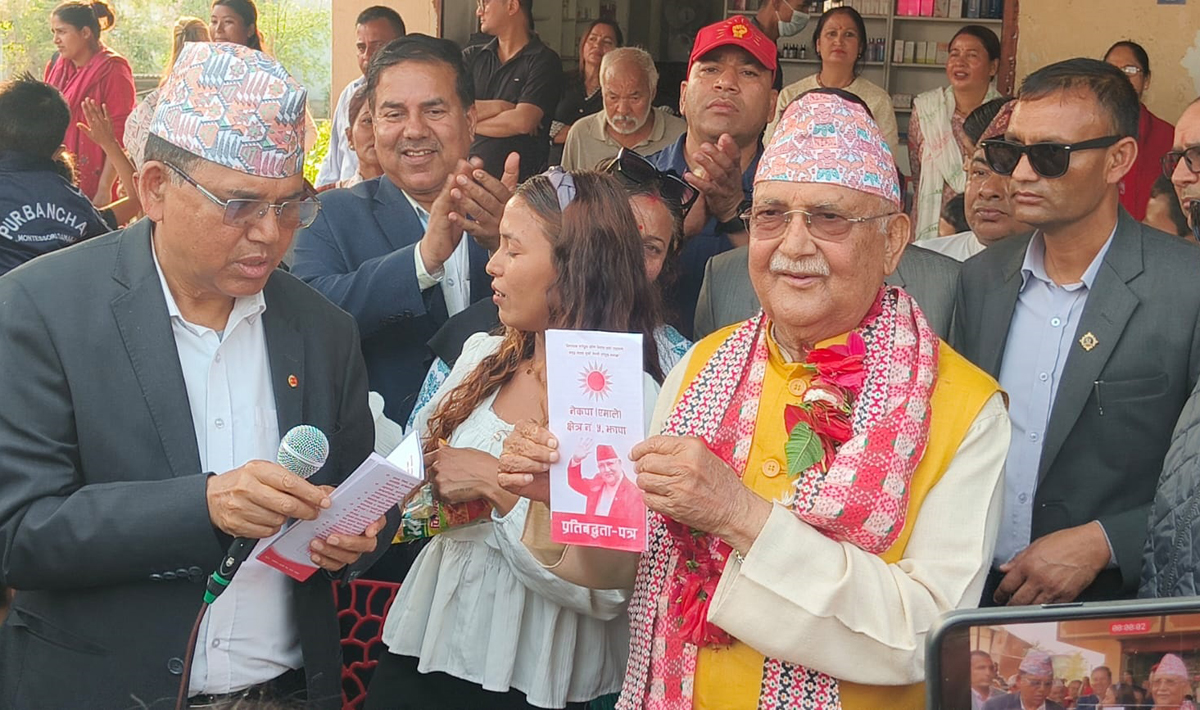
JHAPA: KP Sharma Oli, chair of the UML, has unveiled a 42-point manifesto for Jhapa-5 constituency, where he is contesting. The manifesto focuses on four main areas: good governance, anti-corruption, nation and nationalism, and infrastructure development.
The manifesto describes UML as the mainstay of the Nepali communist movement, established in 1949, highlighting its 76-year history of achievements despite challenges. It emphasizes the party’s role in forming Nepal’s first communist government in 1994/95 and notes that the country is advancing based on that foundation.
The document also criticizes parties lacking clear agendas, claiming UML has overcome numerous obstacles to progress. It cites the 2017 elections, where Oli assumed government leadership, and notes that internal and external pressures led to government dissolution in 2021, causing setbacks for the communist movement and raising opportunities for right-wing forces. The manifesto further acknowledges the disruption caused by COVID-19 during 2017–2022 but asserts that the country achieved significant progress in infrastructure development despite the pandemic.
The manifesto also takes aim at stunt politics and populist moves by other parties, highlighting how flashy slogans and social media misinformation have confused the public. It points to the unregulated use of artificial intelligence (AI) tools as contributing to the spread of false information and public misunderstanding.
UML stresses that its slogan, ‘Sukhi Nepali, Samriddha Nepal,’ is backed by concrete programs, not just rhetoric, and the party is committed to preserving past achievements while completing unfinished initiatives.
Ahead of the elections on March 5, UML has urged voters to elect Oli in Jhapa-5, promising to strengthen democratic governance and political stability, implement zero tolerance policies against corruption, protect national sovereignty, and advance infrastructure development.
The manifesto outlines the party’s determination to complete pending development works, issue land ownership certificates to landless and marginalized communities, continue public and low-income housing programs, and improve the lives of indigenous peoples, Dalits, Muslims, and other backward groups.
It also pledges to upgrade health insurance services, improve roads, complete community buildings, modernize irrigation and agriculture, promote self-reliance in food production, and develop markets, industrial parks, and tourism sites.
The manifesto further highlights plans to modernize urban centers such as Damak, Gauradaha, and Gauriganj, implement smart city programs, construct bridges and embankments, develop science parks and industrial zones, upgrade hospitals and provincial Ayurvedic facilities, and ensure safe drinking water for every household.
Cultural and eco-tourism projects, including the development of ponds, model wetlands, and heritage sites, are also emphasized. Through this comprehensive plan, UML positions Oli as the leader tasked with implementing the manifesto in Jhapa-5 and fulfilling the party’s vision of change, stability, and prosperity.




Comment