




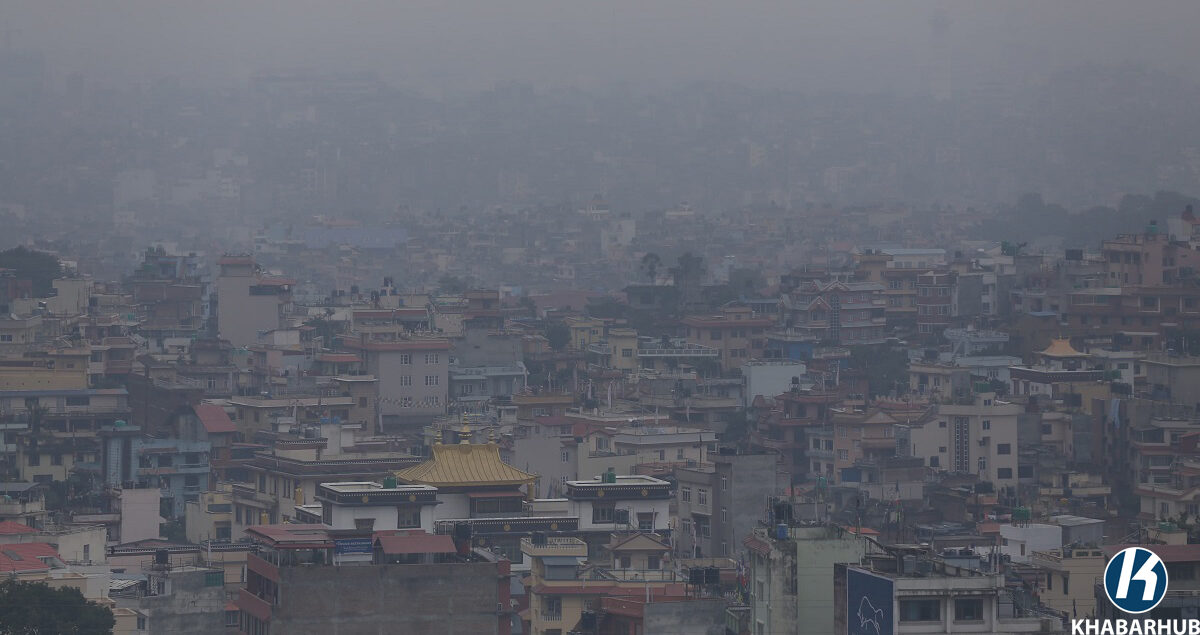
KATHMANDU: Air pollution in the Kathmandu Valley has risen sharply, with the Air Quality Index (AQI) reaching 191 by Tuesday noon, up from 178 on Monday. This level falls under the unhealthy for all category, posing heightened health risks, particularly for children, senior citizens, and individuals with respiratory or heart conditions.
According to the AQI, Kathmandu is currently ranked as the third most polluted city globally. Delhi, India, leads with an AQI of 229, followed by Lahore, Pakistan, at 203.
Director General of the Department of Environment, Gyanraj Suvedi, warned that pollution could worsen in the coming days if rainfall does not occur. “Rain helps settle dust and particles from the air, so prolonged dry weather can increase pollution levels,” he said. Suvedi also advised relevant authorities to implement sustainable and environment-friendly measures effectively.
Environment activist Varsha Parajuli cited rapid vehicle growth, emissions from diesel and petrol, dust from ongoing road and infrastructure projects, forest fires, and prolonged dry weather as key factors contributing to the rise in air pollution. She cautioned that “if timely measures are not taken, the situation could become more complex.”
According to AQI standards, an index of 0–50 is considered good (green), 51–100 requires caution (yellow), 101–150 is unhealthy for sensitive groups, 151–200 is unhealthy for all, 201–300 is very unhealthy, and above 300 is hazardous.
Under the Kathmandu Valley Air Quality Management Action Plan, 2076, the Nepal government classifies AQI above 300 as a disaster. Measures include halting open burning of waste, increasing the use of street cleaning machinery like brooms and vacuum cleaners, and issuing public warnings for children, senior citizens, and patients.
The National Environment Policy mandates the preparation and implementation of national standards to control pollution in air, water, soil, sound, electromagnetic waves, radioactive emissions, and hazardous chemicals. Monitoring centers are also to be established in major cities, industrial areas, and high-risk zones to map air, water, and noise quality.



Comment