




Some relationships between countries are constructed through treaties, diplomatic negotiations and calculations of national interest. Others seem to have existed long before anyone thought of defining them. Nepal and India belong to the latter category.
Long before modern borders were drawn, people moved across the plains and mountains that today separate our two countries. They traded, worshipped, studied, married and settled among one another. Pilgrims travelled in both directions. Languages, food, music and traditions crossed freely.
That human connection remains perhaps the greatest strength of Nepal–India relations.
For millions of Nepalis and Indians, this relationship has never been primarily about diplomacy. It is about relatives arriving for a wedding, students making lifelong friends at university, pilgrims travelling to sacred places, traders doing business across the border and people discovering a second home on the other side.
Sometimes adversity reminds us just how deep those bonds run. When the devastating earthquake struck Nepal in 2015, Indian rescue teams joined the effort to find survivors beneath the rubble.
No diplomatic communiqué can express neighbourliness as powerfully as one human being reaching out to save another. The recent Himalayan disaster in Nepal has made that idea painfully relevant again. Lives have been lost, communities devastated and vital infrastructure damaged.
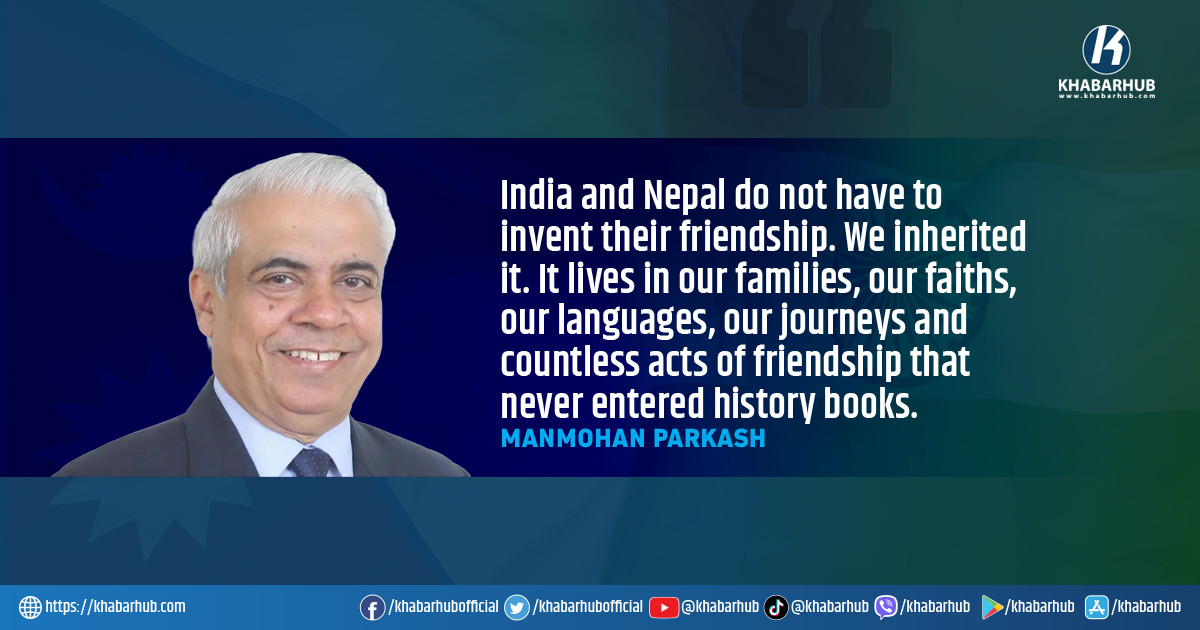
India and Nepal do not have to invent their friendship. We inherited it. It lives in our families, our faiths, our languages, our journeys and countless acts of friendship that never entered history books.
But tragedy can also illuminate possibilities less visible in normal times. The disaster reminds India and Nepal of something fundamental: the mountains, rivers, glaciers and weather systems that shape our lives do not recognize political borders. Increasingly, neither can the solutions to the risks they create.
For two old friends, this could be a moment to discover how much more we can accomplish together.
For me, the Himalayas are also personal. I was born in Dehradun and spent my early years in the Himalayan foothills. Perhaps that is why the mountains have always felt to me less like a geographical boundary and more like a shared inheritance.
Today, that inheritance also brings a shared responsibility. The Himalayas are increasingly exposed to floods, landslides, glacial hazards and extreme weather. What happens high in one part of these mountains can affect people hundreds of kilometres away.
Water does not carry a passport. Neither does a glacier, a flood, a landslide or an earthquake. India and Nepal should therefore increasingly move from cooperating after disaster strikes to cooperating before it does.
Imagine scientists from both countries jointly monitoring glaciers, unstable slopes and river systems using satellites, radar, seismic networks and weather information. Imagine information moving across borders in real time, identifying communities and infrastructure at risk and reaching people’s phones while the physical hazard is still travelling downstream.
A flood must travel kilometre by kilometre. The warning does not.
India brings substantial capabilities in space technology, remote sensing, meteorology, telecommunications and disaster management. Nepal brings intimate knowledge of its mountains, rivers and communities, alongside growing scientific capabilities.
The opportunity is not for one country to provide solutions to the other. It is to build solutions together.
That principle extends far beyond disasters. Few neighbouring countries have been given as much to work with as India and Nepal. We share geography, civilisational links, religious traditions and extraordinary cultural familiarity. From Pashupatinath and Janakpur to Varanasi and Bodh Gaya, our sacred geography tells a story that predates modern states.
Along the open border, marriage across national boundaries has been so commonplace that the relationship acquired that wonderfully simple description: roti-beti ka rishta—a bond of bread and daughters. A border may appear prominently on a map while running almost invisibly through a family.
Generations of Nepalis serving in India’s Gurkha regiments provide another remarkable connection.
This is an extraordinary inheritance. But there is also a danger in speaking too comfortably about our “age-old relationship.”
History can become a substitute for imagination. Every generation must discover its own reasons to value friendship. That is the opportunity before India and Nepal today.
Energy provides perhaps the clearest example. Nepal has enormous hydropower potential. India has enormous and growing energy needs. Nepal increasingly exports surplus hydropower to India. And now adversity has demonstrated why integration works both ways: with Nepal’s hydropower system badly affected by the recent floods, India has approved electricity supplies of up to 654 MW for 18 hours a day through the end of the year.
At one moment, clean electricity generated in Nepal’s mountains can help power Indian homes and businesses. At another, electricity from India can help Nepal through an emergency.
That is not dependence. It is interdependence.
Why stop at energy? Indian and Nepali universities could become partners in Himalayan research, disaster resilience, public health and emerging technologies. A young Nepali entrepreneur should think naturally of India’s enormous market. An Indian entrepreneur should see Nepal not simply as a neighbouring market, but as a place to invest, innovate and build together.
Better physical, energy and digital connectivity can make geography work for both countries.
And the next generation should increasingly own this relationship. Businesses should invest together. Universities should collaborate. Scientists should solve problems together. Young people should travel in both directions. Even the rise of cricket in Nepal is creating another shared language far removed from treaties and diplomatic negotiations.
Perhaps we should measure the relationship not simply by agreements signed during official visits, but by students crossing the border to learn, businesses created together, clean electricity traded, scientists sharing knowledge, communities receiving warnings before disaster reaches them—and young Indians and Nepalis who can say they have a friend on the other side.
That is how an old relationship becomes young again.
None of this can happen without trust.
India and Nepal are vastly different in size. But equality between neighbours does not require equality in size. It requires equality in respect.
India’s size gives it greater weight in the relationship. It also gives India a greater responsibility—to listen carefully, understand Nepal’s sensitivities and ensure that partnership is experienced as partnership.
Nepal, for its part, has one of the world’s largest and most dynamic economies immediately across its open border. That should be seen not simply through the lens of asymmetry, but also as an opportunity. Both countries should engage confidently with the wider world. But they should also ask a simple question:
History gave India and Nepal an extraordinary friendship. Our generation has the opportunity to give that friendship a future worthy of its past. Perhaps that is the opportunity before us: two old friends discovering just how much more they can accomplish together.
Why should two neighbours with so much in common and so many complementary strengths always look thousands of kilometres away for solutions they could sometimes build together?
India and Nepal do not have to invent their friendship. We inherited it. It lives in our families, our faiths, our languages, our journeys and countless acts of friendship that never entered history books.
But inheritance brings responsibility. The challenges facing the next generation—climate change, Himalayan hazards, energy security, technology, employment and economic transformation—will require new forms of cooperation. The answer is not to replace the old relationship. It is to give it a new purpose.
Let India and Nepal protect their shared Himalayas together. Let them generate and trade clean energy together. Let their scientists research together, their entrepreneurs build together and their young people imagine together.
The geography is already there. The familiarity is already there. The complementarities are increasingly there. Most importantly, the affection is already there. What we need now is trust—and the ambition to turn that trust into collaboration.
History gave India and Nepal an extraordinary friendship. Our generation has the opportunity to give that friendship a future worthy of its past. Perhaps that is the opportunity before us: two old friends discovering just how much more they can accomplish together.
(Manmohan Parkash is a former Senior Advisor in the Office of the President and former Deputy Director General for South Asia at the Asian Development Bank (ADB). Views expressed are personal.)




Comment