




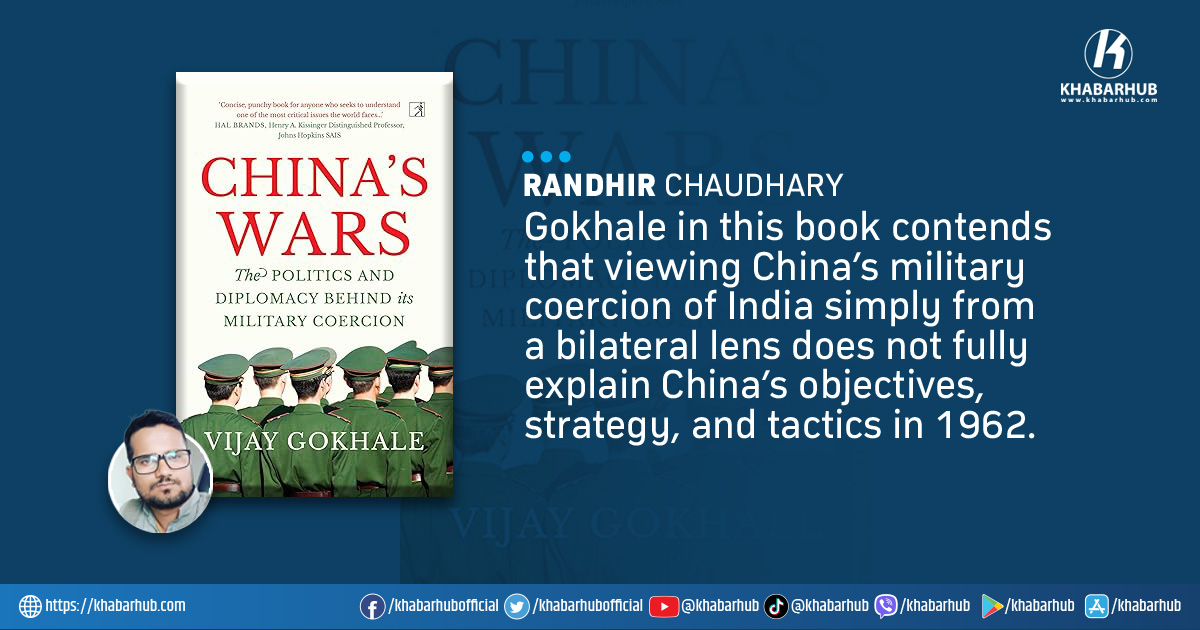
Eight decades of Chinese military conduct are examined in Vijay Gokhale’s recent book, China’s War: The Politics and Diplomacy behind Its Military Coercion. Published by Simon & Schuster, the book was released just a few weeks ago. This 174-page book has 498 footnotes, which makes it a weighty work. Gokhale, who retired from the Indian Foreign Service in 2020, has nearly four decades of experience in the service.
Through particular case studies from the 1950s to the present, this book examines the complex elements that influence China’s decisions to employ force by exploring its politics, diplomacy, and military thinking, as well as the instruments it utilizes to create positive narratives. Why would China instigate a conflict or exercise coercion? When and in what situations does China initiate hostilities?
These two important questions are the focus of this book. In order to illustrate China’s geopolitical interests in war, four conflicts in which China had a direct role are presented as case studies.
The four chapters of this book are based on those wars: the Taiwan Strait Crisis of 1958, in which the US was involved; the Sino-Indian War of 1962; the Sino-Soviet Border Conflict of 1969; and the Sino-Vietnam War; as well as the PRC’s subsequent military coercion of the Philippines and Taiwan following the end of the Cold War. “Conflict in the grey zone” is discussed in the fifth chapter, and some lessons for India are incorporated in the sixth chapter.
Cases of victimhood
President Chiang Kai-shek had never given up his right to militarily retake the mainland after being forced to relocate to the island of Taiwan in 1949, and his presence in Taiwan continued to pose a threat to Beijing’s new regime. One of the PRC’s goals in instigating the Taiwan Strait Crisis was to crush Taiwanese aspirations to retake the mainland. The Beijing leadership continued to feel threatened by his presence in Taiwan.
Grey-zone conflict can be described in a number of ways, from the deployment of military force that falls short of a full-scale battle to the application of pressure through diplomatic and economic means that are entirely non-military.
The ideal scenario, in Mao’s opinion, would have been for the Taiwanese to launch a military operation that would allow China to execute its plan under the pretext that it was merely a counterattack. However, the Taiwanese did not provide the PRC with such a pretext; instead, Mao Zedong gave the order to bombard Jinmen directly to the defense minister. Following the bombardment, Chinese official media accused the US and Taiwanese President Chiang Kai-shek of inciting tensions in the Taiwan Strait and said the PRC was forced to launch a counterattack.
However, the Taiwanese did not provide the PRC with any such justification. Zhou Enlai acknowledged that Mao seems to have used the Taiwan Strait Crisis and military coercion to suppress domestic opposition to his program and solidify his supreme position of power.
Similarly, China was experiencing economic hardship by 1959, and it was evident that Mao’s “Great Leap Forward” to quickly industrialize the PRC through the communalization of industry and agriculture had failed. Mao’s political rivals, particularly Defense Minister Peng Dehuai, had questioned his policy; despite Peng’s dismissal from the government, Mao’s authority gradually waned throughout 1960 and 1961.
Others like Deng Xiaoping and Liu Shaoqi took up the task of redressing the situation by reversing Mao’s policy, which included reducing tensions and reconciliation with India. India was significant not only because of its proximity to Tibet but also because of its relationships with the two superpowers.
Gokhale in this book contends that viewing China’s military coercion of India simply from a bilateral lens does not fully explain China’s objectives, strategy, and tactics in 1962.
Likewise, in 1967–1968, as a result of Mao’s “Proletarian Cultural Revolution,” which he had started in August 1966 as a means of regaining political dominance following the failure of his “Great Leap Forward” economic program in the early 1960s.
By mid-1967, the Cultural Revolution had devolved into a full-scale civil war that resulted in widespread disruption of economic activity and law and order, leading to hand-to-hand fighting between “revolutionary” groups in several cities.
Mao believed that the pretext of a serious external threat posed by a border conflict with the Soviet Union might be useful on the eve of the Chinese Communist Party’s Ninth Congress, which was scheduled for April 1969. As stated in the book, one historian claims that the dramatization of international events for domestic purposes is a “time-honored” tactic used by the Chinese.
Mao believed it would stop public unrest and bring the Communist Party back under his control. On the eve of the party convention, he believed that the pretext of a serious external threat provided by a border conflict with the Soviet Union might be useful. As a result, a significant armed conflict between Soviet and Chinese border guards broke out on March 2, 1969.
In order to maintain his legacy, Mao selected the lightweight Hua Guofeng as his successor prior to his death in September 1976. Hua was confirmed as China’s supreme leader by the Eleventh Party Congress in August 1977.
In 1978, as the Vietnam crisis worsened, Deng and Hua were engaged in a political struggle for supremacy under their respective leaderships, and it suited Deng to have an external “threat” to rally the Communist Party behind his cause, just as Mao had done.
A military victory against Vietnam could consolidate his position within the party and with the PLA and allow him free rein to pursue new policies. Consolidating Deng’s hold on power in China was one of the many reasons China invaded Vietnam militarily.
In the guise of Grey-Zone
Since the mid-1990s, the Chinese have pursued long-term grey-zone coercion against the Philippines, Vietnam, and Malaysia in order to gain precedence over other claimants in the South China Sea. Deng prioritized diplomacy over military action in his foreign policy.
In order to create long-term plans to deal with future Chinese grey-zone coercion, India must effectively utilize the extensive military and diplomatic expertise it has gathered from dealing with China.
He restored ties with the Soviet Union, strengthened connections with Southeast Asia and India, and normalized relations with the US and Japan. Grey-zone conflict can be described in a number of ways, from the deployment of military force that falls short of a full-scale battle to the application of pressure through diplomatic and economic means that are entirely non-military.
Under the grey-zone policy, China may argue that it will not strike its adversaries first militarily. However, when in 2022 the Speaker of the US House of Representatives, Nancy Pelosi, visited Taipei, China imposed six exclusion zones around Taiwan, some overlapping with Taiwan’s territorial waters, where it carried out military exercises signaling that it had the capability to enforce a blockade. In this way, the PLA’s activities set many new grey-zone coercion benchmarks.
Manipulation of the term “defense”
In India’s instance, the PRC uses a different version of the same strategy called “fight-and-talk.” Since 2013, the PRC has typically used this strategy in all grey-zone coercion with India. China started a grey-zone dispute in each case—from Depsang (2013) to Galwan (2020).
Pre-emption is a component of China’s concept of deterrence; such coercive tactics are essentially preemptive rather than defensive. China justifies coercion and the display of military might by using the word “defense.”
India must develop plans and tactics to cope with each of these in order to deal with China in the future. India is one of the few nations that has had direct experience with grey-zone coercion for at least ten years. In order to create long-term plans to deal with future Chinese grey-zone coercion, India must effectively utilize the extensive military and diplomatic expertise it has gathered from dealing with China.


Comment