




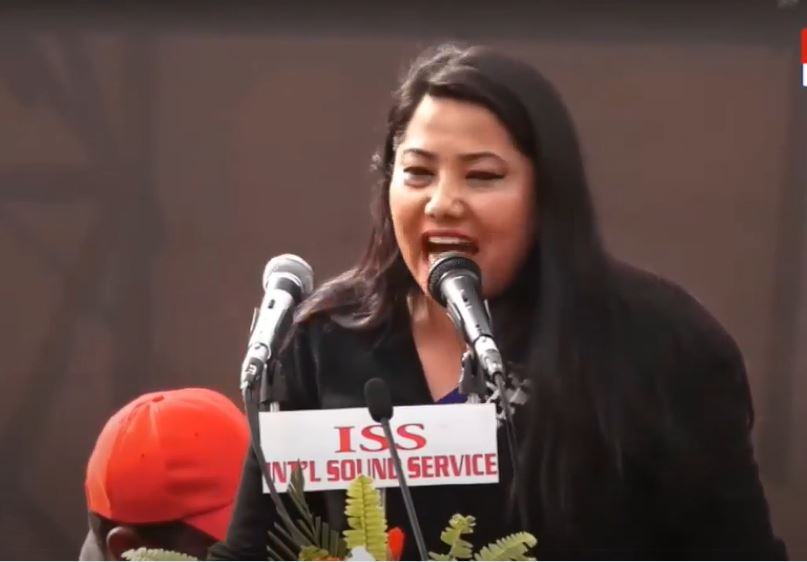
KATHMANDU: As political parties intensify their election campaigns across the country, CPN-UML leader Ram Kumari Jhakri has come under criticism for a series of controversial remarks that have sparked debate within political circles.
At a time when leaders are focusing on consolidating their voter base, Jhakri’s statements targeting political opponents and independent figures have drawn attention on social media and among party supporters.
During a recent public program, Jhakri made comments about former minister and social entrepreneur Mahabir Pun, who runs the National Innovation Center. Referring to Pun in a critical tone, she questioned his activities and used remarks that many observers described as inappropriate.
A video clip of her speech has since gone viral on social media, prompting criticism from various quarters. While responding to the controversy, Pun issued a measured reaction, urging his supporters not to engage in abusive exchanges.
Jhakri also targeted Balen Shah, the Mayor of Kathmandu Metropolitan City, questioning his suitability for higher executive office. She described him as an “average engineer” and rapper, arguing that holding a mayoral position does not automatically qualify someone to become a prime ministerial candidate.
Publicly available information shows that Shah completed his master’s degree in structural engineering in India. Despite Jhakri’s remarks, Shah remains popular among urban youth and sections of the electorate.
Her statements have fueled fresh debates about political discourse and the tone of election campaigning.
In addition, Jhakri made remarks targeting candidates of the Rastriya Swatantra Party, suggesting that some individuals who could not succeed abroad had returned to Nepal to enter politics. The comments have been interpreted by critics as dismissive of new political entrants and diaspora returnees.
The Rastriya Swatantra Party has emerged as a significant political force in recent elections, positioning itself as an alternative to traditional parties.
Jhakri has previously made strong comments against CPN-UML Chair KP Sharma Oli, particularly following the split of the then Nepal Communist Party (NCP). During internal party disputes, she had criticized Oli in personal terms, referencing his early life struggles and the honorary doctorates he received from foreign universities.
Her past statements had also triggered controversy within party ranks at the time.
Observers say the series of remarks highlights the increasingly confrontational tone of political campaigning in Nepal. Critics argue that personal attacks and derogatory language could alienate voters, while supporters maintain that political leaders have the right to critique opponents.
With elections approaching, parties are seeking to expand their support base. Whether such rhetoric will influence voter sentiment remains to be seen.



Comment