




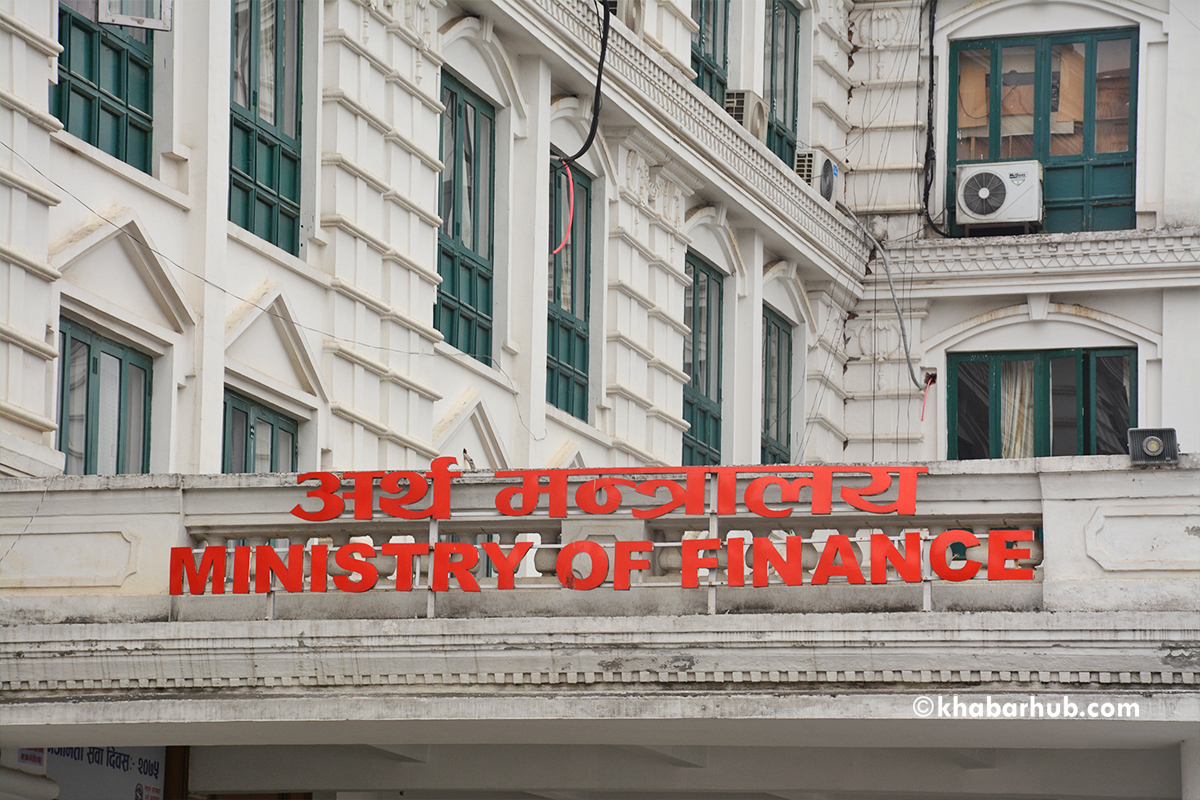
KATHMANDU: Nepal’s economy grew by 3.85 percent in fiscal year 2082/83 BS, while government capital expenditure fell to its lowest level in five years, according to the Ministry of Finance’s annual economic bulletin.
The country’s gross domestic product (GDP) reached Rs. 66 kharba during the review period. However, economic growth slowed from 4.43 percent in fiscal year 2081/82 BS and remained below the 10-year average of 4.53 percent.
Consumer price inflation eased to an annual average of 3.07 percent, down from 4.06 percent in the previous fiscal year. Inflation in the food and beverage category averaged 1.04 percent, while prices of non-food goods and services rose by 4.21 percent. Average annual wholesale inflation stood at 4.27 percent.
Remittance inflows recorded substantial growth, increasing by 37.1 percent to Rs. 23 kharba 63 arba. Remittances accounted for 35.8 percent of GDP during the review year.
The country’s foreign exchange reserves also increased significantly, rising by 45.6 percent to Rs. 38 kharba 98 arba, equivalent to 59.1 percent of GDP. According to the bulletin, per capita GDP reached US$1,513, while per capita gross national disposable income stood at US$2,044.
External sector maintains surplus
Nepal’s external sector remained in surplus during fiscal year 2082/83. The current account registered a surplus of Rs. 9 kharba 23 arba 60 crore, equivalent to 13.99 percent of GDP. Similarly, the balance of payments recorded a surplus of Rs. 10 kharba 27 arba.
Merchandise exports totalled Rs. 3 kharba 15 arba, while imports amounted to Rs. 20 kharba 96 arba. The substantial gap between imports and exports resulted in a merchandise trade deficit of Rs. 17 kharba 81 arba.
Government revenue rises as expenditure increases
The federal government collected Rs. 12 kharba 41 arba 33 crore in revenue during fiscal year 2025/26, representing a 5.21 percent increase compared with the previous fiscal year. Total federal government expenditure reached Rs. 15 kharba 61 arba 42 crore, up 3.18 percent year-on-year.
Of the total expenditure, recurrent spending accounted for Rs. 10 kharba 15 arba 69 crore, while capital expenditure amounted to Rs. 1 kharba 91 arba 88 crore. Expenditure on financial management stood at Rs. 3 kharba 53 arba 85 crore.
Despite the increase in overall spending, capital budget implementation remained particularly weak, raising concerns about the government’s ability to execute development projects and deliver infrastructure improvements.
Capital budget utilization falls to five-year low
The government spent only 47.04 percent of its allocated capital budget in fiscal year 2025/26, marking the lowest utilization rate in the past five fiscal years.
Overall budget expenditure reached 79.50 percent of the total allocation. By comparison, capital budget utilization averaged 58.5 percent over the preceding five fiscal years, highlighting the significant decline in development spending.
The low utilization rate reflects persistent challenges in implementing infrastructure and development projects, as well as difficulties in translating budget allocations into actual investment and economic activity.
Public debt rises to 45.18 percent of GDP
Nepal’s outstanding net public debt reached Rs. 29 kharba 81 arba 70 crore, equivalent to 45.18 percent of GDP. Domestic debt accounted for Rs. 13 kharba 75 arba 42 crore, while external debt stood at Rs. 16 kharba 6 arba 29 crore. The public debt-to-GDP ratio increased from 43.13 percent in the previous fiscal year, indicating a growing debt burden relative to the size of the economy.
Budget deficit narrows
Nepal’s budget deficit declined to Rs. 3 kharba 20 arba 9 crore in fiscal year 2025/26, equivalent to 4.85 percent of GDP. In the previous fiscal year, the deficit stood at Rs. 3 kharba 33 arba 43 crore, or 5.38 percent of GDP.
Although the deficit narrowed in both absolute terms and as a share of GDP, slower economic growth, weak capital expenditure and a rising public debt ratio continue to pose challenges for Nepal’s fiscal management.
The figures point to a mixed economic performance: remittance inflows and foreign exchange reserves strengthened, inflation eased and external balances remained positive. However, slower growth and persistently low capital spending underscore the need to improve public investment and the implementation of development projects.



Comment