




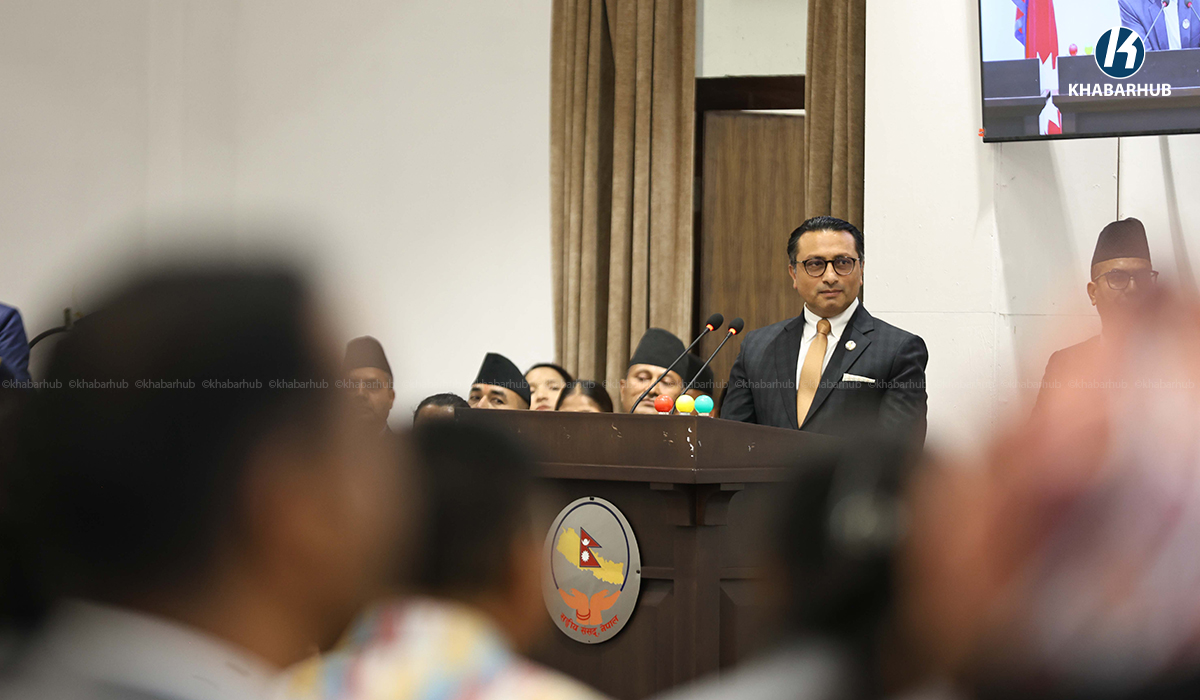
KATHMANDU: Finance Minister Swarnim Wagle has outlined the government’s major priorities for the upcoming fiscal year 2026/27, placing digital transformation, structural economic reforms and employment-oriented growth at the center of the national budget framework.
Presenting the principles and priorities of the Appropriation Bill in separate meetings of both houses of the Federal Parliament on Thursday, Wagle said the government aims to build a new foundation for economic development through extensive use of information technology and institutional reforms.
The proposed budget priorities focus on strengthening federal governance, modernizing public administration, promoting productive sectors and accelerating infrastructure development.
Digital governance and institutional reform
The government plans to introduce a “single-window, time-bound and digital” administrative system by reviewing laws related to investment, financial services and public service delivery.
According to Wagle, all processes ranging from business registration and tax administration to payments and regulatory approvals will gradually be integrated into digital platforms.
The government also intends to implement a unified database linked to the national identity card under the principle of “one-time data submission for all services.” Public services including citizenship, health, education, banking, social security and land administration will be made accessible through integrated digital platforms and the Nagarik App.
Artificial intelligence, digital technology and data-driven governance will also be prioritized in public administration reforms.
Economic restructuring and production-focused growth
The government said limited public resources and private investment will be redirected toward high-return and employment-generating sectors including agriculture, tourism, energy, information technology and services.
Wagle said Nepal’s import-driven economy would gradually be transformed into a production-based and export-oriented competitive economy.
The budget priorities include promoting commercial agriculture, improving irrigation, storage and processing infrastructure, and connecting farmers with finance, insurance, markets and technology through cooperatives and producer companies.
The government also plans to promote forest-based industries, carbon trading, medicinal herb processing and climate-resilient agricultural systems.
Nepal as a regional tech hub
The government has announced plans to transform Nepal into a “weightless high-value economy” by promoting software exports, cloud services, AI computation, cybersecurity and digital services.
Policies supporting remote work, digital nomads and international digital payment systems are also expected to be introduced.
The “Startup Nepal” initiative and national innovation programmes will be integrated into a broader entrepreneurship and innovation framework.
Infrastructure and investment mobilization
The budget will prioritize the completion of long-delayed national pride and high-return projects rather than launching new schemes.
Key priorities include accelerating hydropower generation and transmission projects, expanding regional energy trade and improving strategic road networks such as the Pushpalal Highway, Postal Highway and Kathmandu-Tarai/Madhes Fast Track.
The government also plans to expand digital public infrastructure including data centers, G-cloud systems, high-speed internet and cybersecurity infrastructure.
Alternative financing mechanisms such as infrastructure bonds, green bonds, diaspora investment and public-private partnerships will be promoted to mobilize long-term capital.
Education, health and social investment
The government has pledged to reform the education sector by reducing political interference, improving quality and aligning education with labor market needs.
A separate National Research and Innovation Fund will be established to finance research in science, technology, agriculture, health, energy and artificial intelligence.
In health, the government plans to strengthen basic healthcare systems, expand rural health access and reform health insurance and social protection programmes.
Mental health, telehealth services and care for elderly citizens and people with disabilities have also been included among the priorities.
Foreign policy and diaspora engagement
The government said Nepal’s foreign policy would focus on protecting national interests while promoting economic diplomacy, foreign investment, tourism, energy trade and technology transfer.
It also plans to strengthen engagement with the Nepali diaspora by encouraging investment, innovation and knowledge-sharing through legal and institutional reforms.
According to Wagle, the upcoming budget aims to address current economic challenges while laying the foundation for sustainable and employment-centered economic growth.
He said the budget would focus on restoring private sector confidence, improving governance and delivering technology-friendly public services to improve citizens’ quality of life.



Comment