




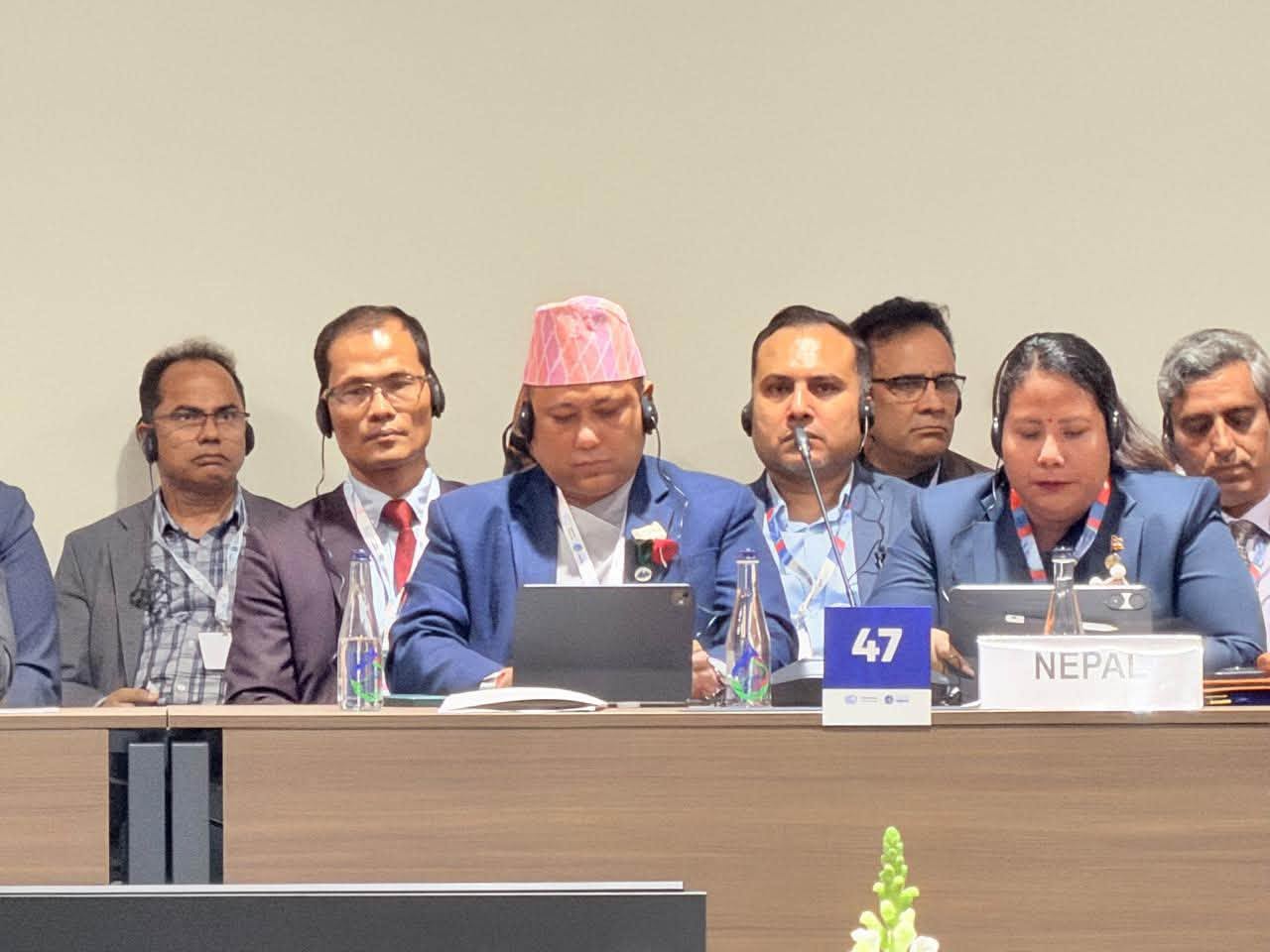
KATHMANDU: Minister for Foreign Affairs Shisir Khanal returned home today after participating in the 31st Conference of the Parties (COP-31) to the United Nations Framework Convention on Climate Change (UNFCCC).
According to a press statement issued by the Ministry of Foreign Affairs, Minister Khanal had left for Antalya, Türkiye, last week following a decision of the Council of Ministers. Minister for Agriculture, Forests and Environment Geeta Chaudhary will lead the Nepali delegation at the conference.
The ministry described COP-31 as one of the world’s major multilateral forums for developing common policies, commitments and strategies to address the challenges and impacts of climate change.
The conference has focused on limiting global temperature rise to 1.5 degrees Celsius, achieving net-zero carbon emissions by 2050, and strengthening the adaptive capacity and resilience of countries and communities vulnerable to climate change.
Held annually since 1995, the conference provides an important platform for collective global climate action, bringing together heads of state and government, negotiators, scientists, private-sector representatives, youth and civil society organisations.
During the conference, the Nepali delegation called for ambitious emission reductions in line with the 1.5-degree Celsius target and predictable, accessible and grant-based climate finance rather than loans to support adaptation, resilient infrastructure and sustainable livelihoods. It also stressed the need for effective loss and damage arrangements to ensure prompt, direct and equitable financial support for vulnerable mountain communities.
The delegation highlighted the importance of strengthening scientific research and establishing multi-hazard early warning systems through high-altitude glacier monitoring, satellite observation networks and regional data sharing. It also called for greater political recognition of mountain-specific climate risks within the UNFCCC process, stronger partnerships between mountain and coastal communities under the ‘Sagarmatha to the Sea’ initiative, and support for the proposed UN Decade for Mountain Resilience.
Addressing the conference’s opening plenary on November 9, Minister Khanal drew the international community’s attention to the recent devastating disasters in Nepal and their severe impacts on people’s lives, livelihoods, physical infrastructure and ecosystems.
He also stressed the need to establish a dedicated ‘Mountain and Climate Change’ Work Programme under COP-31, incorporating mountain-specific indicators into the Global Goal on Adaptation and the new collective quantified climate finance target.
Minister Khanal and Minister Chaudhary also participated in the Antalya Summit on November 11. Addressing a high-level event on ‘Early Warning Systems for All’ the same day, Khanal emphasised that effective early warning systems are essential to protecting the lives of mountain communities.
He highlighted the need for systematic data collection, satellite-based monitoring, snow and ice surveillance, and the dissemination of early warnings in local languages in high-altitude regions.
On November 12, addressing a high-level event on ‘Promoting the Mountain Agenda’, jointly organised by Nepal, Bhutan, Kyrgyzstan, Pakistan and Tajikistan, Khanal said that a crisis in mountain regions poses risks to humanity as a whole.
Calling for mountain issues to be incorporated into mainstream global climate negotiations, he stressed the need for substantial emission reductions, grant-based climate finance, timely and equitable support for loss and damage, and scientific monitoring of glaciers.
During the summit, Nepal, in collaboration with Bhutan, Kyrgyzstan and international partners, including the International Centre for Integrated Mountain Development (ICIMOD) and the Zoï Environment Network, also organised a high-level event on adaptation finance for mountain resilience.
At the event, Khanal briefed participants on the human, physical and economic losses caused by recent devastating floods in Nepal. He underscored the need for adequate and easily accessible adaptation finance to strengthen resilience in mountain regions.
He also addressed an event at the Nepal Pavilion on sharing experiences of transboundary climate-induced disasters and regional cooperation mechanisms in the Hindu Kush-Himalayan region. He emphasised that addressing shared climate challenges requires regional cooperation, technology transfer, knowledge and experience sharing, and partnerships among multiple stakeholders.
On November 13, addressing a session on the climate finance needs of Small Island Developing States (SIDS) and Least Developed Countries (LDCs), Khanal reiterated the need for climate finance that is accessible, predictable, easily obtainable and grant-based. He stressed that such support is essential for climate-vulnerable countries and the conservation of high-altitude Himalayan ecosystems.
Minister Khanal inaugurated the Nepal Pavilion at the conference venue on November 9. According to the ministry, the pavilion provided a platform to showcase Nepal’s climate ambitions, achievements in biodiversity conservation and community-based climate adaptation initiatives to the international community.
During the conference, Khanal also held separate meetings with UN Secretary-General António Guterres, Ethiopian Foreign Minister Gedion Timothewos and Finland’s Minister for Foreign Trade and Development Ville Tavio. The meetings covered various issues of mutual interest.
He also participated in a joint meeting with the UN Secretary-General alongside a ministerial-level delegation representing the Least Developed Countries.
According to the Ministry of Foreign Affairs, Nepal’s participation in COP-31 helped highlight the distinctive challenges faced by mountainous countries due to climate change and bring their concerns to the attention of the international community.
The ministry said Nepal presented its positions on several key issues, including a dedicated work programme on mountains and climate change, equitable access to climate finance, effective mechanisms to address loss and damage, scientific monitoring of the Himalayan region, technology transfer, capacity building, early warning systems and regional cooperation.





Comment