




For almost four decades, Nepal has experienced repeated political transformations without a corresponding consolidation of effective governance. The restoration of multiparty democracy in 1990 ended the Panchayat system and established competitive politics, initially dominated by the Nepali Congress (NC), the Nepal Communist Party (Marxist-Leninist) (UML), and the Rastriya Prajatantra Party (RPP), which was formed by former Panchayat-era politicians.
The subsequent decades brought constitutional change, the Maoist insurgency, the Comprehensive Peace Agreement (CPA), the abolition of the monarchy, federalism, republicanism, secularism, and the inclusion of new political forces.
Yet political transformation did not produce comparable institutional consolidation. Governments changed frequently, factionalism deepened, political patronage expanded, and the state remained vulnerable to clientelist networks.
The central problem, therefore, was not a lack of political change. It was the failure to convert political change into state capacity.
That distinction is essential to understanding Nepal’s present moment. The September 2025 Gen Z uprising and the March 2026 election disrupted a political cycle that had persisted for decades. But the rise of a new political force is not, by itself, national resurgence. The strategic test is whether Nepal can transform political renewal into institutional credibility, economic capacity, social cohesion, and strategic stability.
From Political Transformation to Institutional Weakness
The Maoist insurgency, launched in 1996, just six years after the restoration of democratic order, with the stated objective of establishing a proletarian republic, exposed the complexity of Nepal’s political turning point. The conflict ended with the Comprehensive Peace Agreement (CPA) of November 21, 2006, bringing the armed Maoists into the democratic mainstream. The subsequent political settlement transformed Nepal from a constitutional monarchy into a federal democratic republic and secular state, while the Madhesh movements brought questions of representation, inclusion, and federal restructuring to the centre of national politics and governance.
The open border with India remains an important economic, social, and civilizational asset. However, its traditional reliance on trust and informal movement must increasingly be complemented by twenty-first-century governance.
These were profound constitutional and political changes. The 2015 Constitution institutionalized federalism, republicanism, and secularism. Yet the post-2006 transition produced a critical contradiction: Nepal changed the architecture of the state faster than it strengthened the state’s capacity.
The new political order expanded representation and redistributed political power, but it also intensified competition for control over public institutions and state resources. Coalition governments, frequent changes in leadership, and party patronage increasingly politicized appointments and weakened institutional autonomy. Political access and the financing of political parties and prominent leaders became important pathways to economic opportunity, public contracts, and administrative influence. Over time, corruption came to be perceived not simply as individual misconduct but as a systemic problem linked to political networks and weak institutional accountability.
These were profound political achievements, but they produced a critical contradiction: political transition without institutional consolidation led to politicization and patronage, which weakened institutional autonomy and, in turn, public confidence in the state.
This became the first structural weakness of the post-2006 order.
The Economic Consequence: An Economy of Survival
Political transformation was not matched by a comparable transformation in productive capacity. Industrialization remained weak. Manufacturing failed to become a major source of employment. Agriculture continued to suffer from low productivity, fragmented landholdings, and limited commercialization.
The privatization of several state-owned enterprises beginning in the late 1990s did not generate a sustained industrial take-off, while political uncertainty, inadequate infrastructure, regulatory weaknesses, and limited investment constrained private-sector growth.
The result was insufficient domestic employment and opportunity. The causal chain was clear: weak institutions led to policy uncertainty, which discouraged productive investment and limited domestic employment opportunities.
The demographic consequences were profound. Migration consequently became Nepal’s economic safety valve. Unable to generate sufficient productive employment at home, Nepal increasingly relied on foreign employment. Between FY 2008/09 and FY 2023/24, the government issued approximately 5.7 million labour approvals for foreign employment. Remittances subsequently became one of the foundations of the national economy, reaching roughly 25 percent of GDP by FY 2023/24.
Migration reduced household poverty and generated essential foreign exchange. Remittances supported consumption and helped stabilize the economy. But they also concealed a deeper structural weakness: the inability of the domestic economy to generate sufficient productive employment.
Nepal increasingly developed a model in which young people left the country, remittances flowed in, consumption increased, imports expanded, and domestic productive transformation remained weak. This model was economically stabilizing but structurally limiting.
The third link in the causal chain was therefore clear: weak domestic opportunities led to labour migration, which increased remittance dependence and allowed the postponement of structural economic reform.
The social consequences accumulated gradually. A generation came of age in a republic that promised inclusion, federalism, opportunity, and a more accountable state but experienced a very different reality: political instability, perceived corruption, weak public services, limited employment opportunities, and the normalization of migration as the principal route to economic advancement.
The challenge is not migration itself. The challenge is an economy in which migration becomes the principal route to opportunity for an entire generation.
The Demographic and Governance Challenge
A further vulnerability is emerging from the interaction between out-migration, immigration, identity, and an inadequately managed open border. Nepal is simultaneously losing a large share of its working-age population to foreign employment while receiving cross-border workers and migrants whose scale and composition are not adequately captured by existing systems.
The 2021 Census recorded 713,973 India-born residents, of whom 84.6 percent reported Nepali nationality and 15.4 percent Indian nationality. Because the open India–Nepal border permits extensive daily movement, however, census data alone cannot measure the scale of short-term or undocumented mobility.
The strategic concern is therefore not legitimate Indian labour migration. It is the absence of sufficiently integrated systems for border management, labour registration, identity verification, and population data.
This becomes more consequential in light of documented cases of fraudulent acquisition of Nepali citizenship. For example, police investigations in 2024 uncovered a case in which a Tibetan national allegedly obtained Nepali citizenship using false identity documents. Nepal also hosts nearly 20,000 registered refugees and people requiring international protection, including long-standing Tibetan and Bhutanese populations, alongside smaller refugee and asylum-seeking communities.
At the same time, Nepal’s religious composition is evolving. The 2021 Census recorded Hindus as 81.2 percent of the population, Buddhists as 8.2 percent, Muslims as 5.1 percent, and Christians as 1.8 percent. Religious diversification itself is not a security problem and should not be treated as one. The strategic concern arises when unregulated migration, identity fraud, undocumented settlement, foreign financing, trafficking, or political mobilization exploits social, religious, or citizenship-related vulnerabilities.
Climate-induced disasters add another dimension. Nepal’s vulnerability to floods, landslides, glacial risks, and other climate-related hazards is no longer merely an environmental concern. It is increasingly a question of national security and development resilience.
The open border with India remains an important economic, social, and civilizational asset. However, its traditional reliance on trust and informal movement must increasingly be complemented by twenty-first-century governance.
Nepal therefore needs to move from an open but lightly governed border to an open but intelligently managed border, preserving mobility while strengthening identity verification, labour records, citizenship integrity, refugee management, intelligence cooperation, and local demographic monitoring. The objective should not be to securitize society but to ensure that demographic change remains manageable, lawful, and socially cohesive rather than becoming a source of strategic vulnerability.
The Legitimacy Gap and the Rise of Gen Z
The social consequences of these structural weaknesses accumulated gradually. For the generation that grew up after the conflict, the political achievements of the peace process and constitutional transformation were historical facts rather than personal experiences. Their expectations were defined less by the political struggles of the 1990s and 2000s and more by contemporary standards of governance: Can the state create jobs? Can institutions function without political connections? Can corruption be punished? Can public services operate effectively? Can young people build a future in Nepal?
By 2025, the accumulated gap between political promises and lived experience had become a structural source of instability.
The September 2025 Gen Z uprising therefore represented more than opposition to a particular government decision. The government’s attempted restriction of major social media platforms was the immediate trigger, but the protests rapidly expanded into a broader rejection of corruption, political privilege, impunity, and a political system perceived as disconnected from the aspirations of younger citizens.
The deeper causal chain had come full circle: post-2006 political transformation led to institutional politicization and patronage, which contributed to weak economic transformation, insufficient domestic opportunities, mass labour migration and remittance dependence, generational frustration, and, ultimately, political rupture in 2025.
From Political Rupture to Democratic Mandate
The March 2026 election transformed that rupture into a democratic mandate, with the RSP emerging as the dominant parliamentary force under Prime Minister Balendra Shah.
The significance of the 2025–26 transition lies not simply in a generational protest or the replacement of established political forces by a new party. Rather, a new political constituency appears to be demanding a different relationship between the state, the economy, and citizens.
The central question for the Balen administration is whether it can break the causal chain that produced the crisis.
That requires moving from patronage to merit; from politicized institutions to institutional autonomy; from corruption to accountability; from labour export to domestic opportunity; from remittance dependence to productive investment; from consumption-led growth to industrial and agricultural transformation; and from political legitimacy to durable state capacity.
This is where Nepal’s present political moment becomes a strategic moment. If the government succeeds, the 2025 rupture could mark the beginning of Nepal’s transition from political restructuring to institutional and economic transformation. If it fails, Nepal risks repeating its historical pattern: each political rupture produces a new political settlement without resolving the structural weaknesses beneath it.
The contemporary challenge is fundamentally similar to those of earlier periods, although the environment is far more complex. Nepal now sits between two major powers, China and India, while the United States and other external actors increasingly shape the country’s development, technology, security, and connectivity choices. At the same time, Nepal faces internal vulnerabilities, including political resistance, institutional weakness, social polarization, unmanaged migration, border-governance challenges, economic dependence, and climate-induced disasters.
Nepal’s resurgence, therefore, cannot be reduced to the rise of a new political party. It must become a national project: the transformation of political renewal into strategic stability and of strategic stability into national resurgence.
Strategic Stability: The Missing Link
Nepal’s challenge is broader than political reform. A state cannot exercise meaningful strategic autonomy if its institutions lack credibility, its economy lacks productive capacity, its society is vulnerable to polarization, its borders are inadequately governed, and its critical infrastructure is vulnerable to predictable shocks.
Connectivity must create economic capacity, not political vulnerability. The strategic progression should be from geography to connectivity, from connectivity to economic capacity, from economic capacity to strategic choices, and from strategic choices to strategic autonomy.
Strategic stability must consequently begin at home. It requires institutional credibility so that governments can change without destabilizing the state; social cohesion so that diversity does not become fragmentation; economic capacity so that citizens have opportunities beyond migration; and national resilience so that disasters and external shocks do not repeatedly overwhelm state capacity.
Climate-induced disasters add another dimension. Nepal’s vulnerability to floods, landslides, glacial risks, and other climate-related hazards is no longer merely an environmental concern. It is increasingly a question of national security and development resilience.
The strategic principle should be simple: anticipate before reacting, coordinate before improvising, build for tomorrow rather than yesterday, prepare locally and act nationally, and learn from every crisis.
Resilience is not an expenditure that competes with development. It is an investment in the state’s ability to protect people, infrastructure, and economic capacity.
From Buffer State to Strategic Bridge
Nepal’s internal transformation must also be matched by a more confident external strategy.
The country sits between two major economic and strategic powers, China and India, while the United States and other external partners increasingly shape Nepal’s development, technology, investment, security, and connectivity choices.
For decades, Nepal’s geopolitical discourse has often been framed in terms of vulnerability: how to survive between larger powers. That perspective is increasingly inadequate.
The strategic objective should be to move from a buffer state to a strategic bridge. This does not mean choosing between India and China, nor does it mean pursuing artificial equidistance. Nepal’s interests require a more sophisticated approach based on active non-alignment, diversified partnerships, and strategic autonomy.
India remains an indispensable partner in trade, connectivity, energy, and people-to-people relations. China is a strategic imperative because of geography, connectivity, infrastructure, and its growing global role. The United States and other middle powers and external partners can contribute technology, investment, development finance, education, and institutional capacity.
The objective is not to align with one power against another. It is to engage with all without becoming dependent on any.
Every major external initiative should therefore be assessed against clear national criteria: economic viability, transparency, debt sustainability, strategic consequences, and long-term national interest.
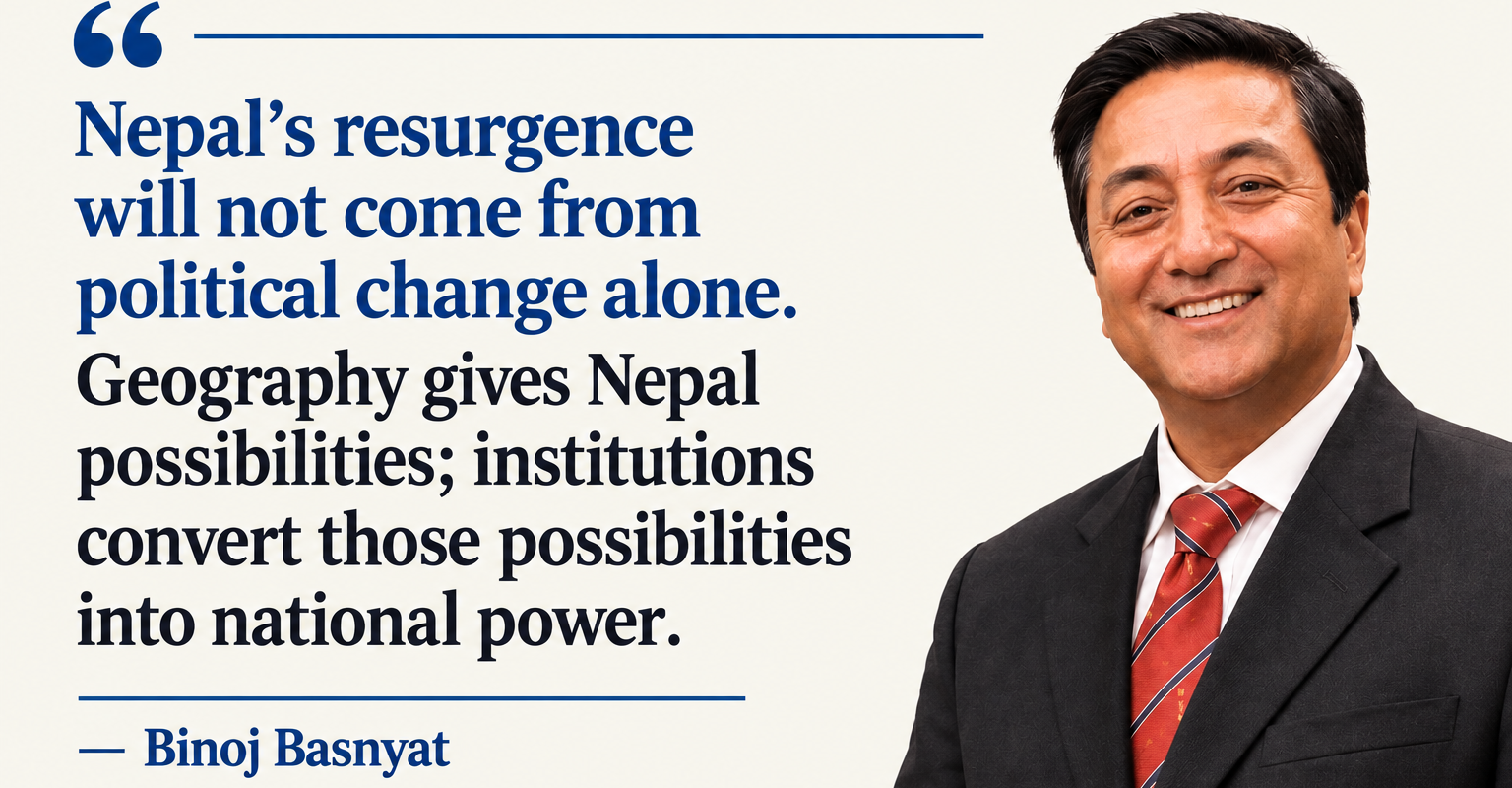
Nepal’s resurgence will not come from political change alone. Geography gives Nepal possibilities; institutions convert those possibilities into national power.
Connectivity must create economic capacity, not political vulnerability. The strategic progression should be from geography to connectivity, from connectivity to economic capacity, from economic capacity to strategic choices, and from strategic choices to strategic autonomy.
Only a Nepal with sufficient domestic capacity can convert its geography from a constraint into an asset.
The National Resurgence Test
Nepal’s 2025 uprising and 2026 election have opened a new political chapter. But political renewal is not national transformation.
The real test is whether Nepal can convert electoral legitimacy into institutional credibility, institutional credibility into national capacity, and national capacity into strategic autonomy.
That requires a professional state whose institutions outlast governments; an economy that creates opportunities rather than merely exporting labour; a society capable of managing diversity without fragmentation; borders that remain open but are intelligently governed; and a national resilience architecture capable of anticipating crises rather than merely responding to them.
Externally, Nepal must pursue active non-alignment, diversified partnerships, and issue-based cooperation while avoiding strategic dependence.
The country’s strategic challenge can ultimately be reduced to five questions: Can Nepal absorb political competition without institutional breakdown? Can it manage diversity without social fragmentation? Can it remain open without governance deficits? Can it benefit from interdependence without strategic dependence? Can it navigate geopolitical competition without strategic entrapment?
The answers will determine whether the present political moment becomes another transition or the beginning of national transformation.
Nepal’s resurgence will not come from political change alone. Geography gives Nepal possibilities; institutions convert those possibilities into national power. The task before the country is to transform political renewal into institutional credibility, institutional credibility into national capacity, national capacity into strategic autonomy, and strategic autonomy into the confidence to shape—not merely respond to—the environment around Nepal.
That is the real meaning of Nepal’s resurgence: from survival to resilience, from resilience to capacity, and from capacity to strategic agency.
(Basnyat is a retired Major General of the Nepali Army and a strategic affairs analyst focusing on international relations, geopolitics, national security, and evolving regional power dynamics. His writings examine the strategic forces shaping regional security, statecraft, foreign policy, and the changing geopolitical order.)





Comment