




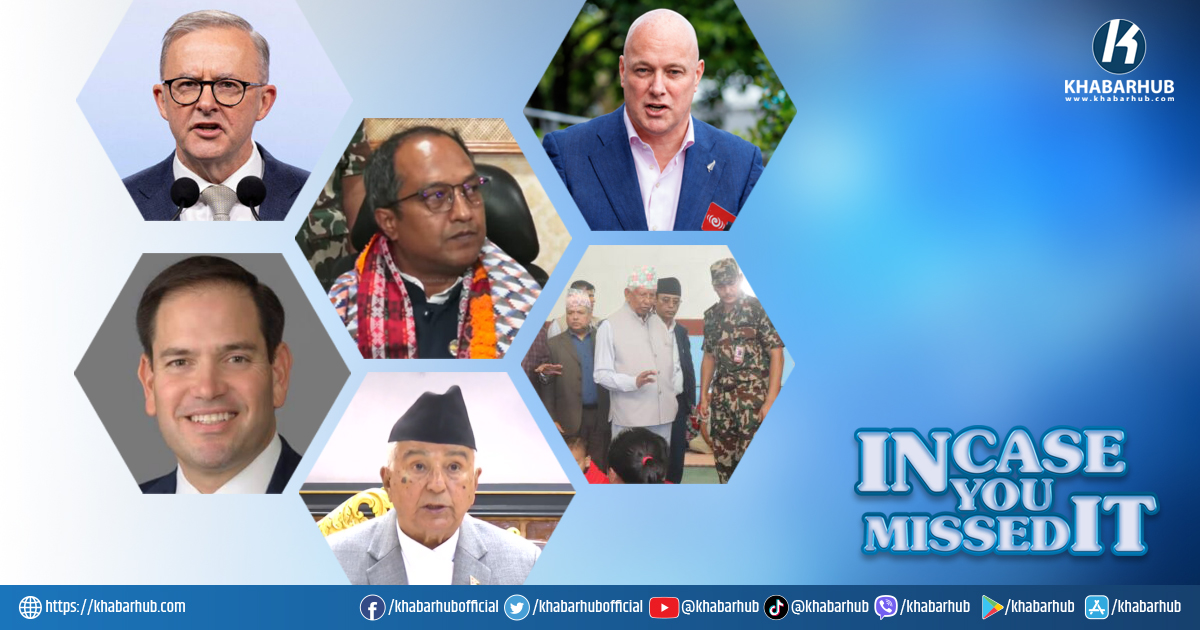
KATHMANDU: Last week was marked by the continuing aftermath of the devastating Bhotekoshi flood in Rasuwa, which emerged as the country’s most pressing humanitarian and political concern. The scale of the disaster, the prolonged search for missing people, the displacement of communities and the extensive damage to infrastructure placed enormous pressure on the government and security agencies.
At the same time, the disaster brought climate change and Nepal’s vulnerability to extreme weather events back to the centre of national and international discussions.
The week also saw important political and diplomatic developments. President Ram Chandra Paudel called for greater international attention to climate-induced disasters, while Prime Minister Balendra Shah held discussions with foreign leaders over the flood response and assistance for affected communities. The government also advanced several administrative and economic initiatives, including preparations for the prime minister’s participation in the United Nations General Assembly and renewed efforts to strengthen cooperation with the private sector.
Bhotekoshi disaster puts search and rescue at the centre of national attention
The Bhotekoshi flood remained the dominant issue throughout the week as search, rescue, identification and relief operations continued in Rasuwa and downstream districts. The disaster not only caused significant loss of life but also damaged homes, bridges, roads, hydropower projects and other essential infrastructure. Its effects extended beyond Rasuwa to areas of Nuwakot and Dhading along the Trishuli River, disrupting transportation and basic services and forcing many residents from their homes.
Taken together, last week’s events revealed several interconnected challenges facing Nepal. The Bhotekoshi disaster showed the immediate human and economic costs of extreme natural events, while the President’s call for climate justice highlighted the international dimension of Nepal’s vulnerability.
President Ram Chandra Paudel’s inspection of the flood-affected areas reflected the seriousness of the situation. During his visits to Rasuwa and Nuwakot, he received briefings on search and rescue operations, relief distribution, temporary shelters and rehabilitation efforts. His interaction with displaced residents also highlighted the growing demand for more effective relief and faster reconstruction.
The President’s message was significant because it went beyond an immediate appeal for relief. He urged authorities to continue searching for those still missing despite difficult terrain and hazardous conditions and called for food, clean drinking water, shelter, medical treatment and psychosocial support for survivors. His emphasis on special protection for children, elderly people, pregnant women and persons with disabilities underscored the need for disaster response to focus not only on rescue but also on the specific vulnerabilities of affected groups.
Climate change and the question of climate justice
The Bhotekoshi disaster also renewed the debate over Nepal’s exposure to climate-related risks. President Paudel used the occasion to call for concrete international action on climate change and greater climate justice for countries such as Nepal, which contribute relatively little to global emissions but face disproportionate consequences from climate-induced disasters.
His remarks highlighted a broader challenge for Nepal: development planning must increasingly account for extreme weather, fragile geography and changing climatic conditions. Roads, bridges, hydropower facilities and settlements built without sufficient consideration of disaster risks can become particularly vulnerable when floods, landslides and other extreme events occur.
The President’s call to reconsider Nepal’s development model was therefore one of the most important aspects of the week. The disaster demonstrated that emergency response alone cannot address the country’s growing vulnerability. Long-term investment in resilient infrastructure, early-warning systems, risk mapping, disaster preparedness and climate adaptation will be equally important.
The issue also gained an international dimension as Australia and New Zealand expressed solidarity with Nepal. Australian Prime Minister Anthony Albanese said 36 Australian citizens remained unaccounted for and conveyed condolences to the families of those affected. He also discussed the crisis with Prime Minister Shah. New Zealand Prime Minister Christopher Luxon similarly held a telephone conversation with Shah and expressed concern over the situation, while Nepal acknowledged New Zealand’s NZ$2 million humanitarian assistance.
National mourning reflects the scale of the tragedy
The government’s decision to observe a day of national mourning demonstrated the magnitude of the human loss. The national flag was flown at half-mast at government offices, as well as at Nepali diplomatic missions abroad, in memory of those killed in the disaster.
The national mourning also carried an important social message. The disaster affected not only Nepali citizens but also foreign nationals who were in Nepal for trekking, tourism or spiritual activities. The government’s assurance that search operations for missing foreign nationals would continue was therefore important for maintaining confidence among affected families and Nepal’s international partners.
The continued involvement of security agencies, local authorities, health workers, volunteers and international partners showed the broad scale of the response. At the same time, the situation exposed the difficulty of conducting search and rescue operations in mountainous terrain and highlighted the need for better coordination and disaster preparedness.
Political focus shifts towards accountability and rule of law
While the flood dominated the national agenda, political developments continued in parallel. Rastriya Swatantra Party Chair Rabi Lamichhane used the first anniversary of the Gen-Z movement to stress accountability, rule of law and the responsibility of political leaders to respond to public demands.
Lamichhane’s statement was significant in the context of Nepal’s recent political transformation. He described the Gen-Z movement as a spontaneous expression of public and particularly youth dissatisfaction rather than an initiative of a specific political party. His warning against political actors attempting to appropriate the movement reflected the continuing debate over how the aspirations expressed by young people should be translated into governance and institutional reform.
His telephone conversation with US Secretary of State Marco Rubio also demonstrated the international attention surrounding both the flood disaster and Nepal’s political environment. Rubio conveyed condolences over the flood and expressed US readiness to provide additional assistance.
The observance of Gen-Z Martyrs’ Day, accompanied by a nationwide public holiday, further connected last week’s events with the country’s recent political upheaval. The commemoration of young people who lost their lives during the 2025 movement served as a reminder that demands for political accountability, good governance and institutional change remain important elements of Nepal’s public discourse.
Govt moves forward on administration and international engagement
The government continued its administrative work despite the disaster. The appointment of Dipak Kumar Sah as Minister for Industry, Commerce and Supplies was one of the notable changes. His appointment followed the resignation of Gauri Kumari Yadav and brought a new figure into a ministry responsible for important areas of Nepal’s economy, including trade, industry and supply management.
The Cabinet also approved Prime Minister Balendra Shah’s participation in the 81st session of the United Nations General Assembly in New York from September 22 to 26. Nepal’s participation at the UN will provide an important platform to raise issues such as climate vulnerability, disaster-related loss and damage, international assistance and Nepal’s development priorities.
The government’s decision to form a negotiation team for the Nepal-India Inter-Governmental Sub-Committee meeting also indicated that bilateral economic and trade issues remained on the government’s agenda despite the domestic emergency.
Private sector cooperation emerges as an economic priority
Economic concerns were another major theme of the week, particularly the government’s attempt to improve relations with the private sector. Prime Minister Shah held discussions with leading entrepreneurs and business representatives at Singha Durbar and pledged to create a more favourable environment for investment and business expansion.
The discussion highlighted a number of longstanding concerns facing Nepal’s private sector, including policy uncertainty, legal barriers and the treatment of businesspeople facing allegations. Business leaders argued that domestic entrepreneurs should receive greater priority in investment opportunities and stressed their capacity to participate in large-scale infrastructure development.
The proposal to hold discussions with the private sector every three months at the Prime Minister’s Office could prove important if it leads to concrete policy reforms. Regular dialogue may help identify obstacles before they become larger problems and could improve investor confidence. However, the effectiveness of such a mechanism will ultimately depend on whether government commitments translate into practical reforms.
Cultural traditions continue amid national challenges
Despite the disaster and political developments, Nepal’s cultural and religious calendar continued to shape public life. Kushe Aunsi, also known as Father’s Day or Gokarne Aunsi, was observed across the country. Families honoured their fathers, while those who had lost their fathers performed religious rituals in remembrance of them.
The festival also brought large numbers of devotees to Gokarneshwor Mahadev Temple, where people performed rituals including tarpan and pinda daan for deceased fathers and ancestors. The observance demonstrated the continuing importance of religious traditions and family relationships in Nepali society.
The immediate rescue and relief efforts are essential, but the real measure of the response will be whether the lessons of the disaster lead to meaningful changes in development policy, disaster preparedness, climate diplomacy and governance.
The week also marked the 160th birth anniversary of poet and literary figure Motiram Bhatta. His contribution to Nepali literature was remembered through various commemorative programmes, providing a cultural dimension to a week otherwise dominated by disaster and political developments.
A week that exposed Nepal’s vulnerabilities and priorities
Taken together, last week’s events revealed several interconnected challenges facing Nepal. The Bhotekoshi disaster showed the immediate human and economic costs of extreme natural events, while the President’s call for climate justice highlighted the international dimension of Nepal’s vulnerability.
At the same time, the government faced the difficult task of balancing disaster management with economic recovery, political accountability and administrative reform. The continued search for missing people and reconstruction of damaged infrastructure will remain immediate priorities, but the longer-term challenge will be to ensure that lessons from the disaster influence future development planning.
The week also demonstrated the importance of international cooperation. Support and solidarity from Australia, New Zealand, the United States and other international partners showed that Nepal’s disasters can have consequences beyond its borders, particularly when foreign nationals are affected.
Ultimately, the events of the week reinforced the need for Nepal to move from a largely reactive approach to disasters toward a more preventive and resilient model. Stronger infrastructure standards, effective early-warning mechanisms, better coordination among agencies and sustained investment in climate adaptation will be essential. At the political level, the emphasis on accountability and rule of law suggests that public expectations for better governance remain high.
The Bhotekoshi disaster may therefore be remembered not only as a devastating natural calamity but also as a test of Nepal’s ability to respond collectively, learn from crisis and build a more resilient state. The immediate rescue and relief efforts are essential, but the real measure of the response will be whether the lessons of the disaster lead to meaningful changes in development policy, disaster preparedness, climate diplomacy and governance.





Comment