




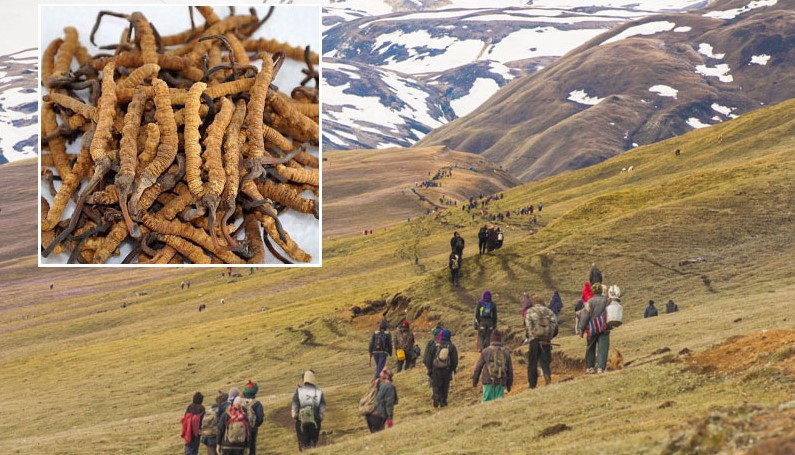
MANANG: Once regarded as a “golden herb” by residents of Nepal’s Himalayan districts, Yarsagumba used to provide a major source of income for local communities.
Every year, thousands of people would travel to the high Himalayan pastures during April and July to collect the valuable medicinal fungus, earning enough in a few weeks to support household expenses for the entire year.
However, recent statistics show a continuous decline in Yarsagumba production and income, directly affecting the livelihoods of thousands of Himalayan residents.
The remote Himalayan district of Manang is known as a major center for medicinal herbs and raw materials. Traditionally considered self-sufficient in medicinal herb production, the district has witnessed a steady decline in its main source of income over the past few years. Locals say Yarsagumba, once abundant in the Himalayan region, has become increasingly rare.
Rising temperatures and decreasing humidity in the Himalayan region have directly affected the growth and reproduction of Yarsagumba. According to the Annapurna Conservation Area Project (ACAP) Office in Manang, annual production and collection have declined significantly over the past five years.
ACAP data shows that in fiscal year 2077/78 BS, 40.5 kilograms of Yarsagumba were collected, generating revenue of Rs. 1.215 million. Collectors paid Rs. 157,950 in Value Added Tax (VAT). Under existing provisions, fees were also paid to local authorities and conservation bodies, including Rs. 67,500 to the municipality and Rs. 450,000 to the Conservation Area Management Committee (CAMC).
In fiscal year 2078/79 BS, Yarsagumba collection increased to 107.052 kilograms, generating revenue of Rs. 3,261,840. During that year, Rs. 367,661 was paid in VAT, while Rs. 1,070,520 was paid in fees to the municipality and CAMC.
According to ACAP, 82.2 kilograms of Yarsagumba were sold in fiscal year 2079/80, generating revenue of Rs. 2,548,200. A total of Rs. 834,500 was paid in fees to the municipality and CAMC. ACAP Chief Dhak Bahadur Bhujel stated that the VAT provision was removed from the current fiscal year after concerns were raised over the burden of double taxation on collectors.
In fiscal year 2080/81 BS, 72.542 kilograms of Yarsagumba were sold, generating income of Rs. 2,248,902. Fees totaling Rs. 725,450 were paid to the municipality and CAMC.
Similarly, in fiscal year 2081/82 BS, the sale of 51.863 kilograms of Yarsagumba generated income of Rs. 1,598,360. Of this amount, Rs. 524,900 was paid to the municipality and Rs. 519,900 to the Conservation Area Management Committee.
In fiscal year 2082/83, up to the month of Falgun, revenue of Rs. 1,481,800 was collected from the sale of 47.8 kilograms of Yarsagumba. Fees amounting to Rs. 478,000 were paid to the municipality and CAMC.
Statistics from fiscal year 2077/78 to 2082/83 BS (up to Falgun) reveal a sharp decline in both Yarsagumba collection and revenue generation. The highest collection was recorded in fiscal year 2078/79, when 107.052 kilograms were harvested, generating revenue of Rs. 3,261,840. Since then, both production and income have steadily decreased each year.
By Falgun of fiscal year 2082/83 BS, collection had fallen to just 47.8 kilograms, while revenue dropped to Rs. 1,481,800. Overall, during the five-year period, a total of 401.957 kilograms of Yarsagumba generated revenue of Rs. 12,354,102, according to ACAP statistics.
Decline in revenue
Local governments and conservation authorities collect revenue from Yarsagumba through royalties and collection fees. However, data from the past five years shows a steady decline in the amount generated from these sources.
In fiscal year 2078/79 BS alone, rural municipalities and Conservation Area Management Committees collected more than Rs. 1 million in fees from Yarsagumba collection.
Since then, the amount has dropped to less than half. The decline in revenue has also affected the development budgets of local governments. Many Himalayan municipalities rely heavily on Yarsagumba income to fund road construction, education, and healthcare programs.
Livelihood linked to Yarsagumba
For people living in the Himalayan region, Yarsagumba collection is an important source of seasonal income and livelihood. In districts such as Manang, Dolpa, Mugu, Mustang, East Rukum, Gorkha, and Myagdi, many families depend on the collection and sale of Yarsagumba to support their households.
Income earned from Yarsagumba has traditionally been used for education, healthcare, and daily household expenses. However, the decline in production has begun to affect the economic condition of local communities. According to local representatives, families that once earned lakhs of rupees during a harvesting season are now being forced to take loans to meet basic living expenses.
Experts and local stakeholders stress that environmental protection measures, sustainable harvesting systems, and climate change mitigation programs must be implemented immediately to conserve Yarsagumba. They argue that the livelihoods and economic security of Himalayan communities can only be protected if the region’s natural heritage is preserved.
Impact of climate change
Rising temperatures, declining snowfall, irregular rainfall, and environmental degradation have disrupted the natural growth cycle of Yarsagumba. Local collectors say reduced snowfall, warming temperatures, and drying pastures in the Himalayan region have significantly affected production.
“Earlier, dozens of Yarsa could be found within a few hours, but now even after searching the whole day, only three or four are found,” said local resident Raj Gurung.
“It is no longer as easy to find Yarsa as before. In the past, they were abundant, but now only one or two are found after an hour of searching,” he added. “There is very little snow now, probably because of the lack of moisture. Even if people hope production will increase next year, fewer Yarsa are being found.”
Experts identify climate change as the main reason behind the decline in Yarsagumba production. ACAP Chief Dhak Bahadur Bhujel said that because Yarsagumba thrives in cold and humid conditions, rising temperatures have directly disrupted its natural growth cycle.
Challenges in conservation
Experts warn that uncontrolled harvesting, overcrowding in collection areas, and poor pasture management are also threatening the future of Yarsagumba. They caution that without effective management of harvesting areas, fixed collection quotas, and environmental conservation programs, Yarsagumba could become increasingly rare in the future.
Locals say it has also become difficult to find enough collectors willing to travel to the highlands for harvesting. Due to population decline and labor shortages in Manang, collectors from districts such as Dolpa, Gorkha, and Dhading have traditionally come to collect Yarsagumba, although their numbers are also decreasing.
For Himalayan communities, Yarsagumba is more than just a medicinal herb—it is a foundation of their livelihood. However, declining production and falling income are weakening that foundation. As the economic condition of many families deteriorates, the need for alternative sources of employment and income has become increasingly urgent.





Comment