




One of the national vulnerabilities for the new administration led by Prime Minister Balendra Shah is resistance to institutional reforms for strategic stability. Of that, geopolitical defiance is imperative to consider. Nepal’s evolving political landscape is no longer a purely domestic transition.
It has become a strategic test case—one that is quietly being read, interpreted, and acted upon by major external powers through distinct and competing approaches. Recent diplomatic engagements from China, India, and the US outreach pattern reveal less about protocol and more about intent. They point to a deeper reality: Nepal is now being engaged not as it is, but as what it might become.
As the administration completes its first month, April serves as a revealing moment—where strategic intent begins to translate into economic diplomacy and foreign policy direction grounded in national interests.
Balen has accepted an invitation from India’s Prime Minister Narendra Modi to visit India, marking an early and significant diplomatic step aimed at recalibrating bilateral ties. Coming soon after assuming office in March, the visit signals an intent to move beyond ceremonial engagement toward a more result-oriented partnership.
The recent visit of US Assistant Secretary of State for South and Central Asian Affairs Samir Paul Kapur underscores a broader shift in how major powers are approaching Nepal. It signals a clear prioritization of economic statecraft as the primary instrument of engagement and reflects an effort to map emerging political actors.
The imperative for Kathmandu is clear: move beyond symbolic diplomacy, engage consistently across levels, and convert external interest into concrete national advantage.
What is more consequential, however, is the simultaneity of competing diplomatic signals. As Kapur concluded his visit, Cao Jing, a senior Chinese diplomat currently serving as Deputy Director General in the Department of Asian Affairs at the Ministry of Foreign Affairs of China, visited Kathmandu, reiterating long-standing concerns over Nepal’s engagement with US-backed initiatives such as the Millennium Challenge Corporation (MCC) Compact, the State Partnership Program, and even emerging technological linkages.
The overlap of these visits is not coincidental—it illustrates how Nepal is increasingly positioned within a contested strategic space, where economic engagement, security concerns, and technological alignment are becoming intertwined.
At the same time, evolving diplomatic protocols—such as President and Prime Minister Balendra Shah’s calibrated approach to high-level meetings—reflect an attempt to assert institutional discipline and redefine engagement hierarchies.
Parallel outreach from Washington, including the proposed visit of US President Donald Trump’s special envoy for South and Central Asia and the US Ambassador to India, Sergio Gor, who is scheduled to visit Kathmandu on April 30 for a four-day trip, alongside anticipated engagement from India through Foreign Secretary Vikram Misri, further reinforces the reality that Nepal is no longer a passive recipient of diplomatic attention but an active node within a multi-vector geopolitical competition.
The strategic implication is clear: Nepal’s external environment is tightening, not loosening. Engagements are no longer isolated or bilateral—they are simultaneous, competitive, and layered. For Kathmandu, the challenge is not merely to manage these interactions, but to translate them into coherent national outcomes—leveraging competition without being constrained by it.
At the heart of this transition lies the emergence of new political actors such as the Rastriya Swatantra Party (RSP), which holds almost two-thirds in the newly elected House, whose rise reflects a broader demand for governance reform, delivery, and a break from legacy political structures. For external powers, this is not merely a domestic political shift—it is a moment of strategic improbability and opportunity.
The Cost of Selective Diplomacy
In diplomacy, the objective is not protocol—it is outcomes that advance national intent. Against this standard, the decision by Nepal’s leadership—including the President and Prime Minister—not to engage with visiting Chinese, Indian, and US delegations, and the reported reluctance to meet senior envoys, sends a signal that extends beyond scheduling.
In geopolitics, absence is not neutrality—it is a position. The US operates through empowered mid-to-senior-level officials; Assistant Secretaries are not ceremonial figures, but key actors who shape policy direction, funding pipelines, and regional priorities.
Limiting engagement only to top-tier interactions effectively narrows channels of influence and constrains Nepal’s ability to shape outcomes at earlier, more consequential stages of decision-making. By contrast, countries like India engage across all levels—technical, bureaucratic, and political—ensuring continuity, clarity, and strategic depth.
As Deputy Director General in the Department of Asian Affairs at the Ministry of Foreign Affairs of China, Cao Jing plays a key role in executing Beijing’s regional diplomacy across East, Southeast, and South Asia. Her responsibilities span both policy and practice—translating strategic directives into operational engagement on the ground.
This includes overseeing policy implementation and regional analysis, managing high-level diplomatic interactions, and coordinating China’s bilateral engagements across multiple capitals. Her role also involves guiding Chinese embassies and consulates, ensuring alignment with Beijing’s priorities, and supporting major diplomatic initiatives through documentation, negotiation, and communication.
At a strategic level, she is tasked with safeguarding China’s regional interests—monitoring political developments, addressing security concerns, and ensuring the continuity of Chinese investments, infrastructure projects, and personnel abroad. Her recent engagements in Nepal reflect this mandate, combining diplomatic outreach with strategic signaling in a rapidly evolving regional environment.
Hesitation in engagement is rarely interpreted as principled distance; more often, it is read as uncertainty. In a region where China closely monitors diplomatic signaling, selective or inconsistent engagement patterns risk creating perceptions of tilt—even when none is intended. And in today’s Asia, perception quickly hardens into policy.
Modern diplomacy is no longer ceremonial; it is functional, networked, and outcome-driven. States maximize leverage not by whom they host, but by whom they engage effectively.
In a crowded strategic theatre, silence is rarely neutral, and the cost of non-engagement is tangible: lost agenda-setting opportunities, reduced policy visibility, and a narrowing of strategic space. The issue, therefore, is not procedural but doctrinal.
Is Nepal practicing symbolic diplomacy, or is it pursuing interest-driven engagement?
For a small state navigating between major powers, the answer cannot remain ambiguous. Strategic autonomy is not preserved through distance, but through calibrated, consistent, and multi-level engagement—engage widely, signal carefully, and extract strategically. That’s how small states preserve space in big-power competition.
The United States: Engaging the Future
The recent visit of Kapur marks the highest-level American engagement since the government led by Balen took office, indicating a shift from strategic probing to strategic engagement. It should not be read as routine diplomacy, but as a quiet strategic assessment.
What is striking is not only the range of engagements, but also the deliberate absence of customary meetings with the President, Prime Minister, or military leadership. This departure from protocol signals a shift away from state-centric engagement toward a more targeted effort to understand Nepal’s evolving political economy and emerging centers of influence.
Kapur’s outreach beyond government—to RSP Chair Rabi Lamichhane and the business community—reflects recognition of future centers of influence as well as new political actors. Outreach to the private sector further highlights a key transition: influence is increasingly built through markets, not ministries alone.
The focus on engagements with Finance Minister Swarnim Wagle and Foreign Minister Shishir Khanal underscores a broader US strategy anchored in economic statecraft—investment, regulatory standards, and governance frameworks. Coupled with renewed commitments toward investment and regulatory reform, this signals a clear prioritization of economic statecraft as the primary instrument of engagement.
Taken together, these patterns suggest a deliberate recalibration. Washington is not reinforcing the existing order; it is positioning itself within the environment from which Nepal’s next phase of leadership and policy direction will emerge.
This approach reflects a wider strategic logic. Situated between China and India, Nepal is now viewed less as a peripheral partner and more as part of a competitive regional balance. The US is engaging not after stability, but during transition—seeking to shape conditions rather than dictate outcomes.
In doing so, it is effectively betting on systems over personalities, privileging institutional alignment, economic openness, and governance credibility as the foundations of long-term partnership.
Against this backdrop, the forthcoming visit of a US special representative linked to Donald Trump assumes added prominence. Unlike the recent assessment-oriented visit, this presents an opportunity for outcome-driven engagement. In contemporary diplomacy, effectiveness lies less in hierarchy and more in access to decision-making and the ability to deliver results.
A meeting with Nepal’s top leadership should therefore be approached not as a matter of protocol, but as a strategic instrument to align expectations, clarify priorities, and secure tangible gains. Limiting engagement risks narrowing Nepal’s influence at a moment when its strategic relevance is increasing.
Engagement, therefore, is concentrated at the level of the state and ruling structures. While China does not overtly interfere in Nepal’s internal political dynamics, it consistently reinforces expectations around political stability and adherence to core sensitivities, particularly those linked to Tibet.
The imperative for Kathmandu is clear: move beyond symbolic diplomacy, engage consistently across levels, and convert external interest into concrete national advantage.
India: Stabilizing the Continuity
India’s approach, by contrast, reflects the imperatives of proximity. For New Delhi, Nepal is not a distant partner but an immediate strategic environment shaped by open borders, deep economic interdependence, unswerving security cooperation, and shared social ties.
As a result, India’s engagement with Nepal’s new political generation is cautious, layered, and calibrated. An invitation for Balen Shah’s visit has been dispatched. Foreign Secretary Misri will be visiting Kathmandu in the near future.
Rather than rapidly embracing disruptive political actors, India seeks to integrate them into an existing framework of bilateral relations that has evolved over decades. Engagement continues across the political spectrum, ensuring that no single shift in Kathmandu fundamentally alters the structure of ties.
Preparations are currently underway between the respective foreign ministries to shape a focused agenda, with expected emphasis on trade, border management, regional cooperation, and economic diplomacy. Discussions led by the Foreign Minister indicate that Kathmandu is seeking to anchor the visit in tangible outcomes rather than symbolic exchanges.
The timing underscores its importance. As his first major diplomatic engagement, the visit represents an opportunity for Balen to define the tone of Nepal–India relations—prioritizing a dignified, interest-driven partnership aligned with economic priorities and regional stability.
This is not disapproval of change, but management of it. While dates are yet to be finalized, the direction is clear: this is not just a visit, but a test of whether intent can be translated into delivery. India’s priority is stability—ensuring that political transition in Nepal does not translate into strategic unpredictability. Connectivity projects, energy trade, and institutional relationships remain the anchors of this approach.
The underlying message from New Delhi is clear: political change in Nepal is acceptable, even expected, but it must unfold within a predictable strategic perimeter.
China: Securing Predictability
China’s engagement operates on a different axis altogether. Its approach remains firmly state-centric, focused on continuity, control, and alignment with core strategic interests. Political transitions in Nepal are viewed less as opportunities for engagement with new actors and more as variables to be managed within an overarching framework of stability.
Cao Jing is a senior Chinese diplomat currently serving as Deputy Director General in the Department of Asian Affairs at the Ministry of Foreign Affairs of China. Prior to this role, she served as Chargé d’Affaires at China’s embassy in Myanmar, where she oversaw bilateral cooperation and diplomatic outreach.
During her visit, she undertook high-level engagements in Nepal, coinciding with parallel visits by US officials—highlighting Kathmandu’s growing strategic relevance and delivering Beijing’s strategic sensitivities.
During her meetings, she reiterated Beijing’s concerns on key issues, including regional security dynamics, the status of Tibetan refugees, and Nepal’s potential involvement in US-linked initiatives such as the Millennium Challenge Corporation Nepal Compact (MCCNC), the State Partnership Program (SPP), and the Starlink satellite network.
For China, Nepal’s importance lies in two domains: security and connectivity. The stability of Tibet and the integrity of the Himalayan frontier are non-negotiable concerns. At the same time, Nepal represents a critical node in China’s broader geoeconomic ambitions, particularly in the context of trans-Himalayan infrastructure and connectivity initiatives.
The visits, the meetings, and even the omissions in protocol are signals. They reflect how Nepal is being read from the outside. The more important question is whether Nepal is equally clear in how it reads itself.
Engagement, therefore, is concentrated at the level of the state and ruling structures. While China does not overtly interfere in Nepal’s internal political dynamics, it consistently reinforces expectations around political stability and adherence to core sensitivities, particularly those linked to Tibet.
This is a model of strategic assurance—top-down, disciplined, and resistant to volatility.
Three Approaches, One Nepal
Taken together, these three approaches reveal a striking divergence in how Nepal’s political transition is being interpreted.
China is securing the predictability of Nepal’s alignment—focusing on state authority, territorial sensitivities, and long-term strategic interests.
India is stabilizing the continuity of Nepal’s state—ensuring that political change does not disrupt the structural foundations of bilateral relations.
The US is engaging the future of Nepal’s politics—probing emerging actors, shaping economic conditions, and investing in governance systems that may define the next generation of leadership.
Each approach is rational within its own framework. Yet, for Nepal, the coexistence of these competing logics creates both strategic opportunity and complexity.
The Strategic Accountability of Nepal
For a new generation of political leadership, this external environment is both enabling and constraining. On one hand, Nepal has the space to diversify partnerships, leverage competing interests, and pursue a more confident form of multi-vector diplomacy. On the other, misreading these external approaches—or over-aligning with any one of them—could generate unintended strategic consequences.
The central challenge, therefore, is not choosing between China, India, or the US. It is understanding the logic each brings and designing a national strategy that can engage all three without being subsumed by any.
This requires a shift in mindset—from reactive diplomacy to proactive statecraft. Nepal must define its own priorities with clarity: economic transformation, institutional credibility, and strategic autonomy. External partnerships should then be aligned with these goals, rather than the other way around.
Conclusion: From Transition to Strategy
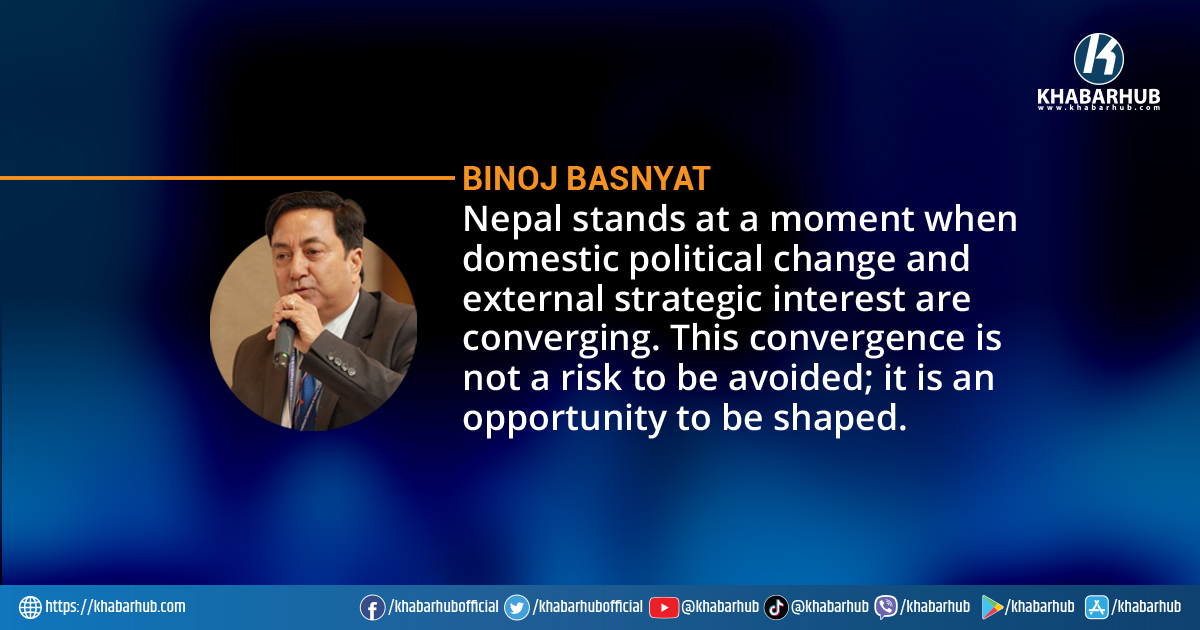
Nepal stands at a moment where domestic political change and external strategic interest are converging. This convergence is not a risk to be avoided; it is an opportunity to be shaped.
But shaping it will require discipline. It will require a political class capable of thinking beyond electoral cycles, institutions capable of sustaining policy continuity, and a strategic culture that understands that engagement with external powers is not about balancing pressures, but about designing outcomes.
The visits, the meetings, and even the omissions in protocol are signals. They reflect how Nepal is being read from the outside. The more important question is whether Nepal is equally clear in how it reads itself.
Only then can it move from being a space of competition to an actor of consequence.
(Basnyat is a retired Major General of the Nepali Army, a strategic affairs analyst, and a researcher affiliated with Rangsit University in Thailand.)





Comment