





KATHMANDU: Economic Digest offers a concise yet comprehensive overview of significant business happenings in Nepal, presented in easily digestible summaries.
Nepal’s current economic landscape reflects a mix of cautious financial stability and underlying structural weaknesses. While capital markets show resilience—evident in high stock market turnover despite a slight dip—and monetary easing through lower interest rates signals liquidity support, real sector challenges remain pronounced.
Strong growth in real estate lending and improved revenue collection contrast with weak provincial capital spending and governance issues such as illegal taxation and unpaid institutional dues. At the same time, external pressures—rising global fuel costs, import dependence, and supply disruptions—are straining key sectors like construction and agriculture, exposing vulnerabilities in productivity and self-sufficiency.
Social concerns, including labor inequality and cooperative fraud, further highlight gaps in policy implementation and protection mechanisms. Overall, the economy appears to be navigating short-term stability, but long-term sustainability will depend on structural reforms, better public spending efficiency, and reduced external dependence.
NEPSE dips slightly as turnover reaches Rs 8.665 billion
The Nepal Stock Exchange (NEPSE) edged down by 4.18 points (0.14 percent) on Monday, closing at 2,833.60. The sensitive index dropped 0.31 percent to 476.65, with float indices also declining. A total of 20.16 million shares of 342 companies were traded through 101,180 transactions, generating Rs 8.665 billion in turnover. Six of the 13 sector indices posted gains, led by hotels and tourism and hydropower, while banking and finance sectors declined. Four companies hit the upper circuit limit during trading.
Gold and silver prices decline in local market
Gold and silver prices fell in the domestic market, with gold dropping by Rs 400 per tola to Rs 296,700 and silver declining by Rs 75 to Rs 4,900 per tola. Despite the daily dip, gold prices have risen significantly over the past week.
Commercial banks reduce interest rates
Commercial banks have lowered deposit interest rates for the month of Baishakh (April 14 to May 14). The average rate for individual fixed deposits has decreased to 4.41 percent from 4.49 percent in Chaitra, while institutional deposits now average 3.23 percent. Seven banks cut rates, 12 kept them unchanged, and Agriculture Development Bank slightly increased its individual rate to 4.15 percent. NMB Bank and Rastriya Banijya Bank are offering the highest individual rates at 5 percent, while others such as Global IME and Nabil Bank remain around 4.5 percent.
NRB launches quarterly real estate market reports
The Nepal Rastra Bank (NRB) has begun issuing detailed quarterly reports on real estate trends, using fiscal year 2022/23 as the benchmark. Drawing data from the Department of Land Management and Archive and the Inland Revenue Department, the reports track transaction volumes, pricing, and bank lending. Madhesh Province leads in transaction numbers and land area, while Bagmati Province records the highest transaction values. Real estate lending expanded by 72.41 percent between fiscal years 2020/21 and 2024/25, while government revenue from the sector rebounded from Rs 8.2 billion in 2022/23 to Rs 15 billion in 2024/25.
Koshi begins refunding cooperative fraud victims
The Koshi Province government has started returning savings to victims of troubled cooperatives. In the first phase, 287 depositors of the Ambe-Koshi Saving and Credit Cooperative in Itahari will receive payments, prioritizing those with deposits below Rs 20,000. The cooperative owes Rs 426 million to members, with investigations showing Rs 200 million was misused by its former chairman. Authorities have frozen 42 land plots and are preparing asset auctions, with Rs 2.8 million to be distributed initially.
Birgunj accused of collecting illegal highway taxes
Birgunj Metropolitan City has come under scrutiny for allegedly collecting unauthorized taxes from cargo vehicles on highways despite federal instructions to stop such practices. Contractors continue to impose vehicle management and scrap fees under contracts worth Rs 76.1 million and Rs 48.8 million, respectively. While local authorities defend the move as necessary for revenue generation, transport operators and federal lawmakers have demanded intervention, with district officials monitoring the situation.
Karnali shows weak capital spending performance
Karnali Province has spent only 19.64 percent of its total budget in the first eight months of fiscal year 2025/26, with capital expenditure at just 12.97 percent (Rs 2.591 billion out of Rs 19.982 billion). The Ministry of Physical Infrastructure has utilized about 15 percent of its allocation, while other sectors such as social development and industry have recorded even lower spending, falling short of last year’s 22 percent benchmark.
Gaur Customs exceeds revenue targets
The Gaur Customs Office in Rautahat has achieved strong revenue performance, collecting Rs 301.8 million by April 11—90.63 percent of its annual target of Rs 332.9 million. Monthly collections have consistently surpassed targets, driven by increased imports of coal, jaggery, and tiles, along with timely auctions of seized goods. Auction revenues alone contributed Rs 4.2 million, though the office still lacks plant quarantine facilities.
NEA resumes recovery of trunk line dues
The Nepal Electricity Authority (NEA) has resumed efforts to collect outstanding payments for dedicated and trunk line services following a favorable regulatory ruling. Regional offices have been directed to contact industrial clients regarding arrears. Although 22 industries had earlier agreed to installment payments, most have defaulted since November. The NEA is considering further legal steps but has not yet cut power supplies.
Govt ensures adequate fertilizer supply
The government has assured that fertilizer stocks will meet demand until mid-July, with around 170,000 tons available or in transit. Despite delays caused by Middle East disruptions, authorities are seeking additional supplies from India under a government-to-government arrangement. Plans are also in place to import 300,000 tons next fiscal year with a Rs 20 billion allocation.
Home Minister discloses Rs 27 million in shares
Home Minister Sudhan Gurung has made his assets public, including 11.24 hectares of inherited land, 89 tolas of gold, and Rs 5.6 million in bank deposits. He also holds shares worth Rs 27.4 million, owns 30,000 shares in Hope Holdings, and possesses an MG S5 vehicle. His financial disclosures come amid public debate over earlier remarks on economic status.
Minister Gauri Yadav reports multi-million assets
Industry, Commerce, and Supplies Minister Gauri Kumari Yadav has declared significant assets, including a three-story house and land in Kathmandu and Mahottari, 180 tolas of gold, and two kilograms of silver. She also holds Rs 1 million in bank deposits and shares worth Rs 33.8 million, with additional income from rental earnings. She attributes her wealth to past business activities in Russia.
Nepal imports Rs 62.9 million worth of dried vegetables in eight months
Nepal continues to rely heavily on imported dried vegetables despite having strong domestic production potential. In the past eight months, the country exported only Rs 707,000 worth of dried vegetables while importing Rs 62.9 million, according to customs data. The United States was the largest export destination, while imports mainly came from India, China, and the US. Although regions such as Manang, Mustang, and Karnali produce traditional dried foods, the sector has yet to scale commercially. Experts say promoting organic dried products could strengthen food security and boost export earnings.
Minister Gita chaudhary reveals modest assets
Agriculture and Livestock Development and Forests and Environment Minister Gita Chaudhary has disclosed assets including electronics, jewelry, and livestock. Her holdings include a watch, phone, laptop, gold and silver ornaments, a bank balance of Rs 126,000, two scooters (one on loan), and small livestock received from her parental home.
Agriculture office distributes Rs 447 million in grants
The Agriculture Development Office has provided Rs 447.1 million in grants to 915 farmers over the past five years, supporting activities such as vegetable farming, orchard management, farm expansion, and machinery purchases. Individual grants ranged widely, with the highest awarded for crop insurance. For the current fiscal year, Rs 51.7 million has been allocated for agricultural promotion programs aimed at boosting productivity and self-sufficiency.
Labor leaders call for equal pay and protection for informal workers
Labor activists in Nepal have demanded an end to wage disparities and stronger social security measures for informal sector workers. At a recent gathering, representatives of the National Freed Haliya Society Federation of Nepal highlighted that gender bias often results in women being paid less than men for the same work. They stressed the need for an “equal work, equal pay” policy and pointed out that poverty, lack of education, and landlessness continue to push people into exploitative labor. Advocates for formerly bonded Kamaiya workers also urged the government to ensure insurance coverage, workplace safety, and effective enforcement of labor protection laws.
Irrigation shortage reduces spring paddy farming
Farmers in Kanchanpur district are increasingly abandoning early spring paddy cultivation due to insufficient irrigation. The cultivated area has dropped sharply from 400 hectares to 150 hectares, despite government subsidies on inputs. The Mahakali Irrigation Canal has failed to provide reliable water supply, and alternative sources such as boring are inadequate for the crop’s needs. Of the district’s 161,741 hectares of arable land, only 29 percent has irrigation access, limiting agricultural productivity.
Rising costs stall construction sector
Nepal’s construction industry has slowed dramatically as fuel and raw material prices surge בעקבות the US–Israel–Iran conflict. Cement prices have risen by Rs 150 per bag, while iron rods have increased by Rs 20 per kilogram. As a result, construction activity has dropped to just 15–20 percent of normal levels during peak season, with contractors citing both high costs and labor shortages as key challenges.
Kaligandaki reservoir project fixed at 640 mw capacity
The Kaligandaki Reservoir Hydropower Project will be developed with a revised capacity of 640 MW, down from the initially proposed 844 MW. The project includes a 244-meter-high dam and a 29-kilometer reservoir spanning parts of Gulmi and Parbat districts. It is expected to generate 1,645.65 GWh of electricity annually and impact several surrounding districts. Feasibility and environmental studies are currently underway.
Madi river arc bridge nears completion in Tanahun
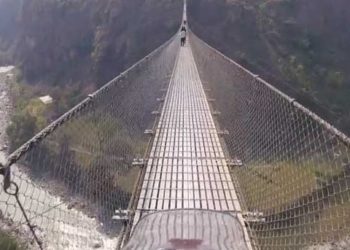
The four-lane arc-design bridge over the Madi River in Tanahun is now 80 percent complete. Built under the Prithvi Highway expansion project with Asian Development Bank support, the 370-meter structure is expected to ease congestion in Damauli and serve as a new tourist attraction once operational.
Triyuga municipality trains traders to clear sidewalks
Triyuga Municipality in Udayapur has conducted awareness training for 225 footpath traders, urging them to stop operating on sidewalks in Gaighat market. Authorities say long-term encroachment has obstructed pedestrian movement, and alternative spaces are being arranged to relocate vendors.
BP Koirala Cancer Hospital faces financial strain
BP Koirala Memorial Cancer Hospital is facing a severe financial crisis, with government bodies owing Rs 416.7 million. The hospital is struggling to meet expenses, including salaries, medicines, and retirement benefits, despite serving over 209,000 patients last year. Administrative challenges have worsened due to the absence of a board chairman.
SWC to take action against tenants over unpaid rent
The Social Welfare Council is preparing to seal the offices of 20 organizations in Bhrikutimandap over unpaid rent totaling Rs 77.9 million. Several prominent organizations, including student groups and NGOs, have long-standing arrears, prompting stricter enforcement measures.
Chandragiri investment group to issue Rs 100 million IPO
Chandragiri Investment Group has approved plans to issue an IPO worth Rs 100 million, offering 1 million shares to the public. The company also declared a 4 percent cash dividend and elected a new board, as it continues to expand investments across multiple sectors.
Talchowk–Begnas road project reaches 72 percent completion
Construction of the 3.28-kilometer Talchowk–Begnas road in Pokhara has achieved 72 percent physical progress and 65 percent financial completion. Funded by the World Bank, the project includes four lanes, cycle tracks, and bridges, and is expected to be completed by mid-July 2026. Once finished, it will enhance connectivity and boost tourism in the Lekhnath area.




Comment