




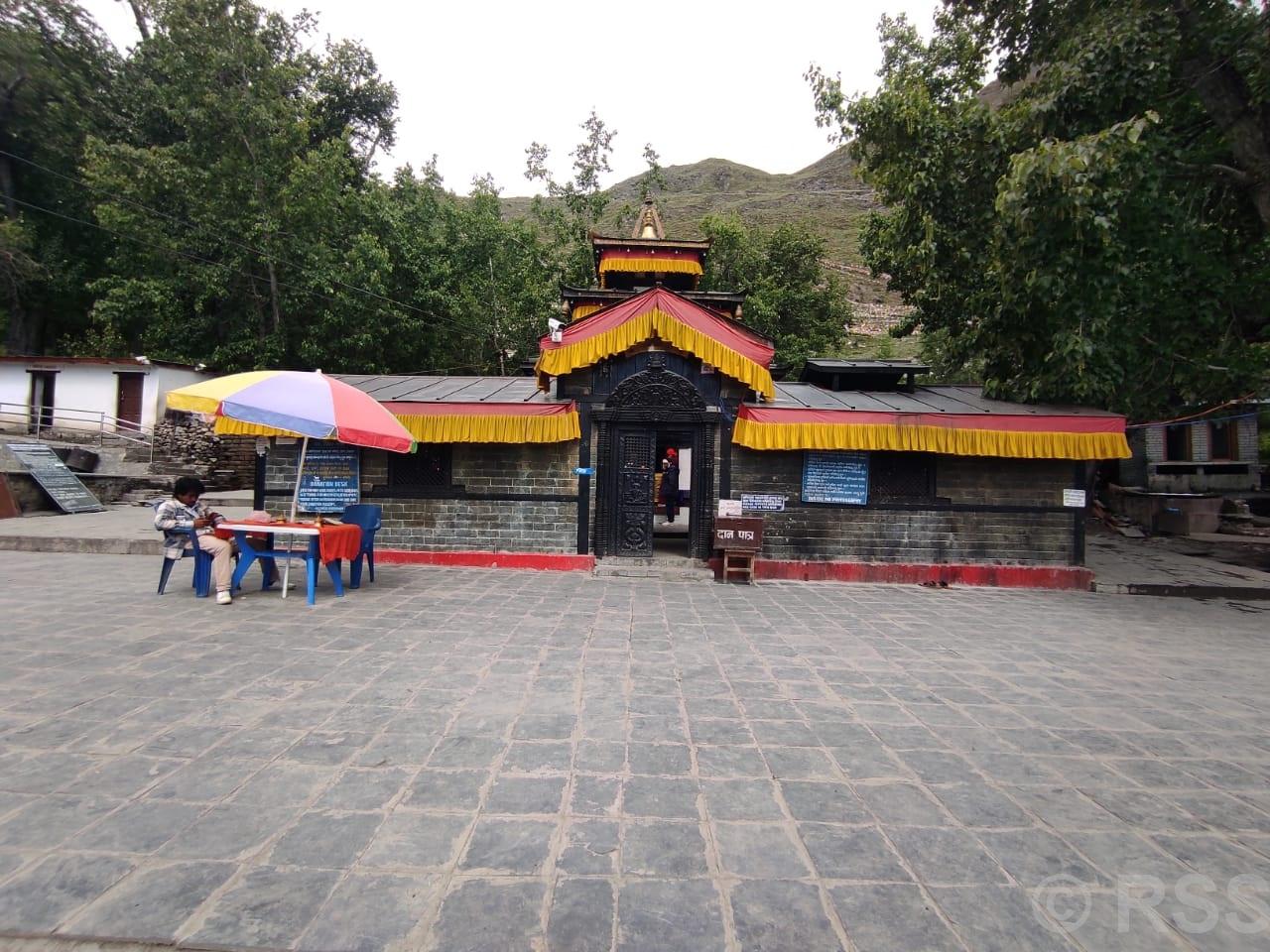
KATHMANDU: The Environmental Impact Assessment (EIA) report of the ambitious cable car project proposed from Shera Phant in Parbat to Muktinath in Mustang has been prepared and submitted to the Ministry of Forests and Environment.
The report was submitted by Muktinath Darshan Pvt. Ltd. through the Investment Board Nepal. The ministry has made the report public for suggestions.
According to the EIA, the proposed cable car will stretch 81.041 kilometers in total, making it one of the longest cable car projects in the country. The system will feature 20 stations and allow passengers to reach Muktinath in 3 hours and 36 minutes in a non-stop journey.
The cable car will begin from Modi Rural Municipality–1 in Parbat district and pass through Annapurna Rural Municipality–5 and 9 in Kaski; Annapurna Rural Municipality–3, 4, 5 and 6 in Myagdi; Gharapjhong Rural Municipality–1, 2, 3, 4 and 5 and Thasang Rural Municipality–1, 2, 3, 4 and 5 in Mustang; and Baragung Muktikshetra Rural Municipality–1, 4 and 5 before reaching Muktinath.
The project aims to promote tourism in the Dhaulagiri region and establish an environment-friendly mass transportation system.
The cable car route will pass through the watersheds of the Kali Gandaki and Modi rivers. It will traverse Shera Phant, Bhukbesi, Ulleri, Ghorepani, Sikha, Ghar, Narchyang, Kabre, Pahirothaplo, Ghassa, Lete, Kobang, Tukuche, Chokhopani, Marpha, Thini/Jomsom, Eklebhatti, Kagbeni and Khinga before ending at Chengresi near Muktinath.
As per the report, the project will include 871 passenger gondolas and 442 towers across its 20 stations. The cable car will start at an altitude of 1,009 meters above sea level and end at 3,653 meters.
Each gondola will be spaced 234 meters apart and accommodate 10 passengers. The gondolas will move at a speed of 7 meters per second. The project will require a maximum of 13 megawatts of electricity for operation. The estimated total cost of the project stands at Rs 55 billion.
During the EIA process, alternative options were also analyzed, including not constructing the project, expanding road networks, expanding airport facilities, and constructing the cable car. The report concludes that the cable car is a feasible option as a pollution-free, land-efficient, all-weather, environmentally friendly and comparatively low-risk mode of transportation that can offer unique natural and cultural experiences.
The total environmental cost of the project has been estimated at Rs 781.25 million.
According to the report, the project will require 271.75 hectares of land in total. Of this, 34.314 hectares will be used for stations, 3.8 hectares for towers, and 233 hectares for right-of-way.
The project area includes 218 hectares of forest land within the Annapurna Conservation Area and 220 hectares of community forest. It is estimated that 229 households will be affected by the project, with 34 households expected to be displaced.
The project is expected to generate employment for 1,769 people during the construction phase and 439 people during operation.



Comment