




As major powers reassess their engagement with global institutions, it has become increasingly clear that the international architecture that has shaped global cooperation for nearly eighty years was built for a world that no longer exists.
The United Nations and the Bretton Woods system, including the International Monetary Fund (IMF) and the World Bank, came into being after the Second World War, when global power rested overwhelmingly in the hands of a small group of Western nations. In 1946, that architecture made sense. In 2026, it increasingly does not.
This is a reality widely acknowledged — sometimes quietly, sometimes openly — by policymakers, scholars, and even leaders inside these institutions themselves. Governance and representation no longer reflect today’s geopolitical and economic balance. Reform is overdue. What remains uncertain is whether the current wave of disruption will finally force meaningful change, or whether it will instead push the system toward fragmentation, weakening the foundations of global cooperation in the process.
To understand the problem, it helps to recall the world these institutions were designed for. The UN and the Bretton Woods system emerged from a war-ravaged global order dominated by the United States and its allies. The U.S. alone accounted for nearly half of global GDP. Europe, though battered, remained central to global politics and finance. Japan and Germany were defeated powers. China was politically fractured and economically marginal. India was still under colonial rule.
Reform will not produce perfect consensus — nor should it. But it could restore legitimacy by aligning authority with reality. Reformed institutions would remain central forums for cooperation, even in a competitive world, because they would be seen as fairer, more representative, and harder to dismiss as relics of another era.
Institutional design followed power. Permanent seats and veto power in the UN Security Council were reserved for the victors of World War II. Voting power in the IMF and World Bank reflected the economic weight of the mid-twentieth-century West. Informal leadership arrangements, a European at the IMF, an American at the World Bank, became accepted practice and went largely unquestioned for decades.
These choices were deliberate compromises, intended to stabilise a fragile post-war world. But history did not pause in 1946.
Today, global power has shifted — yet governance has not. The contemporary landscape bears little resemblance to the one that shaped these institutions. China is now the world’s second-largest economy and a central player in global trade, finance, and manufacturing.
India is the most populous country on earth and an increasingly influential economic and strategic actor. Japan and Germany are advanced industrial powers with global reach. The Global South accounts for most of the world’s population growth, economic expansion, and future demand. Yet the structures of global governance still reflect an earlier era.
India, Japan, and Germany remain outside the UN Security Council’s permanent membership. Africa — a continent of more than 1.4 billion people — has no permanent seat at all. Voting shares at the IMF and World Bank continue to lag behind real economic weight, with Europe still overrepresented relative to its share of global GDP and growth. Across many UN bodies, agenda-setting remains heavily shaped by Western donors, norms, and political priorities.
This gap between power and representation has real consequences. It erodes legitimacy. It weakens authority. And it fuels growing scepticism about whether these institutions truly represent collective global interests or are simply preserving institutional habits from another age.
Defenders of the status quo often argue that effectiveness matters more than representational fairness. And they are right about one thing: representation alone does not guarantee better outcomes. But legitimacy and effectiveness are not separable. Institutions seen as unrepresentative struggle to command trust, compliance, and political buy-in — especially in a multipolar world where alternatives exist.
When emerging and middle powers feel sidelined, they hedge. Participation becomes selective. Commitments become conditional. Parallel institutions and informal groupings multiply. The rise of alternative forums and regional development banks does not signal a rejection of cooperation itself, but frustration with how cooperation is organised and whose voices count.
This is not a failure of multilateralism as an idea. It is a system-wide governance problem in which political and economic realities have evolved faster than institutional rules.
Calls for reform are nothing new. UN Security Council reform has been debated for more than thirty years. IMF quota reform has been revisited repeatedly, producing incremental changes that fall short of structural adjustment. World Bank governance has evolved, but cautiously and unevenly.
What is different today is that even institutional leaders increasingly acknowledge the gap. Official speeches, reform roadmaps, and internal reviews routinely speak of the need to reflect “today’s world” and adapt to a multipolar international order. The diagnosis is no longer controversial.
The obstacle has always been political. Reform requires those with entrenched power to give some of it up. Permanent members of the Security Council must dilute exclusivity. European states must accept reduced voting shares. Donors must loosen control over agendas they have long shaped. These are difficult concessions — and for decades, the costs of delay seemed lower than the costs of reform. That calculation may now be changing.
Recent withdrawals, funding cuts, and disengagements by major powers — most notably the United States — should be understood against this backdrop. They are not simply acts of isolationism or reflexive rejection of multilateralism. They are signals that the existing equilibrium no longer delivers sufficient influence, legitimacy, or returns for some of its most powerful stakeholders.
Whether one agrees with these tactics or not, the message is unmistakable: participation can no longer be assumed simply because institutions are historically important. In a more transactional and competitive global environment, legitimacy must be earned continuously.
Seen this way, disruption can act as a forcing mechanism. It raises the cost of inaction. It confronts institutions with a stark choice: adapt or risk marginalisation. The present moment is therefore a genuine inflection point. Two paths lie ahead.
Lasting reform requires coalition-building among both emerging and established powers. It demands recognition that representation and responsibility must move together. And it requires accepting a simple truth: a multipolar world cannot be governed indefinitely by institutions designed for a unipolar or bipolar age.
One path leads to reform. Under sustained pressure, governance structures are recalibrated to reflect contemporary power realities. Representation broadens. Decision-making becomes more inclusive. Emerging powers take on greater responsibility alongside greater influence. At a minimum, reform must address voting power, leadership selection, and agenda-setting in ways that better reflect today’s economic and demographic realities.
Reform will not produce perfect consensus — nor should it. But it could restore legitimacy by aligning authority with reality. Reformed institutions would remain central forums for cooperation, even in a competitive world, because they would be seen as fairer, more representative, and harder to dismiss as relics of another era.
The other path leads to fragmentation. If reform stalls while disengagement accelerates, institutions risk hollowing out. Funding becomes unpredictable. Norm-setting authority weakens. Parallel structures multiply. Cooperation shifts from shared rules to ad hoc, interest-driven coalitions.
In such a world, power matters more than process. Smaller and poorer states lose voice. Global public goods — from climate stability and financial safety nets to pandemic preparedness — become harder to manage collectively. The system does not collapse overnight, but it frays, becoming less coherent and less capable.
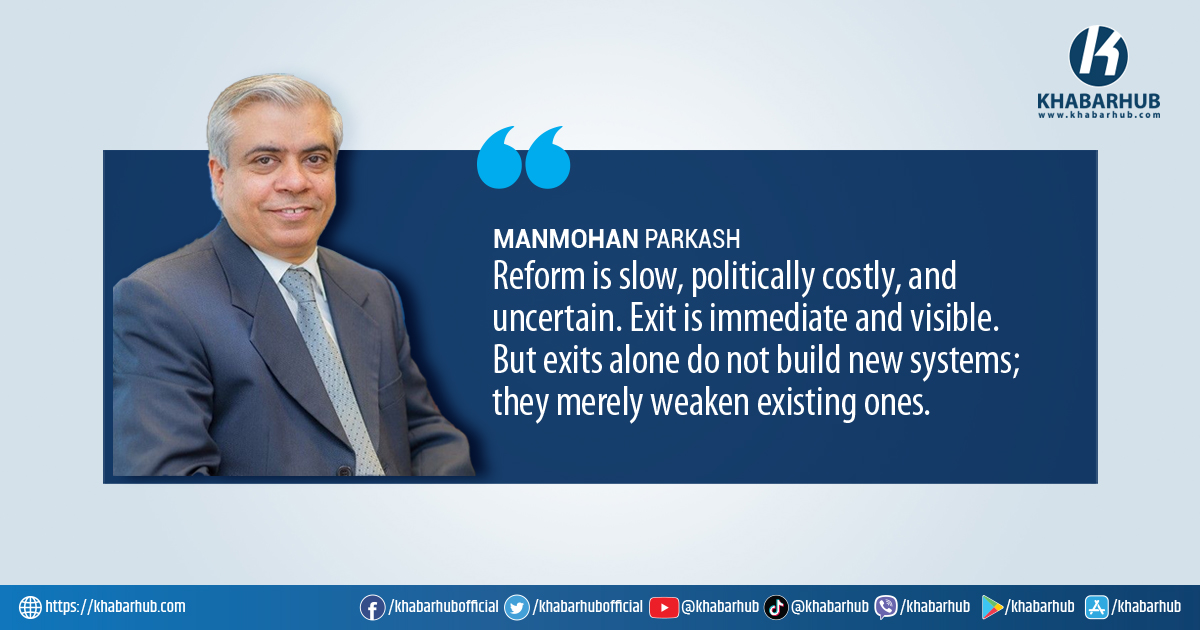
The temptation to exit or disengage is understandable. Reform is slow, politically costly, and uncertain. Exit is immediate and visible. But exits alone do not build new systems; they merely weaken existing ones.
Lasting reform requires coalition-building among both emerging and established powers. It demands recognition that representation and responsibility must move together. And it requires accepting a simple truth: a multipolar world cannot be governed indefinitely by institutions designed for a unipolar or bipolar age.
The irony is that many of the countries most dissatisfied with the current system also have the greatest stake in its survival — if it can be adapted.
(Former Senior Advisor, Office of the President and Deputy Director General, South Asia, Asian Development Bank. He writes on economic policy, infrastructure, and development finance, with a focus on inclusive growth and reimagining global institutions. Views are personal.)






Comment