




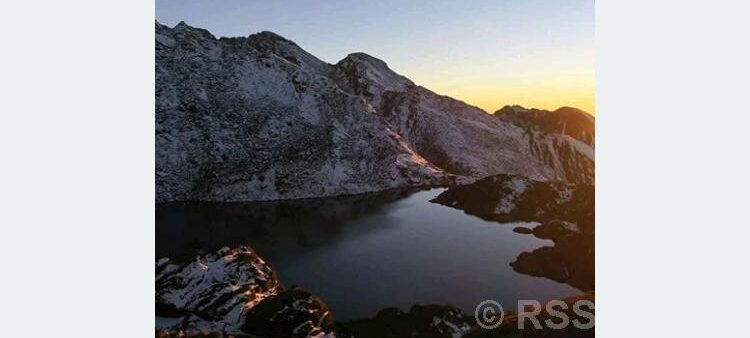
RASUWA: Bhairav Kunda, situated in the Gosaikunda region of Rasuwa, holds a distinctive place among the area’s numerous sacred lakes because of the religious beliefs, myths and traditional restrictions associated with it.
Unlike other water bodies in the region, Bhairav Kunda is traditionally regarded as a mysterious and forbidden lake associated with fear and spiritual restrictions.
Located in the high Himalayan region below the main Gosaikunda (Chhokar) and above Saraswati Kunda (Banglatti), the lake is known as ‘Chona’, meaning black lake, among the local Tamang community.
While Gosaikunda is traditionally regarded as a symbol of purity, life and divine blessings, Bhairav Kunda is associated with fear and spiritual prohibitions. According to local beliefs, pilgrims visiting Gosainkunda refrain from bathing in Bhairav Kunda. There is also a longstanding tradition of not looking back at the lake while returning after circumambulating Gosaikunda.
Dolma Yangzen Tamang, acting ward chairperson of Gosaikunda Rural Municipality-5, said pilgrims traditionally worship and bathe in Gosaikunda before proceeding without approaching or looking back at Bhairav Kund. In recognition of this cultural practice and the need to ensure visitor safety, the ward office has planned to construct a safe footpath and install information boards to educate visitors about the lake and its associated beliefs.
Several mythological accounts and folk narratives from Hindu and Buddhist traditions explain the origin of Bhairav Kunda.
According to one Hindu belief, Lord Shiva created the lake below Gosainkunda during the Satya Yuga to atone for the sin of beheading Brahma and to relieve the physical suffering that followed.
Another popular legend links the lake’s formation to the Samudra Manthan, or the churning of the cosmic ocean by gods and demons. According to this account, Lord Shiva consumed the deadly poison released during the churning to save the universe.
The intense burning sensation caused by the poison lodged in his throat reportedly made him sweat profusely. Bhairav Kunda is believed to have formed from this poisonous sweat. As a result, local folklore associates the lake with poisonous substances and a venomous serpent believed to inhabit it. Its water is consequently considered impure.
A different explanation appears in Buddhist folklore, which attributes the creation of Bhairav Kunda to Mahadev’s brother, Chona.
According to the book Biological Diversity Conservation, Tourism Development, Religion and Culture, written by Rasuwa-based author Phurpa Tamang, Chona and his brother had set out in search of a suitable place to live. After finding an appropriate location, Chona reportedly forgot about his brother and settled there.
Angered by his brother’s actions, Mahadev is said to have cursed him, declaring that because his heart was black, the lake he created would also be black. According to this legend, the lake built by Chona came to be known as Kalokunda, or Bhairav Kunda, while the lake created by Mahadev became Setokunda, identified with Gosaikunda.
Rinjen Ghale, a local resident and Lama guru from Dhunche, said Gosaikunda and Bhairav Kunda carry distinct meanings in Buddhist and Tamang traditions. Gosaikunda is known as ‘Chhokar’, meaning a pure white lake, while Bhairav Kunda is called ‘Chona’, meaning a black lake.
He explained that the belief that Bhairav Kunda embodies anger and destructive spiritual energy underlies the traditional restrictions against bathing in the lake or even looking back at it. Such practices, he said, also reflect the community’s religious discipline and its traditional relationship with nature.
Bhairav Kunda is also linked to a distinctive ancestral tradition among the Gole clan of the Tamang community.
According to an oral legend, a traditional shaman, or Jhakri, belonging to the Gole clan once travelled to the Gosaikunda region with his wife. Intending to subdue the venomous serpent believed to inhabit Bhairav Kund, he instructed his wife to continuously beat the dhyangro (ritual drum) and scatter akshata (sacred rice grains) while he entered the lake to confront the serpent.
After a prolonged struggle, the Jhakri reportedly defeated the serpent and emerged from the water. However, his wife became terrified by the frightening scene and abandoned her ritual duties, fleeing the area without continuing to beat the drum or scatter the sacred rice.
According to the legend, the interruption weakened the Jhakri’s spiritual power, allowing the serpent to regain its strength, coil around him and take his life.
The incident is believed to have led the Gole clan to maintain a tradition of avoiding Bhairav Kunda. Some members of the clan reportedly extend this restriction to Gosainkunda as well.
Babulal Tamang, president of the Rasuwa Civil Society, said members of the Gole clan continue to observe the ancestral practice of avoiding Bhairav Kund.
He emphasized that documenting and preserving such oral histories, religious beliefs and intangible cultural traditions could contribute to a new dimension of religious, cultural and educational tourism in Rasuwa.
Bandipur to develop tourist park featuring a 67-foot national flag
DAMAULI: A tourist park featuring a giant national flag measuring 67 feet in height is being developed in Tallotar, Ward No. 1 of Bandipur Rural Municipality in Tanahun district.
The national flag, which will be installed at the park near the Prithvi Highway, was unveiled for the first time in Bandipur Bazaar on Thursday.
According to the park construction committee, the initiative aims to promote tourism in Bandipur and attract domestic and international visitors travelling along the Prithvi Highway. The proposed park is expected to emerge as a new tourist attraction for passengers commuting between Kathmandu and Pokhara.
The national flag will measure 67 feet in height, 45 feet in length and 30 feet in width. The project is being undertaken as part of local efforts to expand tourism infrastructure and create additional attractions for visitors.
Sher Bahadur Rana, coordinator of the Flag Park Construction Committee, said construction work was progressing through voluntary labour contributions from local residents. Infrastructure worth more than Rs 1.5 million has already been completed, he added.
The public unveiling of the giant flag was organized to raise awareness about the proposed park and inform residents and visitors about the ongoing construction initiative.
Alongside voluntary labour, local residents have also launched a fundraising campaign to support the project. A Deusi-Bhailo programme has been organized in Bandipur Bazaar during the Tihar festival to collect financial contributions.
Local leader Basu Pant said the funds raised through the traditional Deusi-Bhailo programme would be allocated to the park’s construction, linking the cultural celebrations of Tihar with community development efforts.
He said local residents were actively participating in the project through both labour contributions and financial assistance, with the objective of completing the park through collective efforts. The initiative is expected to add another attraction to Bandipur’s growing tourism portfolio.
Bandipur is a popular tourist destination renowned for its natural beauty, traditional culture and well-preserved historic settlements. The construction of the flag park near the Prithvi Highway is part of broader efforts to develop additional tourism infrastructure and attract more visitors.
Thousands of passengers and tourists travel along the highway between Kathmandu and Pokhara every day. Local residents believe the proposed park will encourage travellers to stop, explore the attraction and take photographs, potentially generating additional economic opportunities for the area.
Pant expressed confidence that the project would further strengthen Bandipur’s identity as a tourist destination and contribute to its growing appeal among domestic and international visitors.





Comment