




For three decades, international climate diplomacy has been organised around preventing dangerous global warming. The Paris Agreement gave that ambition a common framework, national commitments and a long-term temperature goal.
Yet, as world leaders gather for COP31 in Antalya, Türkiye, an uncomfortable reality demands recognition. Even if the world succeeds in accelerating decarbonisation, societies will continue to face serious climate risks for decades.
The problem is not that adaptation has been ignored. It is that global climate policy has yet to give managing the consequences of unavoidable warming the same political urgency, financial commitment and institutional discipline devoted to reducing emissions.
The world has established a global framework for limiting how much the planet warms. It must now give comparable priority to limiting how much humanity suffers from the warming already underway. This is the missing half of global climate policy.
The Paris Agreement was a historic achievement. It established a collective temperature objective and recognised adaptation as an essential component of climate action. Subsequent negotiations have advanced the Global Goal on Adaptation, adaptation planning and financing arrangements. COP31 should build on these achievements by moving beyond agreement on indicators towards measurable improvements in the protection of people, infrastructure and economies.
Climate justice must also acquire a broader meaning. Countries that contributed least to historical emissions frequently face some of the greatest climate risks. Their vulnerability reflects not only geography but also limited fiscal resources, infrastructure gaps and institutional capacity.
Yet international climate progress continues to be judged predominantly through emissions trajectories, renewable energy deployment and financing commitments.
These measures are indispensable but incomplete. They reveal how effectively humanity is addressing the causes of climate change. They tell us considerably less about whether people, infrastructure and economies are becoming safer from its consequences.
A country may expand renewable energy rapidly while remaining vulnerable to catastrophic floods. A city may reduce emissions while becoming increasingly dangerous during extreme heat. A hydropower project may contribute to decarbonisation while remaining exposed to changing river flows. Progress on mitigation does not automatically produce resilience.
Climate policy therefore needs a second organising principle: protecting human lives, livelihoods, economic assets and essential ecosystems against the physical risks of a changing climate. This is not an alternative to decarbonisation. It is its indispensable complement.
What is missing is not another adaptation framework, but the systematic integration of climate resilience into the institutions that determine how economies are financed, infrastructure is built and public resources are allocated.
Climate change is increasingly becoming a macroeconomic challenge. Extreme weather disrupts production, damages infrastructure, reduces agricultural output, strains public finances and threatens financial stability. Repeated disasters can undermine sovereign creditworthiness, increase borrowing costs and divert scarce resources from development into reconstruction.
Yet climate resilience remains insufficiently integrated into mainstream economic decision-making. Finance ministries assess fiscal deficits and public debt. Central banks monitor financial stability. Infrastructure agencies evaluate investment returns. But the growing economic consequences of physical climate risks are not always adequately reflected in these decisions.
This must change. Climate risk should become a standard consideration in national budgets, infrastructure standards, public investment management, financial-sector supervision and long-term development strategies.
A road designed using historical rainfall patterns may not withstand future extremes. A hydropower facility planned around past river flows may become less reliable. Cities built without adequate drainage, ventilation and heat protection may accumulate enormous future liabilities.
The economic logic is compelling. The Global Commission on Adaptation estimated that selected adaptation investments could generate benefits ranging from two to ten times their costs. Climate resilience should therefore be treated not merely as environmental expenditure, but as investment in economic stability, productivity and national security.
The international community has developed considerable capacity to mobilise humanitarian assistance after disasters. It has been less successful at financing the investments needed to prevent avoidable losses.
This imbalance is increasingly difficult to justify. Advances in satellite observations, artificial intelligence, climate modelling, remote sensing and communications technology now make it possible to identify and monitor many emerging hazards with greater precision.
The challenge is translating scientific knowledge into timely preventive action. The Himalayas offer a powerful illustration. In August 2026, a massive rock-and-ice collapse on Langtang Lirung triggered a destructive debris flood through the Nepal–China border region. Subsequent scientific analysis identified substantial slope movement before the collapse, illustrating the potential value of advanced monitoring while highlighting the difficulty of anticipating complex mountain hazards.
Such cascading mountain hazards demonstrate why climate preparedness must extend beyond rainfall forecasting and river monitoring to integrated assessments of glaciers, unstable slopes, river basins and critical infrastructure.
The lesson is global. Whether confronting Himalayan floods, African droughts, Asian heatwaves or coastal storms, governments must move from reacting to disasters towards anticipating and reducing risks.
Early warning systems, resilient infrastructure, risk-informed land use and community preparedness should become essential public investments.
The financial architecture of climate action also requires adjustment. Emissions-reduction projects, particularly renewable energy investments, can often generate commercial revenues. Adaptation investments frequently produce benefits through avoided losses, protected livelihoods and continuity of essential services.
These benefits are economically valuable but difficult to monetise. Consequently, adaptation projects struggle to attract private capital, even when their social returns are substantial.
This requires a different financing approach. Grants, concessional finance, guarantees, insurance mechanisms and public investment must play a greater role in financing resilience, particularly in vulnerable developing countries.
Multilateral development banks should make physical climate resilience a core requirement of country strategies, infrastructure financing and investment appraisal. Their performance should be judged not only by the climate finance committed but also by the resilience of the assets financed and the economic losses their investments help prevent.
Equally important, success must be measured by the number of communities protected, the resilience of infrastructure, economic losses avoided and the continuity of essential services. Mobilising climate finance matters. Ensuring that it produces measurable protection matters more.
COP31 offers an opportunity to advance what might be called Climate Policy 2.0: a more comprehensive approach integrating emissions reduction with the systematic management of unavoidable climate risks. Four changes are essential.
The success of climate policy cannot be judged solely by the temperature increase humanity manages to avoid. It must also be assessed by the lives protected, economic disruption prevented, livelihoods preserved and resilience created.
First, the existing Global Goal on Adaptation should acquire greater operational significance through credible, measurable indicators of reduced vulnerability and improved resilience.
Second, physical climate risks should be integrated into national economic governance, including fiscal planning, public investment decisions and financial-sector risk management.
Third, international finance should prioritise prevention and preparedness alongside disaster recovery, with stronger support for countries facing disproportionate risks.
Fourth, global scientific cooperation should expand climate observation, multi-hazard early warning systems, regional risk assessments and cross-border information sharing.
These priorities should build on existing international agreements and institutions rather than create another layer of climate bureaucracy. The objective is not another declaration. It is to make resilience a measurable pillar of global climate progress.
Climate justice must also acquire a broader meaning. Countries that contributed least to historical emissions frequently face some of the greatest climate risks. Their vulnerability reflects not only geography but also limited fiscal resources, infrastructure gaps and institutional capacity.
International cooperation must therefore address both responsibility for emissions and the ability of vulnerable societies to protect themselves.
The success of climate policy cannot be judged solely by the temperature increase humanity manages to avoid. It must also be assessed by the lives protected, economic disruption prevented, livelihoods preserved and resilience created.
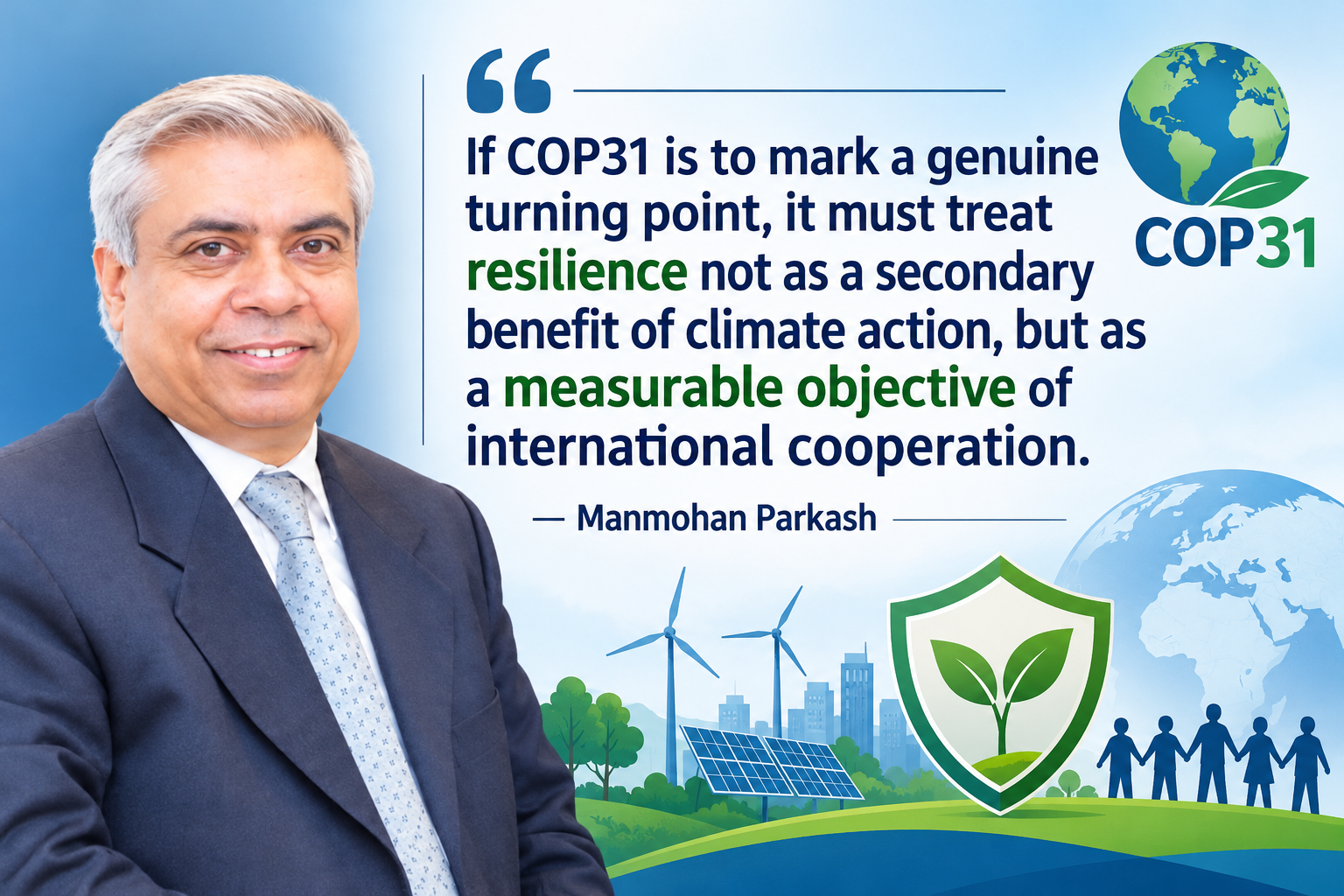
If COP31 is to mark a genuine turning point, it must treat resilience not as a secondary benefit of climate action, but as a measurable objective of international cooperation. The world cannot afford to weaken its commitment to decarbonisation. But neither can it assume that reducing emissions alone will protect societies from the climate consequences already unfolding.
The next generation of climate policy must pursue two equally indispensable objectives: limiting future warming and reducing human vulnerability to the warming already underway.
The future of the planet depends on the first. The security and prosperity of humanity depend on achieving both.
(Manmohan Parkash is a former Senior Advisor in the Office of the President and former Deputy Director General for South Asia at the Asian Development Bank (ADB). Views expressed are personal.)






Comment