




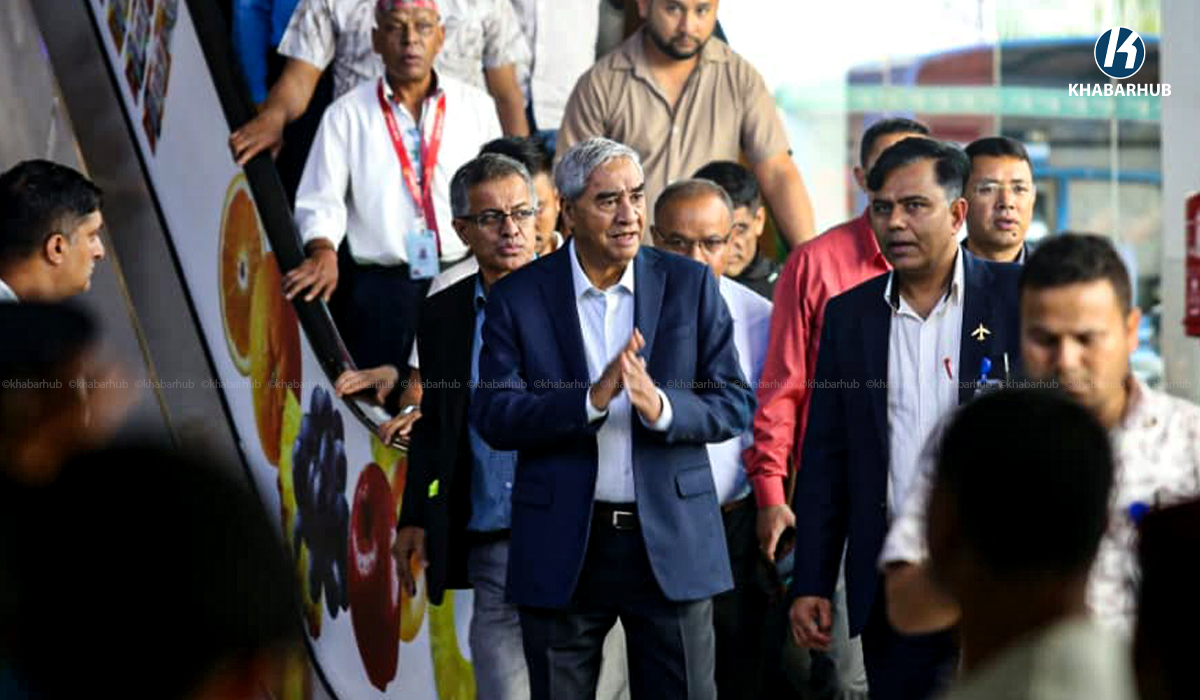
KATHMANDU: Former Nepali Congress president Sher Bahadur Deuba has delivered a series of political messages after returning to Nepal following nearly five months abroad for medical treatment, adopting a notably softer tone towards party president Gagan Thapa.
Deuba returned to Kathmandu on Thursday amid a high-profile welcome, after remaining abroad amid political and legal speculation surrounding his return.
In a statement issued after his arrival, Deuba appeared to acknowledge the generational transition taking place within the Nepali Congress, while also cautioning against sidelining the older generation.
Although he did not directly name Thapa, who replaced him as party president through a special general convention last year, Deuba’s remarks on ego, generational change and party unity carry an apparent message for the current leadership.
1. Congress must address Gen-Z demands
Deuba said the Nepali Congress must acknowledge the legitimate demands for change raised by the younger generation during the Gen-Z movement last September.
He recalled that he had supported addressing the legitimate demands of the movement at the time.
However, he stressed that embracing change should not mean dismissing the struggles and sacrifices made by previous generations.
2. Move youth forward, but don’t discard older generation
One of Deuba’s clearest messages was that generational transition should not come at the cost of experienced leaders.
“Young people should move forward, but the narrative that all senior and experienced people are bad is wrong,” Deuba said.
He said his political experience should be passed on to the younger generation, suggesting that the transition of leadership should involve both generations rather than completely replacing one with the other.
3. Government must respond to people’s desire for change
Deuba did not directly attack the government led by Balendra Shah.
Instead, he said the current government has a responsibility to respond to the people’s desire for change.
He warned that failing to respect a fresh public mandate would not be in the interests of either the ruling party or the country.
Deuba also said the Nepali Congress was ready to contribute to the process of managing the ongoing political change.
4. He returned to strengthen national unity
Deuba said he had returned to Nepal not to seek power or position but to contribute to strengthening national unity.
He invoked BP Koirala’s policy of reconciliation and called for an end to the divisions and hostility of the past.
Deuba stressed that the country should choose reconciliation over retaliation and move towards broader political unity.
5. Congress must resolve its internal dispute
Deuba called for the immediate resolution of disagreements and frustration within the Nepali Congress.
He said the party must remain focused on the interests of the people rather than the egos of individual leaders.
“The Nepali Congress must move forward not on anyone’s ego, but by keeping the supreme interests of the people at the centre,” he said.
The message comes as the party remains divided over its leadership, organisational direction and generational transition.
6. Gagan not named, but message is clear
Deuba did not mention the name of current party president Gagan Kumar Thapa anywhere in his statement.
However, his comments on generational change, respect for experienced leaders and the dangers of ego-driven politics are being viewed as an indirect message to the current leadership.
Thapa became party president after the special general convention held last year, effectively ending Deuba’s tenure as party chief.
Deuba’s call for the immediate resolution of internal disagreements also comes as rival factions prepare for a national gathering and debate the future direction of the party.
7. National consensus needed on Constitution
Deuba also called for the protection of the Constitution while allowing necessary amendments through national consensus.
He said the Constitution was achieved through the long struggle and sacrifices of Nepalis and should be protected through broad political agreement.
He called on the Nepali Congress and other political parties to work through consensus and cooperation to strengthen nationalism and democracy.
Deuba’s return and his first political statement after nearly five months abroad have therefore set the tone for his re-entry into active politics.
Rather than launching a direct attack on Thapa, Deuba has emphasised reconciliation, generational balance, national unity and respect for the people’s mandate—messages that could shape the next phase of the Congress power struggle.





Comment