




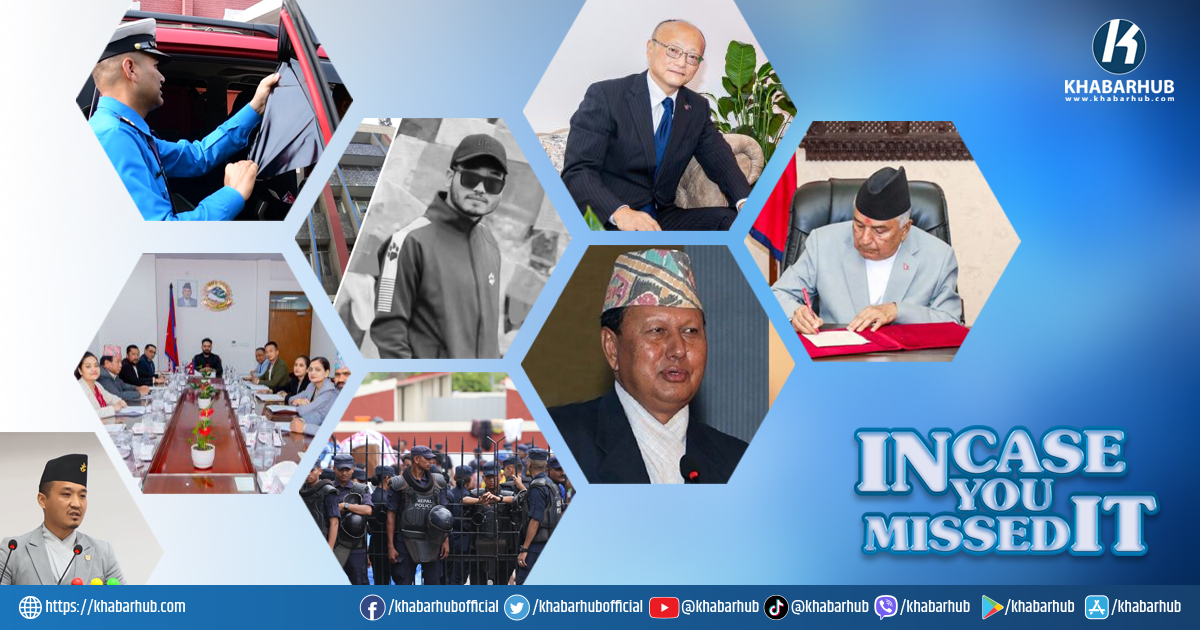
KATHMANDU: The past week marked a significant period in Nepal’s political, judicial and economic landscape. Courts delivered landmark verdicts in one of the country’s biggest political corruption scandals, the government intensified its governance and economic reform agenda, international development cooperation gained fresh momentum, and troubling incidents exposed continuing weaknesses in public service delivery and social protection.
Collectively, these developments reflected a country attempting to strengthen institutional accountability while simultaneously pursuing economic revival under Prime Minister Balendra Shah’s newly elected administration. However, the week’s events also underscored the deep structural challenges that continue to confront Nepal—from corruption and administrative inefficiency to political disagreements and public frustration.
Judiciary Reinforces Accountability
Undoubtedly the week’s most significant development was the Kathmandu District Court’s verdict in the fake Bhutanese refugee scam, one of Nepal’s most politically explosive criminal cases in recent years.
The conviction of former Deputy Prime Minister Top Bahadur Rayamajhi and former Home Minister Bal Krishna Khand represents a rare instance where senior political figures have been held criminally liable for abusing public office. The court concluded that the accused participated in a scheme that falsely promised Nepali citizens resettlement in the United States by fraudulently portraying them as Bhutanese refugees.
The convictions extended beyond politicians to include former Home Secretary Tek Narayan Pandey, refugee leader Tek Nath Rizal, political aides and several intermediaries, illustrating the extensive network allegedly involved in the operation. Although sentencing remains pending, the verdict itself carries substantial political significance.
For years, critics have argued that high-profile corruption cases in Nepal rarely reach meaningful judicial conclusions due to political interference or prolonged legal delays. The court’s decision therefore sends an important signal regarding judicial independence and the willingness of institutions to pursue accountability regardless of political status.
Nevertheless, the verdict alone cannot restore public confidence. Much will depend on whether appeals proceed transparently and whether future governments refrain from politicising judicial outcomes.
Mixed signals in fght against corruption
Another notable judicial development came from the Special Court’s ruling in the Teramax telecommunications corruption case. While three former Nepal Telecommunications Authority officials were convicted and sentenced to prison, former Communications Minister Mohan Bahadur Basnet was acquitted of all charges.
The contrasting outcomes in the two major corruption cases demonstrate an important principle often overlooked in politically charged environments: accountability requires evidence rather than public perception. The acquittal illustrates that anti-corruption efforts cannot simply become instruments for political punishment. Instead, convictions must be grounded in credible evidence capable of surviving judicial scrutiny.
At the same time, repeated corruption scandals involving procurement, public infrastructure and government contracts continue to expose weaknesses in Nepal’s governance architecture. The challenge now lies not only in prosecuting wrongdoing but also in preventing corruption through stronger procurement systems, digital governance, greater transparency and institutional oversight.
Government prioritises economic revival
Economic management emerged as another defining theme of the week. Prime Minister Balendra Shah held a series of consultations with private sector leaders, business organisations and construction industry representatives. These meetings reflected a deliberate shift towards collaborative policymaking.
Business leaders raised longstanding concerns including policy instability, delayed government payments, regulatory complexity, investment uncertainty and bureaucratic inefficiency. The Prime Minister responded by pledging legal, administrative and policy reforms aimed at improving Nepal’s investment climate. Such engagement is particularly significant because private investment has remained sluggish despite abundant banking liquidity.
Nepal’s economic recovery increasingly depends upon rebuilding investor confidence rather than relying solely on remittance-driven consumption. Whether these consultations translate into concrete policy reforms will largely determine the government’s economic credibility in the coming months.
NRB projects stronger growth but warns of structural risks
Adding cautious optimism, Nepal Rastra Bank projected that economic growth could reach seven percent during fiscal year 2026/27. The projection rests upon assumptions of improved private sector confidence, stronger domestic investment and continued policy reforms. However, the central bank’s report also highlighted several structural vulnerabilities. Growth for the current fiscal year remains below four percent, reflecting slow credit expansion despite ample banking liquidity.
Banks continue to face deteriorating asset quality, declining profitability and pressure on capital adequacy. Meanwhile, although remittances continue to strengthen foreign exchange reserves and maintain external stability, Nepal remains heavily dependent upon overseas employment. The report also identified weak capital expenditure as a major concern.
Government borrowing increasingly finances debt repayment instead of productive development projects. Without substantial improvements in public investment execution, achieving sustained high economic growth may prove difficult despite favourable macroeconomic indicators. The report therefore offers both encouragement and caution: Nepal’s economy possesses significant potential, but structural reforms remain indispensable.
ADB Support Strengthens Nepal’s Development Outlook
The visit of Asian Development Bank President Masato Kanda further reinforced Nepal’s economic prospects. ADB announced plans to provide approximately US$2.4 billion in financial assistance aimed at accelerating economic transformation, promoting investment and creating employment. The announcement carries importance beyond its monetary value.
International financial institutions increasingly evaluate governance quality alongside infrastructure needs. ADB’s continued commitment suggests confidence in Nepal’s development trajectory while also raising expectations regarding effective project implementation.
Prime Minister Shah’s meeting with Kanda highlighted infrastructure, investment and economic reforms as common priorities. The challenge now will be ensuring that development assistance produces measurable outcomes rather than becoming delayed within Nepal’s often cumbersome administrative processes.
Administrative reforms continue
The appointment of Govinda Bahadur Karki as Nepal’s new Chief Secretary represents another important administrative development. As the country’s highest-ranking civil servant, the Chief Secretary plays a central role in coordinating government implementation. The appointment comes at a time when the government is emphasizing governance reforms and improved service delivery.
Similarly, changes within public institutions—including the resignation of Nepal Stock Exchange CEO Chudamani Chapagain—reflect broader efforts to reorganize government-appointed positions following the political transition. Whether these personnel changes improve institutional performance will depend less on individual appointments than on strengthening administrative systems and accountability mechanisms.
Higher Education Faces Greater Regulation
The government’s approval of new regulations governing foreign-affiliated colleges represents a significant policy reform within higher education. By requiring affiliated universities to rank among the world’s top 1,000 institutions and strengthening quality assurance standards, the government aims to improve academic credibility and protect students from substandard educational programmes.
The decision responds to growing concerns regarding the rapid expansion of foreign-affiliated colleges with varying academic standards. However, implementation will require balanced regulation that protects educational quality without unnecessarily restricting international academic partnerships.
Public service delivery under scrutiny following tragic deaths
Perhaps the week’s most emotionally powerful developments were the deaths of Ganesh Nepali and Ashwin Raut following separate self-immolation attempts. Ganesh Nepali’s case attracted nationwide attention after he sustained critical burns outside the Department of Passports. His death sparked renewed criticism regarding public service delivery, administrative responsiveness and citizen frustration. The government’s decision to establish an investigation committee indicates recognition of the incident’s seriousness.
However, investigations alone cannot address deeper systemic problems. When citizens resort to such desperate acts, broader questions arise regarding bureaucratic efficiency, grievance mechanisms and access to public services. Improving administrative responsiveness may therefore become as important as broader economic reforms.
Civil Liberties Questions Emerge
Another issue attracting public attention was the detention of Gen-Z campaigner Majid Ansari while visiting flood-displaced families in Kirtipur. Although police have yet to clarify the reasons for the detention, the incident generated criticism from civil society and youth groups.
In democratic societies, interactions between law enforcement and peaceful civic engagement require transparency and proportionality. Prompt official clarification would help prevent unnecessary speculation while reinforcing public trust.
Political Consensus Remains Elusive
Despite the government’s reform agenda, constitutional politics experienced renewed friction. The CPN-UML formally withdrew from the government’s constitutional amendment task force, citing concerns regarding its objectives and possible implications for Nepal’s constitutional framework.
The withdrawal highlights the continuing difficulty of achieving political consensus on constitutional reform. Constitutional amendments require broad cross-party agreement, particularly on issues involving federalism, governance and institutional structure. Without inclusive dialogue, meaningful constitutional reform will remain politically challenging.
Legislative Progress Continues
Amid broader political debates, President Ram Chandra Paudel certified four important bills passed by Parliament. The legislation covers public procurement, money laundering prevention, cooperatives and health sciences. These measures represent incremental but important steps toward improving governance, financial regulation and institutional effectiveness.
Particularly noteworthy is the amendment concerning money laundering, given Nepal’s continuing efforts to strengthen financial oversight and comply with international regulatory standards.
Conclusion
Last week’s developments illustrate both the opportunities and complexities facing Nepal. On one hand, landmark judicial decisions demonstrated growing institutional willingness to hold powerful individuals accountable. The government’s active engagement with the private sector, strong support from international development partners and ambitious economic projections collectively suggest renewed momentum for reform. On the other hand, persistent structural weaknesses remain evident.
Slow capital spending, dependence on remittances, governance challenges, administrative inefficiency, political fragmentation and citizen frustration continue to constrain Nepal’s development. Ultimately, the coming months will determine whether recent initiatives evolve into lasting institutional improvements.
Judicial accountability must be complemented by preventive governance reforms. Economic optimism must be supported by effective implementation. International financial assistance must produce tangible development outcomes. Administrative restructuring must translate into better public services.
The week therefore reflected a broader reality of contemporary Nepal: a nation demonstrating increasing institutional maturity while continuing to grapple with long-standing governance challenges. Sustaining reform momentum, maintaining political consensus and improving implementation capacity will ultimately determine whether these encouraging developments produce meaningful long-term transformation.






Comment