




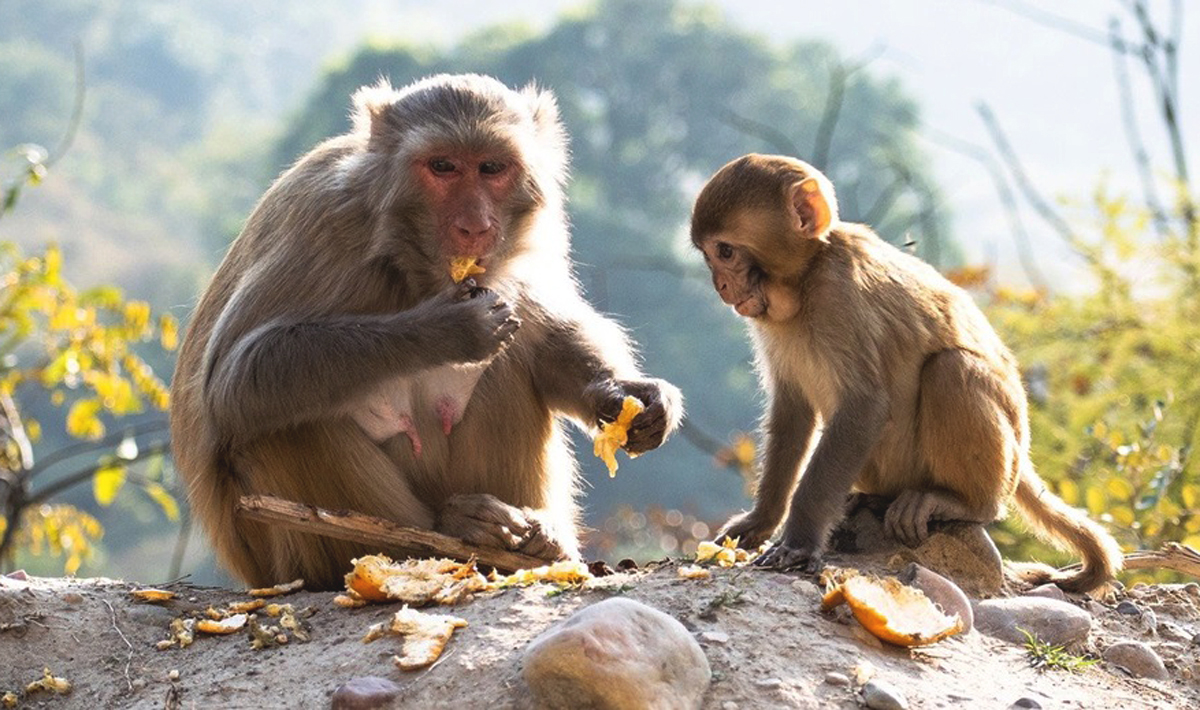
KATHMANDU: The growing monkey menace is no longer limited to Nepal’s villages. In recent years, the problem has spread into the capital Kathmandu, affecting residential areas and religious sites alike.
Around major heritage areas such as Pashupati and Swayambhu, residents say monkeys have become increasingly disruptive, forcing people to stay alert day and night to protect kitchens, gardens and rooftop farms.
With limited land availability in Kathmandu, rooftop farming has become common. But residents say even those small patches of cultivation are no longer safe.
Monika Baral, a resident of Gaushala, says monkeys around Pashupati have become so accustomed to urban life that they enter homes by opening doors themselves.
“They open doors and walk inside like people. They know where food is kept,” she told Khabarhub. “They find the kitchen and even the prayer room. They eat cooked food and fruits offered to God.”
According to her, the damage goes beyond food.
“They take shoes left outside. They even steal clothes drying on rooftops — including innerwear,” she said. “Later we found out they chew the elastic. They also open rooftop taps to drink water but never close them. If unnoticed, the entire tank empties and water enters the house.”
Despite facing such disturbances every day, Baral says killing monkeys is not the answer.
“The Earth belongs to all living beings. Every creature has the right to live,” she said. “If we destroy one species, the ecosystem suffers. Humans should not solve problems by eliminating animals.”
Monkey attacks driving migration in villages
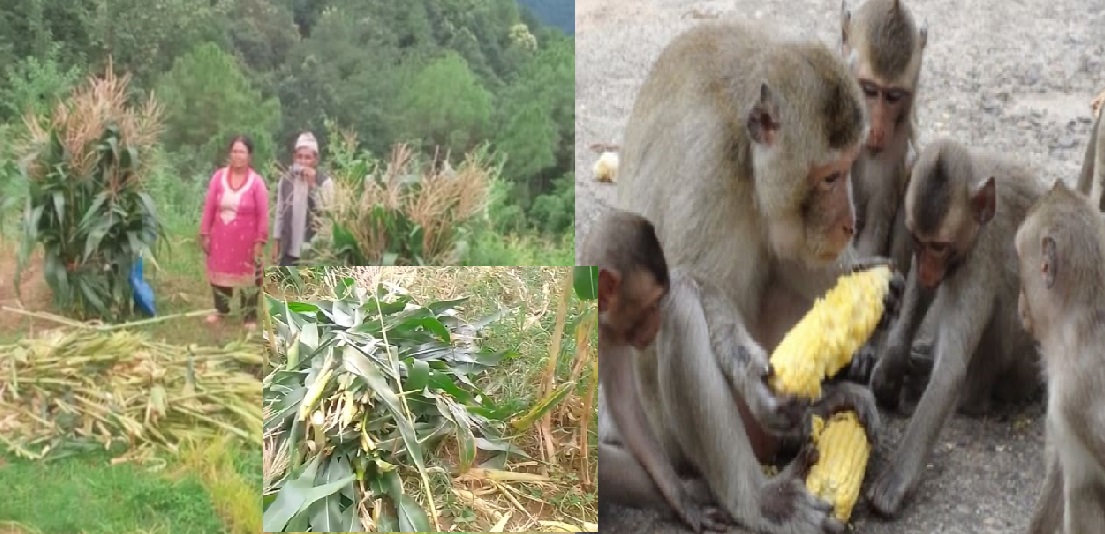
The monkey problem has become increasingly severe across rural Nepal, where farmers say crop destruction is forcing families to leave agriculture and migrate elsewhere.
The issue has repeatedly entered parliamentary debate in recent years.
In January 2024, a Nepali technical team visited India’s Himachal Pradesh under the coordination of Parliament’s Agriculture, Cooperative and Natural Resources Committee to study monkey population management.
The issue has again become a prominent topic in the House of Representatives.
Political leaders had also promised monkey management during recent elections.
However, opinions remain divided.
Some lawmakers have openly argued that monkey populations should be reduced, while others insist animals also have a right to survive and that humans should avoid interfering with nature.
Labor Culture Party leader Dhruv Rai has repeatedly advocated monkey culling in Parliament.
He previously claimed that while serving as chairperson of Temkemaiyung Rural Municipality–9 in Bhojpur, around 600 monkeys were killed under local management efforts.
Rai has since argued that Nepal may need to eliminate up to 600,000 monkeys to control the problem.
Supporting that position, former minister Sudan Kirati warned that monkeys continue adapting rapidly.
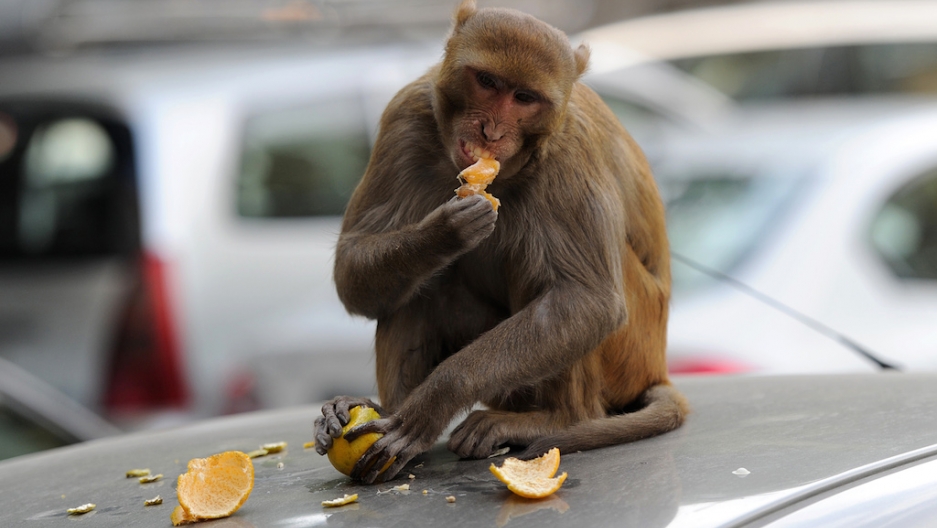
“Earlier monkeys did not eat oranges. Now they have adapted to eating them. They have even learned to wash corn before eating,” he said at a public event. “At this rate, one day they may even learn to throw stones at people.”
Animal rights groups oppose culling
Animal rights activists have strongly opposed calls for mass killing.
Demonstrations have been held at Maitighar Mandala against proposals to kill monkeys, and complaints have also been filed against lawmakers supporting such measures.
Nepal is home to around five monkey species.
Among them, rhesus monkeys are known to adapt closely to human environments, while langurs generally avoid human settlements.
Gaushala resident Suresh Chapagain argues that human expansion is largely responsible for the conflict.
“There used to be dense forests and plenty of food,” he said. “As human settlements expanded, monkey habitats disappeared. That is why they started entering our communities.”
According to him, monkeys have become increasingly strategic in obtaining food.
“Temple monkeys used to snatch bags. Now they take phones and glasses instead,” he said. “Not because they want to eat them, but because people then offer food to get their belongings back.”
Chapagain believes Nepal should explore alternatives rather than culling.
“We can plant food-bearing trees such as chestnut, kafal and local fruit species in forests,” he said. “Sterilization is another option. Sri Lanka has trained monkeys for coconut harvesting — perhaps Nepal can also explore innovative approaches.”
He also argues against killing monkeys on religious grounds.
“We worship Hanuman and offer the first harvest to him. It does not make sense to worship monkeys on one side and kill them on the other.”
Communities taking matters into their own hands
The pressure has become so severe in some areas that local governments have stepped in.
On May 15, Laligurans Municipality in Tehrathum announced a public holiday to mobilize residents to drive monkeys away after repeated complaints.
Residents carrying sticks, metal sheets and slingshots joined efforts to chase monkeys from fields and settlements.
Locals say they now remain alert not only during the day but sometimes even at night.
Meanwhile, some residents have floated unconventional ideas.
Durga Lamichhane, whom Khabarhub met near the Pashupati area, argued that monkeys should be relocated or sold rather than killed.
“People living in cities cannot imagine the suffering faced by villagers,” he said. “If villages become empty, people and eventually monkeys will all move to cities.”
He added that emotional responses alone would not solve the issue.
“The government should act quickly and think about long-term damage.”
A similar proposal had surfaced in Parliament three years ago when Nepali Congress leader Ramhari Khatiwada suggested Nepal could study examples such as Sri Lanka’s monkey export policies as part of broader population management discussions.
As monkey-human conflict intensifies across Nepal, the debate remains unresolved: should the country control the population, restore habitats, or find ways for humans and wildlife to coexist?





Comment