




Operation Epic Fury—the joint US–Israel military campaign launched against Iran following the death of Supreme Leader Ali Khamenei and numerous other senior political and military leaders—represents a critical test of prevailing intimidation strategies by great powers, but it is also part of a global reordering that entails both strategic vulnerability and upheaval, or the potential for a new order.
Supporters argue that the campaign demonstrates escalation control, exposes regime vulnerability, and could free the US to concentrate on strategic competition with China. Critics question whether airpower alone can compel capitulation or collapse a resilient authoritarian regime.
This essay analyzes the conflict through two theoretical lenses: structural realism and compellence diplomacy. It argues that while the campaign reflects realist logic in its regional balancing and China-focused strategic calculus, its operational success depends on far more fragile assumptions of pressure-based diplomacy—specifically, the belief that calibrated military force can induce political surrender without occupation.
The outcome ultimately hinges on three variables: missile suppression, American casualty tolerance, and elite fragmentation inside Iran.
Introduction: War and Strategic Reordering
Operation Epic Fury has been framed by its proponents as a limited but decisive campaign designed to degrade Iran’s missile and nuclear infrastructure, dismantle its proxy network, and potentially trigger regime transformation—all without American ground occupation.
At the same time, the campaign carries an explicit strategic objective beyond the Middle East: enabling the US to redirect attention and resources toward long-term competition with China.
Operation Epic Fury represents a fusion of realist strategy and hard-power diplomacy. From a structural perspective, weakening Iran could reduce Chinese leverage in the Middle East and restore American strategic flexibility. The geopolitical rationale for the campaign is therefore clear.
The conflict therefore raises a central question in international relations theory: is the campaign primarily a realist act of regional balancing, or an experiment in hard-power diplomacy aimed at forcing regime capitulation through calibrated force?
In practice, it is both. The strategic rationale for confronting Iran reflects the logic of structural realism, in which great powers attempt to remove regional challenges that drain resources and complicate broader geopolitical competition.
Yet the operational design of the campaign relies heavily on power-driven diplomacy—the attempt to achieve political change through limited military force, economic pressure, and psychological shock rather than conquest.
This fusion creates a fundamental tension. Realism assumes endurance and long-term power balancing, while hard-power diplomacy depends on speed, credibility, and psychological pressure. Operation Epic Fury therefore represents not only a military campaign but also a test of whether forceful airpower can achieve decisive political results in an era defined by great-power rivalry.
The Realist Logic: Strategic Bandwidth and Great-Power Competition
From a structural realist perspective, the campaign against Iran reflects a broader effort by the US to simplify the global strategic environment. Great powers seek to minimize distractions, consolidate favorable balances of power, and prevent rivals from exploiting peripheral theaters.
For Washington, the Indo-Pacific has increasingly become the primary arena of geopolitical competition, but a second priority after the Western Hemisphere. Yet for decades, Iran has functioned as a persistent drain on American strategic bandwidth.
Tehran’s missile arsenal, proxy networks, and maritime disruption capabilities have required continuous US military deployments to the Persian Gulf and surrounding regions.
Iran’s ability to threaten shipping through the Strait of Hormuz and the Red Sea imposes global economic risks and demands an ongoing naval presence. These commitments tie down military assets that might otherwise be deployed to deter China in the Western Pacific.
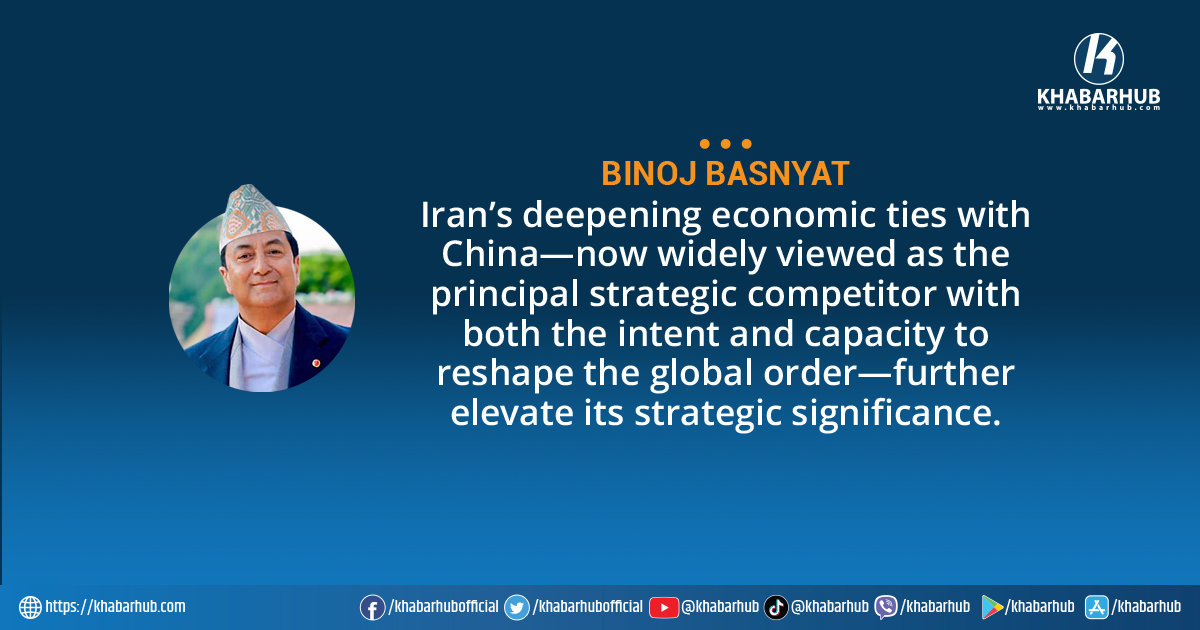
Iran’s deepening economic ties with China—now widely viewed as the principal strategic competitor with both the intent and capacity to reshape the global order—further elevate its strategic significance. In this context, Iran–Russia cooperation is increasingly embedded within a broader Iran–Russia–China alignment rather than a purely bilateral axis.
Beijing’s sustained purchases of discounted Iranian oil, alongside its infrastructure investment and financial channels that help Tehran bypass sanctions, have made China a central enabler of Iran’s economic resilience.
In effect, Iran operates as a regional node within a wider Chinese effort to reconfigure the global balance of power. The emergence of a revisionist alignment among these actors—capable of challenging the security architecture and sovereignty of US allies and partners—now represents one of the defining strategic risks of the contemporary international system.
While cooperation between Iran and Russia predates Moscow’s pivotal 2015 military coordination with Tehran in Syria, it has since evolved from episodic, tactical coordination into a more institutionalized defense partnership. The longstanding assumption—particularly among Middle East analysts—that Russia held dominant leverage and could moderate Iran’s destabilizing behavior is increasingly untenable.
Russia’s war in Ukraine has not only eroded this asymmetry but has reversed elements of it, with Moscow now relying on Tehran for critical military support.
This shift demands a reassessment of prevailing strategic assumptions. The Iran–Russia partnership is neither temporary nor transactional; it reflects a deeper convergence of interests and worldview. It is underpinned by deliberate coordination aimed at resisting US-led efforts to isolate and constrain both actors.
Any effective strategy to mitigate this challenge must therefore account for the evolving balance of influence within this partnership and its broader alignment with China.
Seen through this lens, Operation Epic Fury is not simply about nuclear enrichment levels or missile ranges. It reflects a broader attempt to remove a persistent strategic irritant that complicates American global priorities.
Every carrier strike group deployed to deter Iran is one less available for potential contingencies involving Taiwan or the South China Sea. Weakening Iran therefore offers the possibility of freeing US resources for more pressing theaters.
The reactions of other major powers are broadly consistent with this realist framework. China has condemned the strikes but avoided military involvement. Russia has increased arms transfers but shown little appetite for direct escalation.
Neither power benefits from a direct confrontation with the US over a secondary partner. Instead, both appear content to support Iran just enough to prevent rapid collapse while avoiding a wider conflict.
If the campaign significantly degrades Iran’s military capabilities and reduces its capacity for regional disruption, the US may succeed in simplifying the Middle Eastern balance of power. That alone would represent a strategic gain.
But realism explains why the campaign occurred, not how it is being fought.
The Hard-Power Strategy
Operation Epic Fury is not an invasion. It is a hard-power campaign.
Rather than occupying territory or overthrowing the Iranian regime through ground forces, the US and Israel are attempting to compel political change through a combination of precision strikes, economic pressure, and controlled escalation. The strategy relies on imposing costs that convince Iranian leaders that continued resistance will only worsen their position.
The ultimate significance of Operation Epic Fury therefore extends well beyond Iran. It is a test of whether modern force-backed strategies can achieve decisive political outcomes in a multipolar world—without repeating the costly overreach of past interventions.
This approach follows the logic of attrition warfare, cognitive warfare, and imposition-based diplomacy, a concept developed by strategic theorists who argued that limited force could be used to influence adversary behavior without full-scale war. The goal is not conquest but persuasion—using credible threats and calibrated violence to alter the calculations of the opposing leadership.
Conclusion: A Test of Leverage-Based Statecraft
Operation Epic Fury represents a fusion of realist strategy and hard-power diplomacy. From a structural perspective, weakening Iran could reduce Chinese leverage in the Middle East and restore American strategic flexibility. The geopolitical rationale for the campaign is therefore clear.
Its success, however, depends on a far more uncertain proposition: that calibrated military pressure can compel a resilient authoritarian regime to yield without the application of overwhelming ground force.
If Iran’s missile capacity collapses quickly, if internal divisions emerge, and if American casualties remain limited, the campaign may validate a model of coercive statecraft suited to an era of great-power rivalry. Precision airpower and economic pressure could become tools for reshaping adversarial regimes without the burdens of occupation.
If the regime endures, however, and the conflict evolves into a prolonged exchange of attritional strikes, the strategic logic behind the campaign may begin to unravel. Resources intended for competition with China would instead remain tied down in the Middle East.
The ultimate significance of Operation Epic Fury therefore extends well beyond Iran. It is a test of whether modern force-backed strategies can achieve decisive political outcomes in a multipolar world—without repeating the costly overreach of past interventions.
The outcome will shape not only the future of the Islamic Republic but also the credibility of hard-power diplomacy as an instrument of statecraft in the twenty-first century.
(Basnyat is a Major General (retired) of the Nepali Army and a strategic affairs analyst. He is also a researcher affiliated with Rangsit University in Thailand.)



Comment