




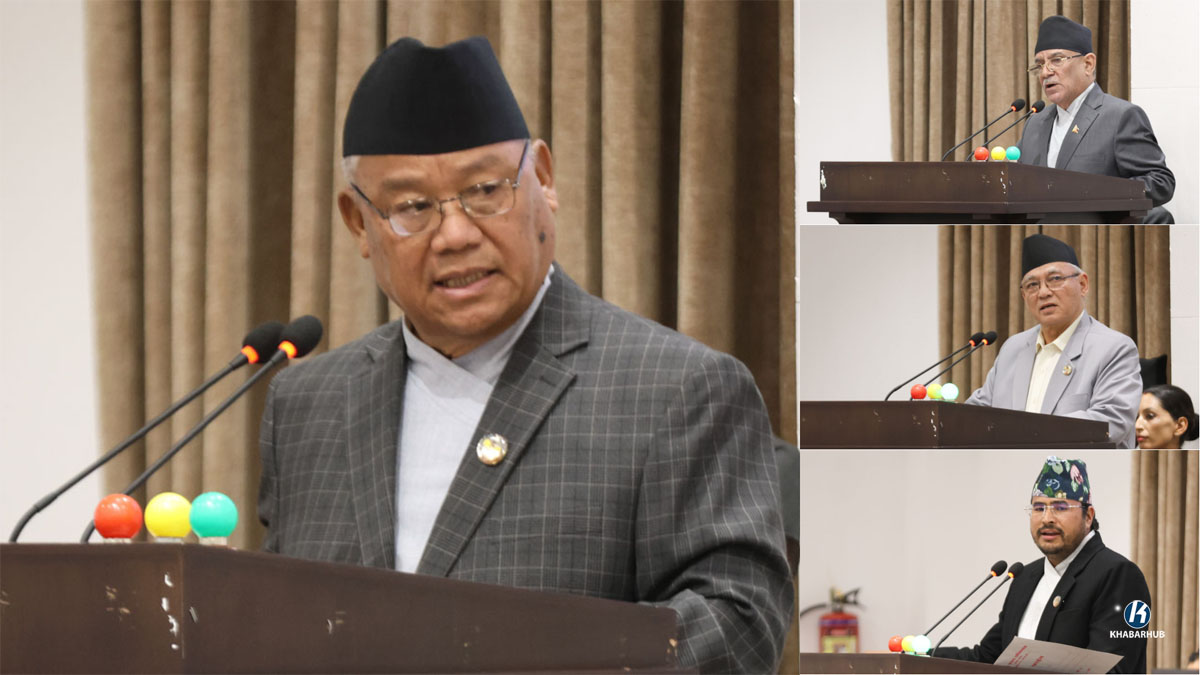
KATHMANDU: Opposition parties in Parliament have expressed mixed reactions and criticism toward the policy and programme for the upcoming fiscal year unveiled by the government led by Prime Minister Balen Shah.
The CPN- UML party said the policy and programme should be completely rejected, while the main opposition Nepali Congress described it as largely a continuation of old policies. Meanwhile, the Nepali Communist Party offered a mixed response, and the Rastriya Prajatantra Party accused the government of presenting a “copy-paste” document that ignored Karnali and Sudurpashchim provinces.
Leader of the opposition parliamentary party Bhishmaraj Angdembe strongly criticized the government for introducing ordinances by bypassing Parliament.
He said none of the commitments promised to be completed within 30 days under the government’s 100-point populist programme had been fulfilled.
Angdembe also expressed dissatisfaction over the lack of adequate pre-budget discussions despite the commencement of the budget session. He argued that lawmakers and stakeholders should have been given at least two months for broader consultations.
Although the policy and programme introduced new terms such as “strategic infrastructure,” “digital economy,” “remote work,” and “service exports,” Angdembe said it lacked concrete implementation plans.
“The old disease of policy on one side and budget on the other still persists,” he said, adding that the practice of distributing the budget “like scattered grains” should end.
UML parliamentary party leader Ram Bahadur Thapa, also known as Badal, described the government’s policy and programme as entirely rejectable.
He claimed the 100-point commitment announced by the ruling Rastriya Swatantra Party was aimed at establishing authoritarianism and said the policy and programme presented by President Ram Chandra Poudel was merely its continuation.
“The 100-point policy and programme presented by the President is a revised continuation of that so-called 100-point commitment,” Thapa said. “To save the nation from extraordinary crisis, it must be rejected in its entirety and completely rewritten.”
Thapa also criticized the government for remaining silent on issues related to violent protests, the role of the Nepali Army during the Gen-Z movement and the mobilization of security forces in squatter settlements.
Former prime minister and Nepali Communist Party coordinator Pushpa Kamal Dahal, also known as Prachanda, said the government should learn from past mistakes, including those of previous administrations.
He criticized the rushed process of presenting the policy and programme, saying parliamentary discussions had become largely ceremonial.
Prachanda further argued that despite the government being formed on the aspirations of Madhesi communities, the policy and programme remained silent on Madhesi and Dalit issues.
“RSP chair Rabi Lamichhane apologized on behalf of the state to the Dalit community, but that apology was nowhere reflected in the government’s policy and programme,” he said.
However, Prachanda welcomed the inclusion of information technology-related policies in the programme.
Harka Raj Rai criticized the government for failing to protect national borders and expressed dissatisfaction over the demolition of temples and churches.
Similarly, Rastriya Prajatantra Party parliamentary leader Gyanendra Shahi criticized the forced eviction of squatters living along the Bagmati riverbanks without sufficient time or humanitarian consideration.
Shahi claimed that the current policy and programme was nearly identical to that of the previous government, alleging that only around 10 percent differed.
“We had expected major reforms because many new faces have entered Parliament from different parties,” he said. “But the policy and programme is almost an exact photocopy, with some words copied exactly as before.”
He also criticized the government for neglecting Karnali and Sudurpashchim provinces and urged authorities to prioritize Karnali in the upcoming budget.




Comment