




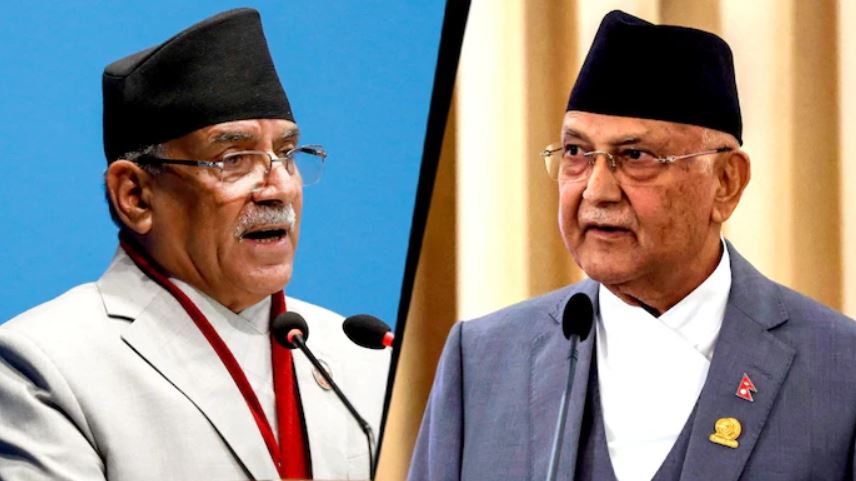
KATHMANDU: The CPN-UML and the Nepali Communist Party (NCP) have proposed a framework for the formation of provincial governments and the allocation of ministerial portfolios.
The framework has been proposed as part of the implementation of the three-point agreement reached between the two parties on July 25.
The proposal, signed by UML Chair KP Sharma Oli and NCP Coordinator Pushpa Kamal Dahal ‘Prachanda’, states that the number of seats held by each party in the respective provincial assembly will be the primary basis for forming provincial governments.
Similarly, ministries will generally be distributed in proportion to the number of seats held by the parties in the provincial assemblies. The proposal also states that the positions of chief minister and speaker will be taken into account when determining the overall balance of power.
Party not taking CM post to choose Ministry first
The two parties have proposed a system of taking turns when selecting ministries.
Under the proposed arrangement, the party that does not take the chief ministerial position will have the first choice of ministry.
The party holding the chief ministerial position will then choose the second ministry. The process will continue alternately until all ministries are allocated.
If the two parties do not have enough seats to form a government in a provincial assembly, a third party may also be brought into the government.
In such cases, ministries will be allocated through mutual understanding with the third party, while the remaining ministries will be selected alternately by the parties.
Minimum common commitment for Provinces
The UML and NCP have also proposed that provincial governments formulate and publicly announce a minimum common commitment aimed at promoting federalism, political stability, good governance, prosperity and accelerated provincial development.
The provincial governments are expected to base their performance on the minimum common commitment.
The two parties have also emphasized strengthening mutual understanding and making cooperation more sustainable while operating provincial governments.




Comment