




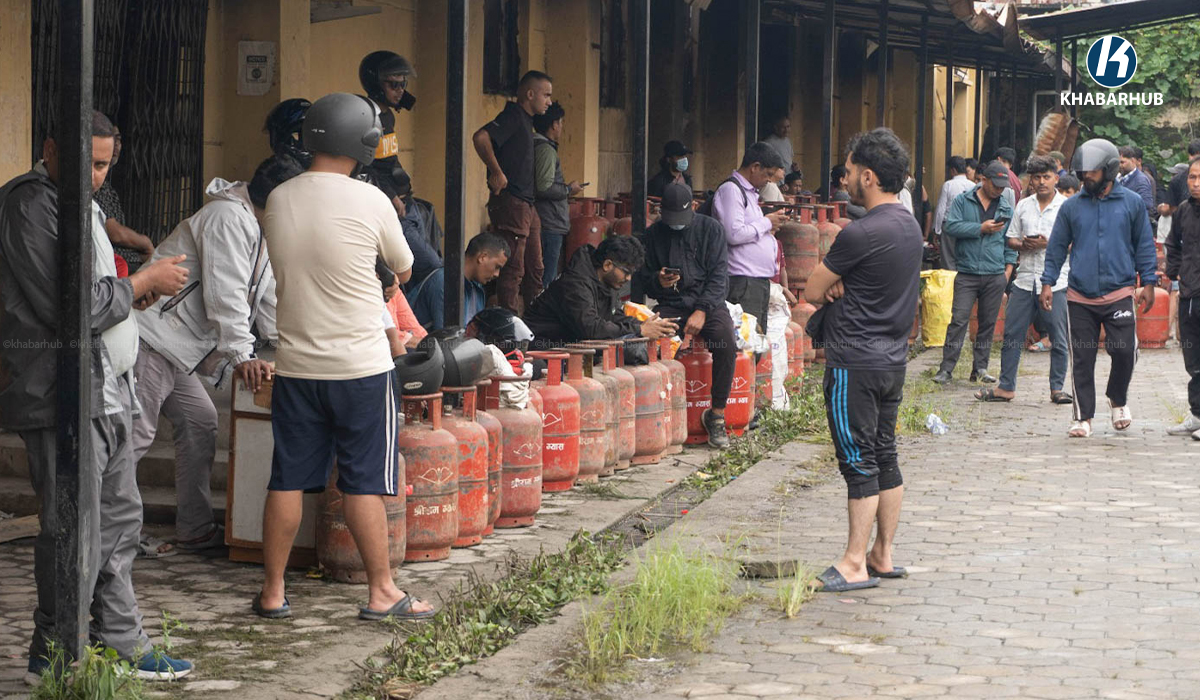
KATHMANDU: It has been a week since government agencies began assuring that cooking gas supplies were sufficient. Yet consumers across the country continue to struggle to obtain LPG cylinders.
Consumers are spending hours, and in some cases entire days, in queues for even half cylinders of cooking gas, with many returning home empty-handed.
Scenes of mothers carrying children on their backs while moving from one gas dealer to another in search of LPG have emerged. Videos of Industry Minister Gauri Kumari Bista herself attending a hotline to address the gas shortage have also circulated.
Despite the government continuing to claim that LPG supplies are gradually returning to normal, consumers were still seen queuing at depots and searching for gas dealers as of Tuesday morning.
Long queues have continued in Kathmandu Valley and many other parts of the country.
On Monday, a teacher from Morang, Bishwobir Mebahang, said hundreds of metres of queues for gas reflected the government’s failure to manage the crisis. He said he finally received a cylinder after waiting for eight hours.
Similarly, Dang-based journalist Uday GM said he had to stand in a gas queue for the first time in his life. After waiting for four hours, he managed to obtain a cylinder, describing it as an achievement equivalent to winning a war.
Thousands of other consumers, however, continued to return home with empty cylinders even after waiting for hours.
This has raised a serious question: Is the problem actually a shortage of gas, or is the distribution system failing?
Consumers have been standing in queues for hours in heavy monsoon rain. Women carrying children and elderly people have also been seen waiting in line.
At some dealers and shops, consumers are still being told that the available gas has already run out.
There have also been complaints that consumers are being forced to pay more than the officially fixed price.
Reports that some traders charged as much as Rs 7,000 for a cylinder have already led to police intervention and legal action.
Even as allegations of black marketing and additional charges under the guise of gas delivery continue, questions are being raised over the effectiveness of the government’s monitoring mechanism.
Nepal Oil Corporation, which is primarily responsible for the country’s fuel supply, has maintained that sufficient LPG is being imported from India.
The corporation has said the situation is improving and that supplies will become normal within a few days.
But if supplies are genuinely sufficient, why are consumers having to spend an entire day in line for a single cylinder? If stocks are adequate, why are consumers still returning empty-handed from dealers? And if the government-fixed price remains unchanged, how has a black market emerged?
The government now faces the need to answer these questions not merely through assurances but through data and transparency.
Is the problem with imports or distribution?
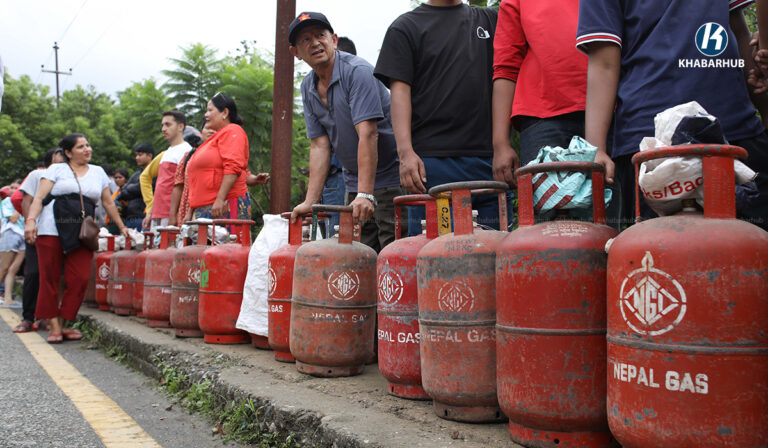
Nepal’s LPG supply depends heavily on imports from India. Supply conditions in the neighbouring country and fluctuations in international markets can therefore have a direct impact on the Nepali market.
In the past, tensions in the Middle East and instability in international markets placed pressure on LPG supplies.
At that time, Nepal Oil Corporation began selling 7.1-kg half cylinders as a crisis-management measure, aiming to distribute limited supplies among a larger number of consumers.
However, consumers complained that half cylinders were insufficient to meet household needs.
Later, as the international situation eased and LPG supplies from India increased, the corporation resumed the distribution of full 14.2-kg cylinders.
The retail price of a full cylinder was fixed at Rs 2,060.
However, even after the return of full cylinders was announced, consumers’ problems did not disappear.
In some places, consumers still have to wait several days to obtain gas.
This has raised questions not only about imports but also about storage, transportation, gas industries, distributors and dealers.
If sufficient gas is arriving from India, where is it?
How much stock does each industry have?
How much has been supplied to each dealer?
And how much has actually reached consumers?
Until clear answers to these questions are made public, assurances that supplies are “sufficient” are unlikely to restore consumer confidence.
LPG shortage affects wider market
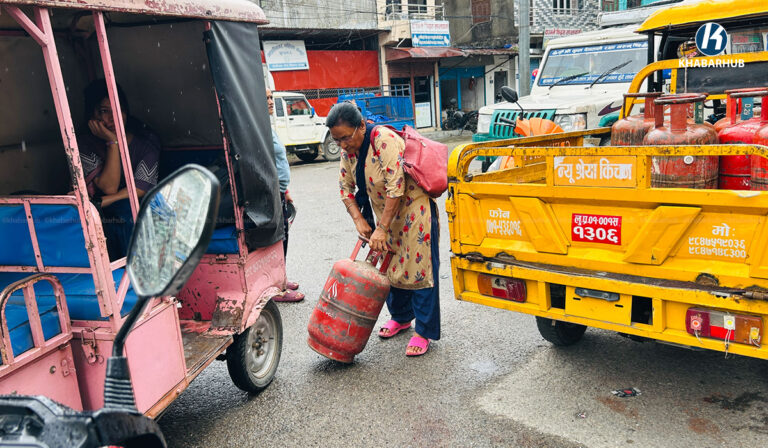
The LPG crisis is not limited to household kitchens. Its impact is gradually being felt across the wider market and in consumer prices.
As LPG becomes expensive and difficult to obtain, operating costs for hotels, restaurants, tea shops and small businesses are increasing.
Businesses are likely to pass those increased costs on to consumers, raising the prices of meals, snacks and other everyday goods.
In other words, a shortage involving a single LPG cylinder is beginning to contribute to higher daily expenses for consumers.
For households already facing pressure from rising prices, the situation has become an additional concern.
Black marketing concerns raise questions over monitoring
The LPG shortage has also increased concerns about black marketing, artificial shortages and unnecessary stockpiling.
If supplies are genuinely adequate, the government needs to investigate whether traders are deliberately withholding gas to create artificial shortages or selling cylinders at inflated prices.
Effective coordination is needed among local governments, district administration offices, consumer protection agencies and Nepal Oil Corporation.
Consumers and stakeholders say monitoring teams should not merely visit markets and return. Where violations are found, the public should also see concrete action against those responsible.
The immediate priority is to ensure that sufficient LPG cylinders reach the market.
But a long-term solution requires broader reform of the import, storage and distribution system.
Consumer rights activists say temporary measures such as reducing distribution or selling half cylinders during a crisis cannot provide a lasting solution.
They have called for adequate storage capacity, digital monitoring of the supply chain, regular inspection of dealers and public disclosure of stock and distribution data.
If the government genuinely has sufficient LPG supplies, consumers now want a simple set of answers:
How much gas has arrived? Where is it being stored? How much has been supplied to each dealer? And how much has actually reached consumers?
Only transparent answers to these questions, accompanied by effective distribution, can end the hours-long queues for cooking gas.
Otherwise, the widening gap between the government’s claim that LPG supplies are adequate and the reality of consumers returning home with empty cylinders could deepen the crisis further.






Comment