



Diplomacy had traditionally been understood as the conduct of bilateral relations between states, focusing only on negotiations driven by political, economic, and security-related factors.
However, the advent of the current century, which has witnessed a sea change in ground realities due to globalization, rapid scientific and technological development, and increased mobility, has transformed and expanded the scope of diplomacy by focusing on new dimensions. India also could not remain untouched by this transformation and adopted a foreign policy with citizen-centric diplomacy at its heart.
This policy places the welfare, security, and interests of the country’s citizens at its core, making Indian citizens an important part of its external engagements, which has, in turn, made the Ministry of External Affairs more responsive to their needs.
How did it evolve?
Until the turn of the last century, Indians living abroad (NRIs) and persons of Indian origin had no place in government policies, as they were considered persons who had migrated out of India for their own individual interests, with no contribution to the development of India.
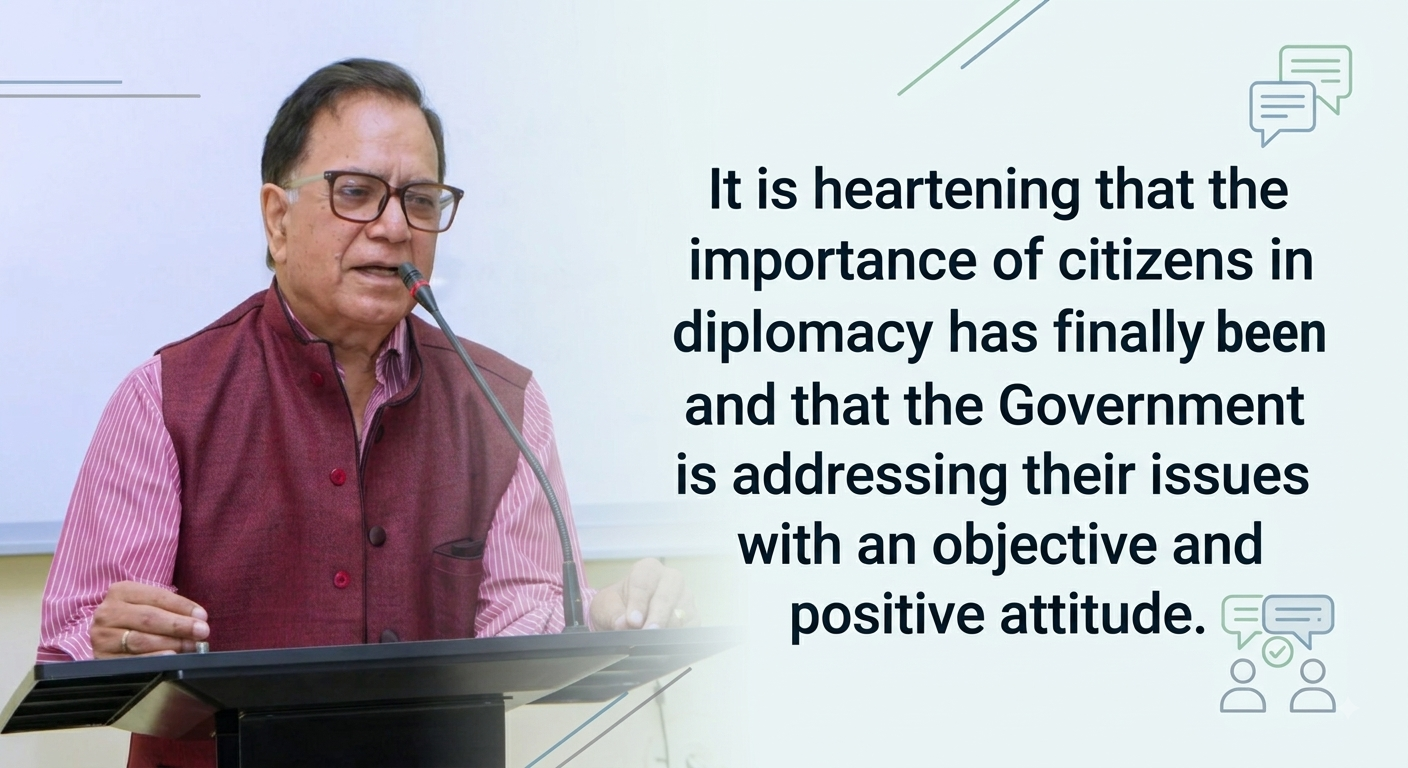
It is heartening that the importance of citizens in our diplomacy has finally been realized and that the Government is addressing their issues with an objective and positive attitude.
However, at the beginning of the current century, it was realized that these Indians not only contribute to the economy of their homeland by way of remittances and investments but also play a significant role in the governments of their countries of residence.
The importance of the Indian diaspora can be understood from the fact that, currently, the Indian diaspora, with a population of more than 35.4 million (more than the combined population of Australia and New Zealand), remitted US$135.46 billion in the last financial year. Moreover, many persons of Indian origin have risen to important positions in academic institutions and governments, which underlines their importance in our foreign policy calculus.
However, in recent years, Indian governments have started paying more attention to this vast reservoir of talent and resources. The annual Pravasi Sammelan and Pravasi Awards have given momentum to outreach efforts toward eminent personalities of the Indian diaspora. The Ministry of External Affairs has taken many initiatives to ensure the welfare of Indian citizens visiting abroad for employment, business, or educational purposes.
Key features of Citizen-Centric Diplomacy
These initiatives cover the period from passport application to visa processing, travel, safe stay, and return to India. In view of the growing number of Indians wishing to travel abroad, the Government has opened new passport offices, established passport application centers in all districts, digitized procedures, and opened more international airports to facilitate international travel.
PDOT (Prior to Departure Orientation and Training) programs are in place, and the Pravasi Bhartiya Bima Yojna has been introduced to ensure health insurance coverage for Indians abroad. Migration and Mobility Partnership pacts have been signed with eight countries, and Social Security Agreements have been signed with nineteen countries to ensure a proper work environment for Indian workers.
An e-Migrate application has also been launched to educate citizens about relevant rules and regulations. MADAD, a multilingual help portal, works round the clock to assist Indian citizens in need. It also examines employment visas, employers’ status, and the insurance cover provided to prospective workers. The government has opened more embassies and consulates to cater to the needs of Indian citizens abroad.
An Indian Community Wing, separate from the Consular Wing, has been established to ensure the well-being of Indians living in those jurisdictions. The Indian Community Welfare Fund has been established in all diplomatic missions and posts abroad to assist citizens in emergencies through temporary shelters, legal assistance, and air tickets to India for destitute or stranded Indians.
Besides, open houses are organized regularly in Indian embassies to listen to and address the grievances of the Indian community. Moreover, the government has conducted a number of successful rescue operations for Indian citizens stranded in violence-hit areas. Ukraine, South Sudan, and Yemen have been among such recent operations.
Challenges
Citizen-centric diplomacy also faces its own challenges. The growing number of Indians traveling abroad for various purposes has put heavy pressure on our missions, which already suffer from shortages of manpower and resources. Effectively assisting the Indian community in war-torn countries also becomes a challenge in view of unstable situations. Misinformation spread by Indian touts and social media, along with different local legal systems, compounds the problems.
The way forward
Allocation of sufficient staff and funds to our missions abroad, along with adequate training before posting, can mitigate these challenges. Pre-departure orientation should be made compulsory for every Indian going abroad for employment or education. Curbing touts who mislead such Indians is imperative.
Conclusion
It is heartening that the importance of citizens in our diplomacy has finally been realized and that the Government is addressing their issues with an objective and positive attitude. With the allocation of more resources and strict action against touts, our citizen-centric diplomacy will certainly bear more fruit.
(Ambassador Jitendra Kumar Tripathi (Retd.) is a retired Indian diplomat who served as India’s Ambassador to Zimbabwe, Argentina, Uruguay, and Paraguay)





Comment