




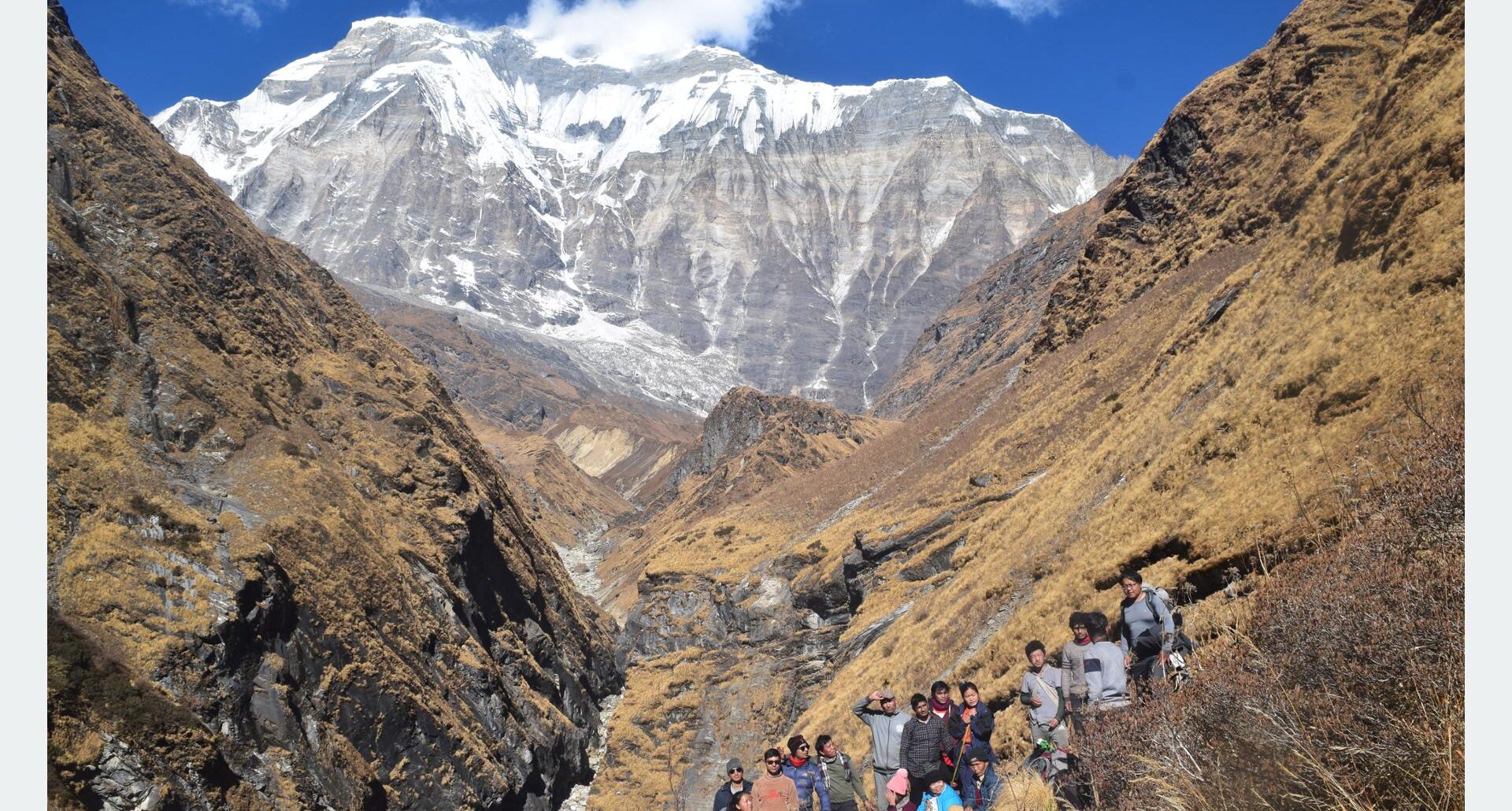
BENI: Nestled in the northeastern part of Myagdi district, Raghuganga Rural Municipality is a remarkable confluence of nature, culture and history.
Blessed with breathtaking landscapes and rich geographical diversity, the rural municipality is home to unique traditions, cultural heritage, and religious and historical sites.
Its stunning terrain stretches from the banks of the sacred Kaligandaki River to the eastern face of Dhaulagiri (8,167 metres), the world’s seventh-highest mountain, captivating visitors with its natural beauty.
The rural municipality derives its name from the Raghuganga River, which originates from the lap of Dhaulagiri. The area extends from the confluence of the Rahughat and Kaligandaki rivers to the Dhaulagiri Icefall Base Camp.
Raghuganga is home to diverse communities, including Magar, Chhantyal, Thakali, Thakuri, Brahmin, Kshetri and Dalit groups. Their coexistence has created a vibrant social fabric, while their customs, traditions and lifestyles have turned the municipality into a living cultural museum.
Beyond its cultural richness, Raghuganga boasts immense tourism potential. Dense forests, cascading waterfalls, pristine rivers, alpine meadows, lakes and towering mountains make the area an attractive destination for nature lovers and adventure seekers alike.
Among its major attractions are the Dhaulagiri Icefall Trek, Dhaulagiri Century Trek and Todke–Dhaulagiri Panorama Trek. These routes lead visitors through spectacular landscapes and offer close-up views of the Dhaulagiri mountain range.
Recognizing its cultural significance, the rural municipality has declared Chimkhola a Cultural Village and has prioritized the preservation and promotion of traditional art forms, including the Thali and Pukhryauli dances.
According to President of the Trekking Agencies’ Association of Nepal (TAAN) Gandaki, Krishna Prasad Acharya, Raghuganga has significant potential for tourism development. He noted that the area offers numerous opportunities for both short- and long-distance camping treks.
“Tourism potential in Raghuganga is immense. However, the development of essential infrastructure such as trekking trails, information boards, signposts, drinking water facilities, shelters and communication networks is necessary to fully utilize that potential,” Acharya said.
He added that the Todke–Dhaulagiri Panorama Trek and Dhaulagiri Century Trek are expected to connect with the Dhaulagiri Icefall Trek and eventually link to Mustang through high mountain passes. For this, detailed mapping of tourism destinations and infrastructure development based on comprehensive studies are required.
The Todke–Dhaulagiri Panorama Trek begins at the popular tourist destination of Todke and connects with the Icefall Trek route through Ghyansikharka, Jhin, Pakhapani, Kotgaun, Raikhor and Mulpani. The Icefall Base Camp route further links to Lete in Mustang.
Another identified route reaches the Dhaulagiri Icefall Base Camp through Gayatri Temple, Piple, Bhagwati, Ruise, Bhediodar, Mutukate and Sobang Dhuri. The Dhaulagiri Icefall Trek offers both short and long trekking options ranging from five days to two weeks.
The trail connects settlements such as Piple, Bhagwati, Begkhola, Dagnam, Chimkhola and Kuinemang in Raghuganga Rural Municipality with Doba, Bhurung, Dana and other areas of Annapurna Rural Municipality, as well as Lete in Mustang, through a network of high-hill trekking routes.
Raghuganga Rural Municipality has already prepared a Detailed Project Report (DPR) for the development and promotion of the Dhaulagiri Icefall Trek. According to Rural Municipality Chairperson Bhawa Bahadur Bhandari, a feasibility study for the project was first conducted in 2068 BS.
Bhandari said the municipality has initiated efforts to secure support from the federal and provincial governments for the development of infrastructure along the 182-kilometre trekking route, which includes the Dhaulagiri Base Camp and other key tourism destinations.
According to tourism stakeholders, although the Ministry of Tourism has developed a trekking route from Chimkhola to Ghyansikharka leading to the Dhaulagiri Icefall Base Camp, sections of the trail through Kokhebhir and the Dhaulagiri Hill View Point remain incomplete.
Likewise, the traditional route connecting the base camp to Lete in Mustang via Kalibaraha, as well as the identified trail from Ruise in Bhagwati through Pachetradhuri, Sobangdhuri, Losdhuri, Dahabuki, Phedi and Sugurthala to the Sasaldhara area, still require upgrading and proper trail development.
The trekking route offers breathtaking close-up views of dozens of peaks in the Dhaulagiri and Annapurna mountain ranges. It also provides opportunities to observe a variety of wildlife, including Nepal’s national bird, the Danphe, as well as Munal, Kalij pheasant, musk deer, Himalayan serow, blue sheep, goral, Himalayan tahr, barking deer and even snow leopards.
In addition to the spectacular sight of icefalls cascading from the Himalayas, visitors can explore scenic alpine lakes. According to Thak Bahadur Paija, Ward Chairperson of Raghuganga Rural Municipality-7, Chimkhola, bringing the Dhaulagiri Icefall Trek into full operation would open a new chapter in tourism development not only for Raghuganga but also for Myagdi and Mustang districts.
Besides promoting long-distance trekking routes, the rural municipality has also prioritized the development of short-distance tourism destinations, including Ruise, Bhediodar, Sobangdhuri, Todke, Malika Dhuri, Rikhar, Nangidanda and the Beg–Badunk Suspension Bridge, one of the longest bridges in Nepal.
Chief Administrative Officer Kulraj Poudel said the local government has been investing in tourism infrastructure, including hiking trails, view towers, shelters and parks. “The rural municipality has also launched campaigns to promote and publicize identified tourist destinations. Tourism holds tremendous potential for the prosperity of Raghuganga,” he said.
This year, hiking trails leading to the religious sites of Malika Dhuri and Rikhar have been constructed. Meanwhile, the hot spring pond at Darmija in Ward No. 4 is widely known as a natural healing destination.
Located in Ward No. 8 at the foothills of the Dhaulagiri range, Rikhar is a rare blend of religious and natural tourism. Situated at an altitude of around 4,600 metres, the sacred site attracts thousands of devotees every year.
A boat-shaped stone temple standing in the middle of a lake adds to the area’s unique beauty. Special religious rituals are performed here during Janai Purnima, making Rikhar a promising religious tourism destination.
Gayatri Temple, located along the historic pilgrimage route to Muktinath, is believed to be a place where sages attained knowledge through meditation and penance in ancient times. The area is also home to artistic and mythologically significant monasteries and is considered an ideal destination for meditation and spiritual retreats.
Similarly, Bhagwati Kot is regarded as one of the oldest Kot temples in Myagdi and stands as a symbol of the region’s rich historical heritage. Believed to date back to the 17th century, the temple has become a prominent religious tourism destination.
Ruise, another increasingly popular tourist destination, is also known for its historical significance as a former centre of the Baise-Chaubise kingdoms. Remains of ancient palaces, resting stones, traditional water wells and elephant tethering sites can still be found there.
Raghuganga has also gained international recognition through the legacy of the late Tul Bahadur Pun of Ward No. 1, Badunk, who was awarded the prestigious Victoria Cross, Britain’s highest military honour, for his bravery during World War II. The rural municipality has proposed establishing a museum in his memory to preserve and promote his remarkable contribution.
The Charm of Indigenous Art and Culture
Raghuganga’s identity extends beyond its natural beauty and historical heritage. The rural municipality is also renowned for its rich indigenous art and cultural traditions.
Folk performances such as Thali Dance, Purkhauli Dance, Sorathi, Madale Maruni, Yanimaya, Sirphule, Sailo Bhaka, Sedo Bhaka, Ratauli, Naumati Panchebaja, and Bhajan-Kirtan continue to keep the area’s cultural heritage alive.
Ward No. 7, Chimkhola, is particularly recognized as the birthplace of the Thali Dance. This unique folk dance has gained popularity not only across Nepal but also in various countries around the world. Hiramaya Shris Pun, a native of Chimkhola and the creator of the Thali Dance, remains a living symbol of this cultural legacy.
Presenting traditional performances to guests and serving meals prepared from locally grown organic products can further strengthen the link between tourism and community-based economic development.
Recognizing its cultural significance, the rural municipality has declared Chimkhola a Cultural Village and has prioritized the preservation and promotion of traditional art forms, including the Thali and Pukhryauli dances.
Another distinctive cultural heritage of Raghuganga is the tradition of Lingo Fighting during the Bhume Puja festival in Dagnam. Believed to have a history spanning nearly 400 years, this unique practice is closely linked to nature worship and has become a major attraction for visitors.
Bhume Puja is celebrated in Magar-majority settlements such as Banduk, Beg, Dagnam, Darmija, Jhin, Pakhapani and Chimkhola. Over time, the festival has evolved into an important platform for promoting domestic tourism while preserving local traditions.
Jhinkhani, regarded as the ancestral homeland of the Chhantyal community in Myagdi, is another historically significant site. The Jhinkhani Bhumethan, located at the birthplace of the community’s forefathers, remains an important symbol of local religious faith and cultural heritage.
Traditional mountain honey hunting in areas such as Kuinemang, Chimkhola, Pakhapani, Beg and Dagnam has emerged as a key attraction for adventure tourism. The centuries-old practice, which involves collecting honey while suspended from steep cliffs, fascinates both domestic and foreign visitors. It represents a unique blend of courage, tradition and the local way of life.
In addition, copper mines, traditional mobile shelters, sheep and goat farming, medicinal herb collection, and opportunities to study Himalayan lifestyles offer new avenues for tourism development in Raghuganga.
Alongside tourism promotion, the rural municipality has focused on improving local livelihoods and increasing household income. Homestays have already been established in Jhin Raykhor, Mauwaphant and Ranipauwa.
Local officials believe that effective management of these homestays, combined with opportunities for visitors to experience local cuisine, culture and traditional lifestyles firsthand, can significantly boost the local economy.
Presenting traditional performances to guests and serving meals prepared from locally grown organic products can further strengthen the link between tourism and community-based economic development.




Comment