




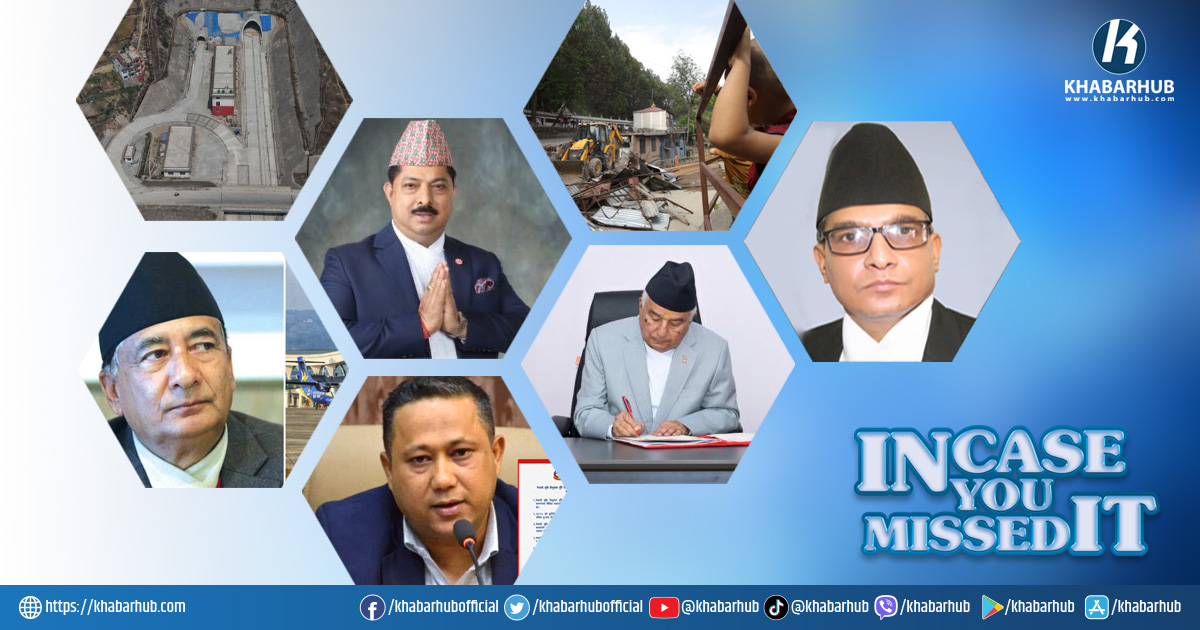
KATHMANDU: Last week marked one of the most politically significant and constitutionally sensitive periods in Nepal since the formation of the government led by Balendra (Balen) Shah. The developments that unfolded over the course of the week were not isolated incidents or ordinary administrative decisions.
They collectively revealed the emerging character of the new administration and its evolving relationship with constitutional institutions, democratic norms, and state power.
At the center of the national debate stood the recommendation of Supreme Court Justice Manoj Kumar Sharma as the next chief justice of Nepal. The controversy surrounding the decision immediately transformed what could have been a procedural constitutional process into a wider debate about judicial independence, executive influence, constitutional conventions, and the future direction of governance under Prime Minister Balen Shah.
The Chief Justice controversy and constitutional convention
The recommendation of Sharma over senior-most Justice Sapana Pradhan Malla became politically explosive because it challenged a long-standing convention within Nepal’s judiciary. Although the constitution does not legally require the senior-most justice to become chief justice, the principle of seniority has historically functioned as an informal but important mechanism to maintain institutional stability and reduce political interference in judicial appointments.
Many ordinary citizens may therefore support the government’s attempt to depoliticize the civil service. There is a widespread perception that trade unions within state institutions have often prioritized political loyalty over public service and accountability.
In constitutional democracies, conventions often carry almost as much importance as written provisions. They provide continuity, predictability, and trust within institutions. When such conventions are broken, especially in sensitive institutions like the judiciary, governments are expected to provide strong and transparent justification. In this case, the government moved forward without adequately explaining why the tradition of seniority had been set aside.
As a result, the controversy quickly deepened. The written dissent registered by National Assembly Chair Narayan Prasad Dahal and opposition leader Bhishma Raj Angdembe carried political significance far beyond procedural disagreement. Their objection reflected growing concern that executive authority is beginning to overshadow institutional balance.
Both leaders argued that the recommendation process lacked sufficient discussion and was pushed through hastily. Their criticism was not only about Sharma himself, but about the process through which the decision was made. Once institutional conventions are bypassed without broad consensus, suspicions naturally emerge regarding political motivations and executive influence.
The controversy became even more serious because it unfolded immediately after President Ram Chandra Paudel issued the ordinance related to the Constitutional Council. The timing created an impression that the government was attempting to reshape constitutional procedures in ways that would strengthen executive control over key appointments.
Ordinance politics and the concentration of power
The ordinance itself became one of the most debated political developments of the week. Nepal’s Constitutional Council was designed to ensure that appointments to constitutional bodies would not fall entirely under executive control.
The structure was meant to incorporate participation from government, opposition, and parliamentary leadership in order to preserve institutional balance and democratic accountability.
However, the new ordinance appears to reduce the practical barriers for decision-making and allows recommendations to move forward with a limited quorum. Critics argue that this weakens the constitutional safeguards originally intended by the framers of the constitution.
The sharpest response came from Nepali Congress, which accused the government of undermining the constitutional principles of separation of powers and checks and balances. The party argued that the ordinance risks turning constitutional bodies into instruments influenced by the executive branch.
This criticism cannot simply be dismissed as routine opposition politics. Nepal’s democratic history has been shaped by repeated struggles against excessive concentration of power. From the Panchayat system to the royal takeover of 2005, Nepali politics carries a strong historical memory of how institutions can weaken when executive authority becomes dominant. Consequently, any move perceived as centralizing constitutional authority immediately triggers political anxiety.
The episode highlighted the delicate balancing act Nepal faces. While nationalist positioning may strengthen domestic political legitimacy, Nepal’s economic and strategic realities require stable and constructive relations with both India and China.
At the same time, the government appears determined to present itself as a force of disruption against an old political order widely viewed as ineffective and corrupt. Many citizens are frustrated with years of political bargaining, bureaucratic inefficiency, corruption scandals, and institutional paralysis. In that context, Prime Minister Balen Shah’s assertive approach appeals to sections of the public that desire decisive leadership and rapid reform.
This tension between reform and institutional caution defined nearly every major development of the week.
Administrative reforms and dismantling union structures
The government’s decision to dissolve 12 trade unions representing civil servants and health workers further reinforced the image of an administration pursuing aggressive institutional restructuring. For years, politically affiliated unions within the bureaucracy have been criticized for weakening professionalism, obstructing administrative efficiency, and turning public institutions into extensions of political parties.
Many ordinary citizens may therefore support the government’s attempt to depoliticize the civil service. There is a widespread perception that trade unions within state institutions have often prioritized political loyalty over public service and accountability.
Yet the method used by the government again raised concerns. The reform was carried out through ordinance mechanisms rather than broad parliamentary discussion or negotiated institutional reform. This pattern is becoming increasingly visible under the new administration. Instead of slow consensus-building, the government prefers rapid executive action.
This reflects a broader political phenomenon seen in many democracies where outsider leaders gain popularity by portraying institutional procedures as obstacles to change. Balen Shah’s administration increasingly appears to be embracing that governing philosophy. The message being projected is clear: traditional political structures have failed, and extraordinary measures are necessary to reform the state.
However, governance through confrontation also carries significant risks. Bureaucracies function not only through legal provisions but also through administrative culture, relationships, and institutional cooperation. If reforms are perceived as hostile or excessively centralized, resistance may emerge from within the system itself.
Judiciary versus executive on the squatter issue
The week also revealed that Nepal’s judiciary continues to function as an important institutional counterweight despite the controversy surrounding judicial appointments. The Supreme Court’s interim order against the forcible eviction of squatters without proper management demonstrated that the judiciary is still willing to challenge executive actions.
This issue touches on a deeply sensitive social and political debate in Nepal. Prime Minister Shah has built much of his public image around promises of restoring urban order, enforcing regulations, and removing illegal encroachments. Many urban residents strongly support these policies, especially in Kathmandu where unmanaged settlements, congestion, and environmental degradation have become major public concerns.
At the same time, the eviction of landless squatters raises difficult questions regarding poverty, housing rights, social justice, and state responsibility. The Supreme Court’s intervention therefore reflected an attempt to balance state authority with constitutional protections and humanitarian concerns.
The case illustrated one of Nepal’s broader democratic challenges: how to modernize urban governance and strengthen rule of law without marginalizing vulnerable communities.
Nepal-India tensions and nationalist positioning
Another major dimension of the week involved Nepal’s increasingly sensitive relationship with India. Nepal’s formal objection to the Kailash Mansarovar route through Lipulekh revived longstanding territorial disputes involving Lipulekh, Limpiyadhura, and Kalapani.
Nepal reiterated that these territories belong to Nepal under the 1816 Treaty of Sugauli. India, however, rejected Nepal’s claim and described Lipulekh as a historically established pilgrimage route.
However, fragmented politics also makes institutional consensus more difficult. In such environments, governments often rely more heavily on executive authority and ordinances to pursue their agendas.
Although such diplomatic disagreements are not new, the broader political context has changed significantly under the current government. Prime Minister Shah appears to be pursuing a more assertive nationalist posture while simultaneously avoiding early foreign visits to both India and China.
This approach appears politically calculated. In Nepal, governments are often criticized for appearing overly dependent on external powers, particularly India. By delaying foreign visits and emphasizing domestic priorities during the government’s first 100 days, Shah may be attempting to cultivate an image of political independence and sovereign confidence.
However, diplomacy is ultimately built on sustained engagement and careful communication. The sudden cancellation of Indian Foreign Secretary Vikram Misri’s planned visit to Kathmandu therefore drew considerable attention. Reports suggesting that the visit was stalled because the prime minister did not allocate meeting time created speculation regarding emerging diplomatic friction.
The episode highlighted the delicate balancing act Nepal faces. While nationalist positioning may strengthen domestic political legitimacy, Nepal’s economic and strategic realities require stable and constructive relations with both India and China.
Anti-corruption drive and political messaging
The week also saw major anti-corruption developments that aligned closely with the government’s broader political messaging. Raids linked to Bagmati Chief Minister Indra Baniya and the large-scale corruption case concerning Pokhara International Airport reinforced the administration’s image as aggressively targeting entrenched corruption networks.
The Pokhara airport case is especially significant because it involves senior bureaucrats, a former finance minister, and a Chinese contractor company. The alleged irregularities involving more than Rs 3.62 billion represent one of Nepal’s largest corruption investigations related to a national infrastructure project.
For the government, such investigations provide both political and symbolic value. Public frustration with corruption remains extremely high, and anti-corruption action continues to generate strong public support. The administration is clearly attempting to position itself as fundamentally different from previous governments accused of protecting political and bureaucratic elites.
Yet Nepal’s history also demonstrates that anti-corruption campaigns are often interpreted through political lenses. The long-term credibility of these investigations will therefore depend on whether they are conducted consistently, transparently, and without selective targeting.
Political fragmentation and the search for a new order
The political fragmentation visible during the week also reflected deeper shifts within Nepal’s political landscape. The departure of former Prime Minister Baburam Bhattarai from the Pragatisheel Loktantrik Party and the decision of Sudan Kirati to join the Shram Sanskriti Party illustrated the fluid and unstable nature of contemporary Nepali politics.
The struggles unfolding now are ultimately about who controls the state, how power is exercised, and whether reform can proceed without weakening the democratic foundations built after years of political struggle.
Traditional ideological structures are weakening, while personality-driven politics and anti-establishment narratives are becoming increasingly influential. The rise of Balen Shah himself reflects this transformation. His political appeal stems less from party structures and more from public frustration with established political elites.
However, fragmented politics also makes institutional consensus more difficult. In such environments, governments often rely more heavily on executive authority and ordinances to pursue their agendas.
A defining moment for Nepal’s democracy
Taken together, last week’s developments suggest that Nepal is entering a new political phase marked by institutional disruption, centralized executive activism, and rapid reform initiatives. The Shah administration is clearly attempting to redefine the relationship between the state and long-established political and bureaucratic structures.
The government’s supporters view this as necessary transformation after years of dysfunction. Critics, however, fear that the weakening of conventions, concentration of authority, and reliance on ordinances may gradually erode democratic safeguards and institutional independence.
The central issue therefore is not whether reform is needed. There is broad agreement that Nepal’s institutions require serious reform and modernization. The real debate concerns the method through which change is pursued.
Democratic systems are not judged only by their ability to deliver fast decisions. They are also judged by their ability to preserve institutional balance, protect dissent, and maintain constitutional restraint even during periods of political transformation.
Last week demonstrated that Nepal’s political transition is no longer simply electoral. It is increasingly institutional and constitutional in nature. The struggles unfolding now are ultimately about who controls the state, how power is exercised, and whether reform can proceed without weakening the democratic foundations built after years of political struggle.
The coming months will therefore be critical. They will determine whether the current wave of political disruption produces stronger institutions and more effective governance, or whether it gradually creates new tensions between executive power and constitutional democracy.





Comment