




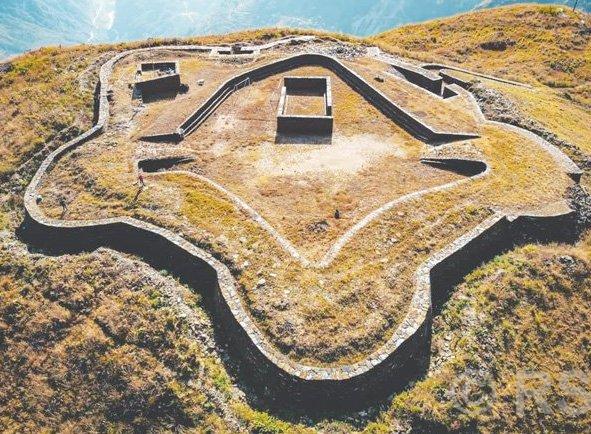
CHAUTARA: The number of domestic and foreign tourists visiting the historic Dugunagadhi Fort in Yarmasing village of Listikot, Bhotekoshi Rural Municipality, has been steadily increasing.
Located near the Nepal–China border, the historic war fort was severely damaged by the devastating earthquake of 205. It has since been reconstructed in its original form under the leadership of the Nepali Army.
Spread across approximately 200 ropanis of land, Dugunagadhi stands at an altitude of about 2,200 meters above sea level. Tourists visit the site to explore history while enjoying the serene natural surroundings.
Domestic tourist Amritman Shrestha says Dugunagadhi has become a favorite destination for visitors, as it offers both historical insight and picturesque views.
According to local elder Krishna Bahadur Pradhan, the fort was constructed in 1912 under the direction of Shri 3 Janga Bahadur Rana, nine years after he became Prime Minister.
At the time, Nepal was engaged in conflict with Tibet. There is historical mention of Junga Bahadur Rana kneeling and firing at the Tibetan army during the war. Pradhan further explains that Dugunagadhi, a site of national archaeological importance, served as a military base during the three wars between Nepal and Tibet.
The Nepali Army is said to have advanced to battle after worshipping at Listimai in Bhotekoshi Rural Municipality. Inscriptions found at the site indicate that Nepal achieved military success in the Bhotekoshi region using this fort.
Tourist Saraswati Shrestha notes that footprints believed to belong to Janga Bahadur Rana are still visible at the site, keeping the history of that era alive. Ward Chairperson of Bhotekoshi Rural Municipality–3, Nimasona Sherpa, says Dugunagadhi reflects ancient civilization and possesses its own customs, culture, and identity.
Surrounded by mountains on all sides, the fort is both charming and scenic. Sherpa adds that efforts are underway to develop the area into a tourist destination while preserving its historical significance.
Visitors with an interest in history often express admiration for the foresight of their ancestors in constructing such a fort. Many who visit once return with friends and family.
As part of its efforts to identify, preserve, and promote unification routes, forts, and military heritage, the Nepali Army has also been organizing a mountain trail race in the area for the past five years.





Comment