




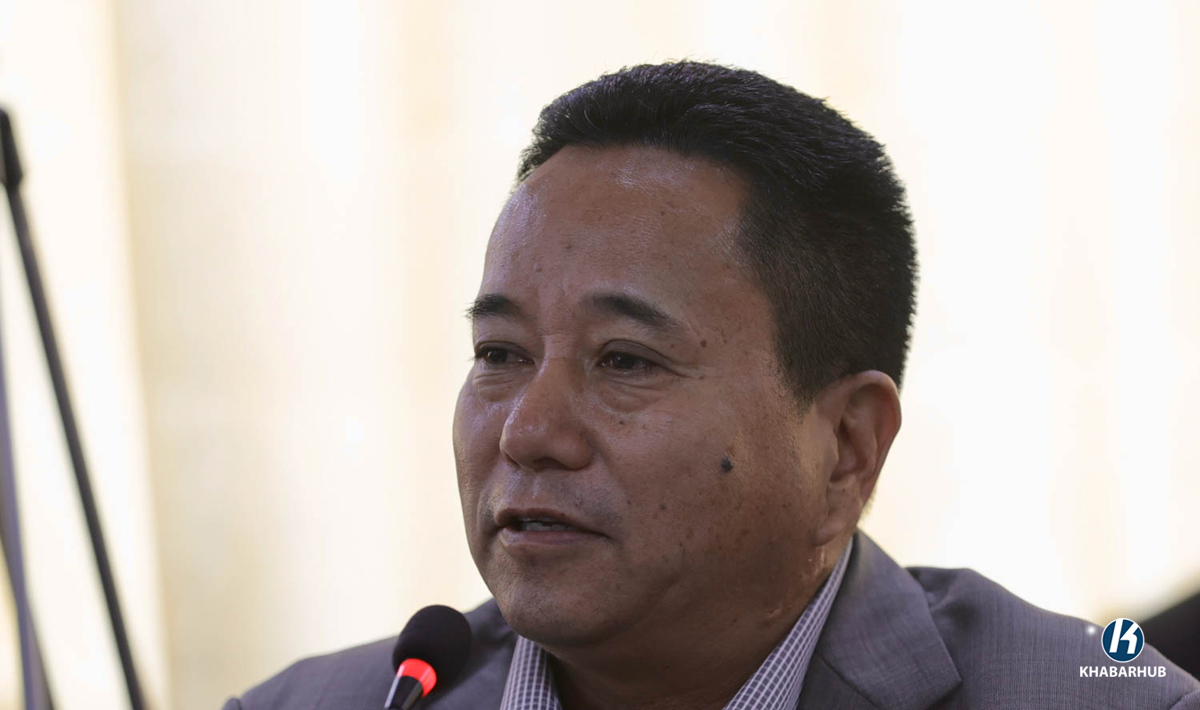
KATHMANDU: Nepali Congress (NC) leader Purna Bahadur “Kancharam” Tamang, who recently played a key role in setting up a liaison office aligned with former party president Sher Bahadur Deuba, has claimed that the party is heading toward a split.
According to Tamang, both former NC president Sher Bahadur Deuba and senior leader Dr. Shekhar Koirala are likely to be part of a separate faction if reconciliation efforts fail.
Tamang alleged that party president Gagan Thapa has shown little flexibility and has not engaged in meaningful dialogue to keep the party united. He argued that an agreement could be reached within “10 to 15 minutes” if Thapa were willing to negotiate.
He further claimed that the party’s internal crisis has deepened because Thapa has not remained in contact with leaders from other factions. Tamang said he would personally take responsibility for facilitating reconciliation among senior leaders if Thapa initiated dialogue.
He also maintained that the party could still remain united if Thapa implemented the seven-point agreement that was drafted jointly with former acting president Purna Bahadur Khadka.
Tamang and Thapa were once considered close political allies, but their relationship reportedly deteriorated after Tamang was denied a party ticket in the March 5 elections. Tamang now believes the Deuba camp has drawn him closer following his split with Thapa.
In an interview with Khabarhub, Tamang spoke about the party’s latest internal developments, the possibility of a split, the activities of the Deuba and Thapa factions, and the future of the Nepali Congress. Edited excerpts follow.
It appears the liaison office has been handed over to party leaders. Does this mean a new party is being formed?
A new party has not been formed yet. The Sher Bahadur Deuba camp has repeatedly urged Gagan Thapa to reach an agreement and move forward together. On June 5, he came to Purna Bahadur Khadka’s residence, and we reached an understanding. However, today is July 10, and there has been no further communication from his side.
After that, an ultimatum was given through Shekhar Koirala as well, but there has still been no progress. Since the ward convention has been scheduled for August 18, there are only 38 days left. If an agreement is not reached within that time, the party should be considered almost certain to split.
If Gagan does not agree, the split will happen soon. From what I understand, preparations are already underway.
As for the liaison office, it was established in preparation for the party’s 15th General Convention. I was asked by Sher Bahadur Deuba’s team to find a suitable location and arrange the office. I located the building, collected contributions after everyone agreed, completed the necessary renovations, and handed over the keys.
You say the party will split if Gagan does not agree. What exactly is the proposed agreement?
We have prepared a seven-point agreement. The team elected through the special general convention is aligned with Gagan. Our position is that the factions led by Sher Bahadur Deuba and senior leader Shekhar Koirala should also receive fair representation in the Central Working Committee formed after the 14th General Convention.
If Gagan’s side holds the majority in the working committee, we have no objection. Our primary concern is that the party remains united. Everyone in the party is working hard for that objective.
Critics say your side has also been inflexible. Isn’t your position changing over time?
That is not true. I do not have to stand with Gagan, nor do I have to stand with Deuba. Tomorrow I may not be with either of them. I may even leave politics altogether.
But I believe I must speak honestly about what I see. I am a person guided by my principles, and many of the concerns I have previously raised have later proven to be valid. In my view, many of Gagan’s recent decisions have been wrong.
Why are you so critical of party president Gagan Thapa?
He said he would build a one-person leadership, and that is exactly what he has done. Now that he has brought senior leaders into his team, people naturally question those decisions.
In my opinion, Gagan cannot unite the party under the current circumstances. If he succeeds in uniting the party within a week, I will leave the Nepali Congress and withdraw from politics.
I have closely observed his political conduct. During the 13th General Convention, he even contested against his own father-in-law for a party position. A father-in-law is a close family member. If someone cannot maintain harmony within such close relationships, how can that person unite an entire party? In my view, Gagan treated his father-in-law unfairly.
You say Gagan Thapa is honest, yet you are also criticizing him. Isn’t that contradictory?
The reason I call Gagan honest is because he openly told his friends, associates, and supporters that he wanted to bring the party under his control. He has been transparent about that objective. Today, he believes he has secured around 54 percent support within the party.
However, the same people who helped him build that majority could become a liability in the future. If the Deuba faction forms a separate party, many of those supporters could leave him. That is why I say his own strategy could eventually trap him.
If Gagan had waited another two or three months, we would have supported him to become party president through consensus and popular backing. Instead, he insisted on holding a special general convention. If those who backed that convention now move toward Sher Bahadur Deuba or join a new party, Gagan will find himself isolated.
In my assessment, Gagan’s political influence is beginning to decline. More than 25 percent of the leaders associated with his camp are now in contact with us.
If that is the situation, do you believe the Nepali Congress will split?
We are not the ones splitting the Congress. By August 10, the Deuba faction will register a separate political party. We also have to choose our own course. We cannot simply surrender to Gagan’s leadership. A new party will be registered. I am fully convinced that the Congress will split.
Have you finalized the party’s election symbol and flag?
A final decision is expected within this month. We have been closely monitoring developments over the past few days, and a decision could come at any time. Much depends on Dr. Shekhar Koirala’s position. As things stand, 91 members of the former working committee remain aligned with the Sher Bahadur Deuba camp.
Is Dr. Shekhar Koirala’s position now the deciding factor?
Dr. Shekhar has his own faction, while Sher Bahadur has his own. We have not formally worked together so far. From what we understand, Gagan is not prepared to accommodate the Sher Bahadur faction. According to Dr. Shekhar, Gagan only wants to keep him personally on board. That is why we are waiting to hear Dr. Shekhar’s final position.
If Gagan does not accept Dr. Shekhar’s proposal to bring the Sher Bahadur faction into a united arrangement, then Dr. Shekhar and Sher Bahadur could jointly launch a new party within a day or two. However, if Dr. Shekhar is able to convince Gagan to include the Sher Bahadur camp and an agreement is reached, that outcome may still be avoided.
So, do you consider Dr. Shekhar Koirala the key figure in this process?
Yes. If Dr. Shekhar decides to remain with Gagan, that is one scenario. Otherwise, forming a separate party would become necessary. The Sher Bahadur faction was already prepared to establish a new party. As of now, Dr. Shekhar has agreed to join us.
Is there no one left in the Nepali Congress who can mediate between the factions?
We have been very flexible. Leaders from the Sher Bahadur Deuba camp have received positions and opportunities. Purna Bahadur Khadka became Deputy Prime Minister, Defence Minister, and Home Minister. Krishna Prasad Sitaula, Prakash Man Singh, Prakash Sharan Mahat, Bimalendra Nidhi, and even Arzu Rana Deuba have all held important responsibilities.
However, leaders from Gagan’s camp have not received similar opportunities. They have not even had the chance to lead the government. Gagan should have pushed to ensure broader participation, but he has not shown any willingness to reach an understanding. Despite having received many opportunities, our side is still prepared to be flexible. Personally, I have also benefited from many opportunities.
Why do you think Gagan Thapa is unwilling to compromise?
My assessment is that Gagan has been straightforward about his intentions. After securing what he believes is a 54 percent majority within the party, he seems to have concluded that he no longer needs the support of others. But if that same majority becomes divided in the future, he could find himself in a difficult position.
Many people argue that it is time for younger leaders to take over from the old guard. What is your view?
Why should we discard senior leaders simply because they are older? That would be like throwing your own parents into a river. The senior leaders were equally important. They struggled for the party, and Gagan became party president because of that struggle. Without their contribution, he would not be where he is today.
Both experienced leaders and younger leaders are necessary for the party. If a new party is formed by Mangsir, then we can compare its future with that of Gagan and Sher Bahadur’s parties afterward.
So, do you believe there is no longer any possibility of keeping the Congress united?
We are still prepared for unity. It is Gagan’s camp, in my view, that is unwilling to move forward together. That is why preparations have begun after assessing the possibility of a split.
After Gagan distanced himself from us, there was no reason for us simply to surrender. Even now, if Gagan reaches out—even late at night—I am prepared to facilitate a meeting immediately.
But he has to come with a flexible approach. I am ready to take responsibility for reconciling those who feel senior leaders have been disrespected. Gagan first needs to initiate contact. If both sides approach the issue sincerely, an agreement is still possible. If Gagan is willing to be flexible, the party can remain united. If not, the split will become inevitable.
What is your formula for reconciling the Gagan Thapa and Sher Bahadur Deuba factions?
The solution is straightforward. Both sides should honestly acknowledge the current situation and move forward together. Members of the former working committee should be given appropriate responsibilities. Representatives from the Sher Bahadur faction should be included in party committees, and positions should be distributed fairly among all groups. If everyone approaches the process with sincerity and flexibility, an agreement can be reached within 10 minutes.
Why do you think Gagan is reluctant to engage with leaders he considers inflexible?
In my opinion, he believes his claimed 54 percent majority is enough to sustain his leadership. But that same majority could create new internal conflicts in the future.
Do you believe Gagan Thapa is making a political mistake?
If Gagan cannot unite the Nepali Congress, it will have serious consequences for his political future. I do not believe he will succeed in the long run under those circumstances.
I have known Gagan since he was young because our families are close, so I believe I understand his political style. His ambition is to become Prime Minister and lead the country, but if he cannot build consensus, he may find that other political forces unite against him. Just as many leaders opposed him in the past, I believe similar challenges could arise again in the future. In my view, that could make it much harder for him to achieve his political goals.
What exactly should Gagan Thapa do today to reconcile the party?
If Gagan has concerns about any of the seven points proposed for reconciliation, those issues should be discussed. If he is willing to engage sincerely, the differences can be resolved today—even tonight.
If Gagan is genuinely ready for reconciliation, I am prepared to help make it happen immediately. Once the party is united, I will remain active in politics only until Mangsir. After that, I plan to step away.
If the Nepali Congress remains united under Gagan’s leadership, will you really leave politics?
Yes. If the party stays united, I do not want to be involved in internal factional disputes. If the party splits, I will remain with the new party as an invited member and support the Shekhar Koirala and Sher Bahadur Deuba groups. But if the Congress reunites, I will withdraw from active politics.
What, in your view, is Gagan Thapa’s biggest mistake?
In the 2074 elections, when the CPN (UML) and the Maoists formed an alliance, I lost by around 36,000 votes. In 2079, when the Congress and Maoists contested together, I received about 47,000 votes and ranked second within the Congress, behind Dr. Sunil Sharma. Nationally, I was among the top vote-getters.
Despite that, I was denied a party ticket in 2082. My concern is not simply that I was not nominated. The issue is that the ticket was given to someone outside the six names that had been recommended.
A similar situation occurred during the National Assembly election. I tried to contact Gagan around 20 times after I was denied the ticket, but I received no response. Even so, I campaigned for the candidate he endorsed because I believed it was my duty as a party member. Ultimately, our candidate finished third. When I contested on my own, I received 36,000 votes, whereas the candidate he supported secured only about 16,000.
Do you expect to benefit politically by joining a new party?
No. As I have already said, I am prepared to leave politics. Even today, my preference is for the Congress to remain united rather than split. But I also have to make decisions based on my own principles.
If a new party is formed, what role do you see for yourself?
I would be happy to serve even as a watchman. I have already told my colleagues that we should build the party with our own modest contributions. Everyone should contribute what they can, even if it is only enough to cover the cost of a cup of tea. That is the spirit in which I want to move forward. I have no desire for any position. If a new party is formed, I am willing to start from the very bottom.
Some people say Nepali Congress is splitting because of Kanchharam Tamang. How do you respond?
Senior leaders in Sher Bahadur Deuba’s camp, including Purna Bahadur Khadka, Prakash Man Singh and Bimalendra Nidhi, regularly seek my advice on important political matters. When I offer suggestions, they listen.
So how do you respond to those who blame you for the Congress’s failure to stay united?
If Gagan calls me and says I am responsible for the split, I am prepared to leave the Congress today. Likewise, if the Sher Bahadur faction says the same, I am also ready to step aside. I have never worked to divide the party. If a new party is eventually formed with my involvement, I have already decided that I will remain only for a short period before returning to my profession and business.





Comment