




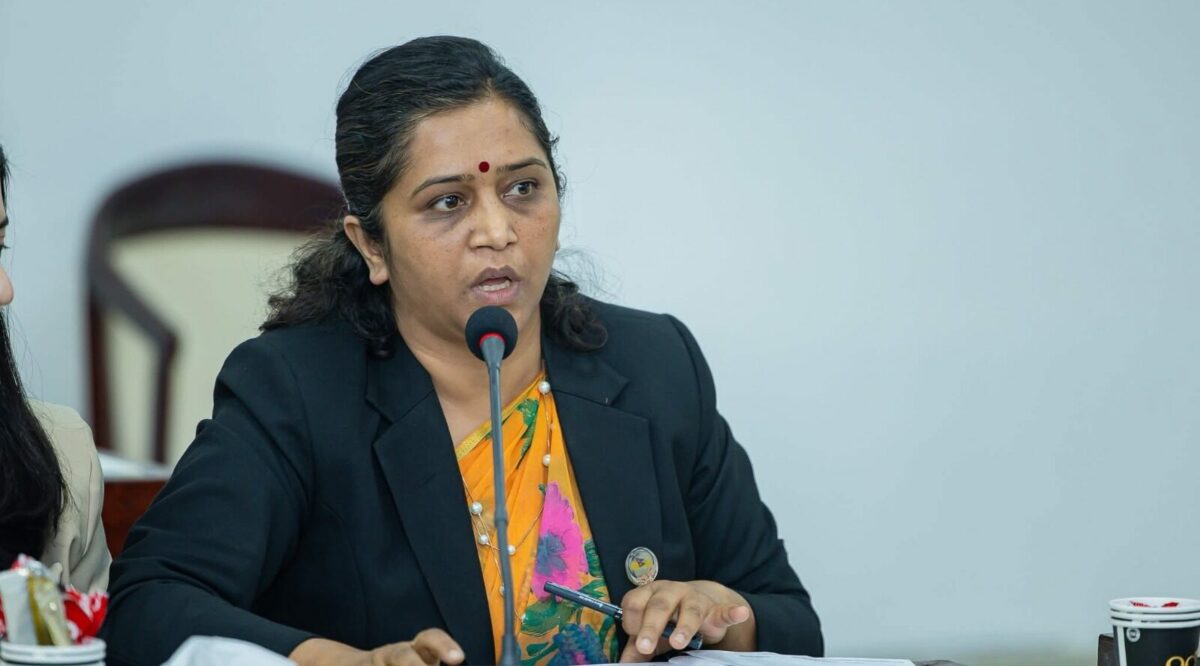
KATHMANDU: On November 30, 2025, the Bibeksheel Sajha Party formally merged with the Rastriya Swatantra Party (RSP), bringing its entire top leadership into the country’s fastest-growing political force. Among those who joined were then party president Sameeksha Baskota and General Secretary Ranju Darshana, along with a broader team of Bibeksheel Sajha leaders.
Following the merger, several leaders were appointed to key positions within the RSP’s central committee, while others secured seats in Parliament. Ranju and several colleagues were elected through the first-past-the-post system, while Baskota entered the House of Representatives through the proportional representation quota.
Today, Baskota serves as Chairperson of the Parliamentary Committee on Law, Justice and Human Rights and remains actively engaged in both parliamentary affairs and party politics. As the RSP prepares to hold its first general convention in Kathmandu from June 21, she says there is little uncertainty over the party’s top leadership, expressing confidence that party president Rabi Lamichhane and senior leader Balendra Shah will continue in their respective roles.
Baskota argues that the RSP has largely embraced the core principles once championed by Bibeksheel Sajha—honesty, transparency, democratic governance and a citizen-centric state—and believes the party will continue to be guided by those values in the years ahead. Looking back on her transition from Bibeksheel Sajha to the RSP, she describes the journey as smooth and politically rewarding, saying it has enabled her to broaden her role and contribute more effectively to public life.
She maintains that good governance remains the cornerstone of the party’s agenda and criticizes the opposition’s continued obstruction of Parliament over demands directed at the Prime Minister, describing it as a reluctance to accept electoral outcomes. While other political forces have gradually adjusted to the country’s changing political landscape, she argues that the CPN-UML has yet to do so.
Baskota also says the upcoming convention will elect a new central committee, while efforts are underway to select the party secretariat leadership through consensus. Dismissing suggestions of factionalism within the RSP, she insists that what exists inside the party is not rivalry, but a shared determination to strengthen the organization.
In this interview with Khabarhub, Baskota discusses the RSP’s first general convention, the understandings reached during the merger with Bibeksheel Sajha, the party’s future leadership, the government’s performance, and the role of the opposition. Excerpts:
Here is the complete translation of the Q&A from Nepali to English, formatted for clarity and readability:
You all transitioned from the Bibeksheel Sajha Party to the Rastriya Swatantra Party (RSP). The RSP’s first general convention is approaching; how excited are you?
A party’s first general convention is a significant and serious matter in itself. For a new party like ours, institutionalizing the organization and refining the party constitution is absolutely essential. We are very excited about institutionalizing the party and bringing clarity to our political documents. I am not particularly concerned about who throws their hat into the ring for which positions. We are confident that the convention will establish the right leadership.
For a party that has never had a general convention, this event is special because it brings together friends who joined from various groups onto a single platform. The convention will settle outstanding agendas and pending issues. The general convention is the ultimate forum to discuss every matter. We are confident that this first convention will make the party more powerful and robust, and our preparations are aligned with that goal.
Questions are often raised against you all, with people asking how the “warriors of Bibeksheel” can stay silent when RSP leaders occasionally stray from the agenda or show weaknesses on key issues. Will RSP adopt the principles, philosophies, and ideologies of Bibeksheel?
First of all, one must understand how the Rastriya Swatantra Party became the country’s leading force within four years. As RSP was being formed, it wasn’t just well-wishers who joined; individuals who left other political parties also integrated into it.
All of them together cast their votes to make this the number one party in the country. Once a party becomes the largest force, it is natural for people to join with various ambitions and plans. The influx of different kinds of people is nothing new. It is precisely these conventions and general assemblies that will filter them out over time.
The Rastriya Swatantra Party itself is highly strict regarding discipline. The disciplinary department is active and working across various levels. The moment the leadership catches wind of an issue, appropriate action is taken. Aside from a few isolated incidents, 99 percent of our members are not undisciplined. We want to build a party rooted in discipline.
We are not looking to build just another ordinary party; we want to build a party capable of transforming the country’s leadership, leading for the long term, and putting the country on the right track. Some issues may arise in the interim, but what matters is how we settle those issues. Built on a foundation of discipline, this party strictly adheres to its code of conduct. Not just us, but the entire leadership of the Rastriya Swatantra Party stands for discipline.
When Bibeksheel Sajha merged into the RSP, you stated that you would adopt your party’s core guiding principles. Will those matters be theoretically and politically documented after the general convention?
Absolutely. I am very confident about that. When we merged the parties, we did so selflessly. The core principles carried by our former party are also carried by the Rastriya Swatantra Party—honesty, transparency, democratic processes, and a welfare state. This is even reflected in our approach to budget formulation. We want to build an entrepreneurial society. We used to raise the issue of a “servant government”—the wording might differ, but the essence is the same.
Right now, from the Prime Minister to the entire Cabinet, the focus is on improving the service delivery system on the foundation of good governance, which is the exact concept of this government. It is about ensuring that citizens can feel a swift and efficient service system. Therefore, policies promoting entrepreneurship are being introduced. This means we need to produce entrepreneurs and pivot society toward entrepreneurship.
We are on the same page regarding these issues, and we are heavily practicing internal democracy. Since we advocate for it, internal democracy is being practiced thoroughly in the ongoing conventions. We stand together. That is the foundation we stand on. We have moved forward with the belief that we need to change the condition of the people, not just the system.
Bibeksheel Sajha emerged in 2017 stating exactly this, and RSP has arrived now stating the same. As we walk together, our speed is the same—our words and actions match completely. If there are any gaps left, the general convention will tear through them. We share the same vision regarding what kind of society, country, and party we want to build.
When the Prime Minister did not show up in Parliament to answer for his statements, leaders who transitioned from Bibeksheel to the RSP expressed differing views. Are you feeling uncomfortable with his behavior? Does it feel like the foundation you were walking on has shaken a bit?
No, not at all. One thing we must understand is that under Article 76 of the Constitution, the Prime Minister is responsible to the Council of Ministers and everyone else. Let’s start with how many days our Parliament has run and how many days the Prime Minister has attended. It’s not as if the Prime Minister hasn’t shown up even for a single day.
Regarding the Prime Minister providing answers, he has already given an answer once. We will not promote the opposition’s tactic of demanding the Prime Minister’s presence every single day just because they lack an agenda of their own. The Executive, Judiciary, and Legislature operate on the principle of separation of powers. Whoever holds executive power functions accordingly.
Rather than seeking his presence daily, he has not failed anywhere on the foundation of accountability to the house. If he fails tomorrow, we will sound the alarm at that same level. However, the opposition must create a working environment for a government that holds close to a two-thirds majority.
The government must also apologize for any mistakes or shortcomings made on its part. In our context, being the opposition shouldn’t mean just raising wrong and negative things and interpreting only those. We have come here to establish order after inheriting 35 years of anomalies and mismanagement.
Expecting tasks that weren’t done in 35 years to be completed in 35 days is impossible. We are clear that we must address weak laws properly and move forward with a fresh approach. Judging us right now would be a bit premature. We have held the Prime Minister accountable, but demanding his daily presence is not right.
Until now, previous Prime Ministers used to run the government from Baluwatar, but our Prime Minister sits in Singha Durbar from 7 AM to 8 PM to do his work.
To ask a party-specific question: there are reports of various factions within the RSP, and rumors that positions in the upcoming Central Committee and Secretariat will be divided based on a quota system. What do you say?
You’ve asked an interesting question. This question perfectly mirrors contemporary Nepali politics. Factionalism is all Nepali politics has seen until today. We have situations where a party with just a single elected MP fragments into twenty different factions.
We joined on November 30, 2025, and other friends joined later. Now, we are all members of the Rastriya Swatantra Party. The leadership that emerges from our general convention will be established based on competence, capability, and merit—based on who can steer the party in the right direction.
If anyone claims there are factions, it is just their imagination. They can keep saying it for their own peace of mind. If you are asking me on behalf of Bibeksheel Sajha, we do not walk around forming such factions. We belong to only one faction, and that is—making the Rastriya Swatantra Party excellent.
What kind of preparations are underway for the RSP general convention?
The preparations for the general convention are going well. We aimed to conclude all district conventions by Sunday, and only a few isolated ones remain. The municipal and ward conventions are complete. After the conventions of all seven provinces wrap up on the 26th, grand preparations are underway for the National Convention in June. In Chitwan, we have arranged the hall and other essential logistics. Eighteen organizing sub-committees are currently working on it.
How are you managing the leadership and senior figures?
Managing leaders is not an issue for us. We will move forward by strengthening the RSP by whatever means necessary. It will emerge stronger and more unified. We are ready for whatever sacrifices and discussions are required to achieve that.
Will the RSP deliver a surprise leadership from this convention, or will it repeat the old leadership?
If by leadership you are referring to the party Chair, Rabi Lamichhane will remain. There is no alternative to Rabi Lamichhane for now. He is the one who provided political guardianship and brought us this far. Rabi Lamichhane will continue as the Chair for now.
Then you must have heard people asking, “Why even hold a general convention if that is the case?”
Such comments are incorrect. At this stage, we are not in favor of looking for an alternative to Rabi Lamichhane. We haven’t even held our first general convention yet, and he is the one doing immense work by bringing this party and scattered alternative political groups together into one place.
Since Rabi Lamichhane is retaining the chairmanship, are there plans to add a “Senior Leader” post to the party statute?
Yes. By adding the post of “Senior Leader” to the statute, the Prime Minister will assume the role of Senior Leader. It is not the time to look for alternatives. Even going into the elections, we had already projected our candidate for Prime Minister.
We cannot practice new politics while carrying the hangover of old politics. We want to practice fresh politics. This is neither the time to look for an alternative nor the time to spark a debate that an alternative is needed. We are absolutely clear on that.
In that case, will you leave the Central Committee elections open and democratic, but form the Secretariat through consensus?
The blueprint for that is not yet ready. Work regarding constitutional amendments and other matters is still pending. Extensive discussions on which model to adopt and how to proceed have not yet taken place.
Intense discussions regarding the National Convention will likely happen only after the provincial conventions wrap up. A capable leadership will emerge; we must move forward with that confidence.
What preparations are you personally making for the first general convention?
I haven’t made any personal preparations. I am a leader of the Rastriya Swatantra Party. I am within the RSP. My wish is for a capable leadership to emerge in the party. We believe that highly competent leaders will join the Central Committee, and we will be among them.
You have become a lawmaker for the first time, and you also hold the responsibility of Chairperson of the Law, Justice, and Human Rights Committee. Could you briefly share your experience?
Parliamentary practice and committee responsibilities are immense. In Nepal, we have severely restricted the responsibilities of committees and the role of Parliament. If an MP can work effectively, they can accomplish a great deal.
Once bills arrive at the Law Committee, there are agendas of long-term significance. I am focused day and night on how we can work effectively in that direction.
Comments have started surfacing that the Prime Minister and MPs are using social media to settle important public matters. What is your take?
I haven’t had the chance to study this matter deeply. I only follow the Prime Minister’s single page with 4.3 million followers. No such status has appeared on that page. Beyond that, I don’t know what other pages exist. One should be active on social media, but how one chooses to be active is a matter of personal choice.
So, has the political journey been comfortable since the merger of Bibeksheel Sajha into the RSP?
When you approach your practices by treating them as a significant responsibility, it naturally becomes comfortable. The more seriously you take a matter, the better results you can yield. My effort is rooted in the fact that parliamentary practice is a prestigious responsibility in itself. My only focus is on how to properly execute the responsibility entrusted to me.
Do you have any suggestions to give to the government through the Prime Minister?
I will provide further suggestions once the government completes its first 100 days in office. For now, I don’t have any critical suggestions. Some of the government’s programs are rolling out, and I will provide positive feedback on those where appropriate.
Personally, I am encouraged by the priority the government has given to good governance so far. Since yesterday, we raised slogans like “we caught a big fish” followed by “good governance, good governance, good governance,” and the Prime Minister has treated good governance as his primary focal point. Right now, it is a “wait and see” situation.
Finally, how do you view the role of the opposition right now?
The opposition is panicking. They have not been able to accept the election results. In particular, the CPN (UML) has not accepted the election outcome by any means. Even within the UML, KP Oli’s loyalists seem unable to digest the RSP’s electoral success.
The opposition’s role is also to assist in running the state. To show good results, the opposition can take a positive stance on various governance matters. We must be clear that opposing just for the sake of opposition leads nowhere.
Opposing merely for opposition to the point of shutting down the citizens’ voice will get us nowhere. I believe the opposition understands this as well. While other parties have mostly understood the situation, the UML—particularly the KP Oli faction—seems to be continuously targeting us. Other parties have generally found their footing, but the UML has not corrected its ways.
Whether the UML or the opposition accepts the election results or not, rejecting the mandate given by the citizens is nothing short of insulting them. The public is sovereign, and the citizens are all-powerful. We must gracefully accept the mandate delivered by the citizens.




Comment