




As the year begins, the world’s three biggest economies are performing very differently. Whereas the United States is roaring ahead, the European Union appears to be stuck in a low-growth equilibrium, and China is experiencing unbalanced growth. While the challenges these economies face differ markedly, they have one thing in common: economic policy has little influence on their prospects.
In China, growth is being driven largely by a massive trade surplus, which surpassed $1 trillion in 2025. Over the last decade, Chinese leaders have often emphasized the importance of stimulating domestic consumption – an effort that would shrink this surplus. But consumption’s share of Chinese GDP remains stubbornly low, and if Japan’s experience is any guide, this is unlikely to change in the foreseeable future.
After the end of the real-estate boom of the late 1980s, Japanese policymakers spent more than a quarter-century trying to stimulate domestic demand, to no avail. Even when they handed out spending vouchers with expiration dates, consumers simply used them for normal expenses, without increasing their aggregate outlays. Decades of fiscal deficits produced enormous debts, which now exceed 225% of GDP.
The pattern of under-consumption in China will be no easier to break, as it would demand a wholesale transformation of the economy’s structure. China is far less motivated to reduce its trade surplus than others, particularly the US, would like it to be. Its leaders argue that its trade surplus in goods simply reflects its competitiveness in key sectors.
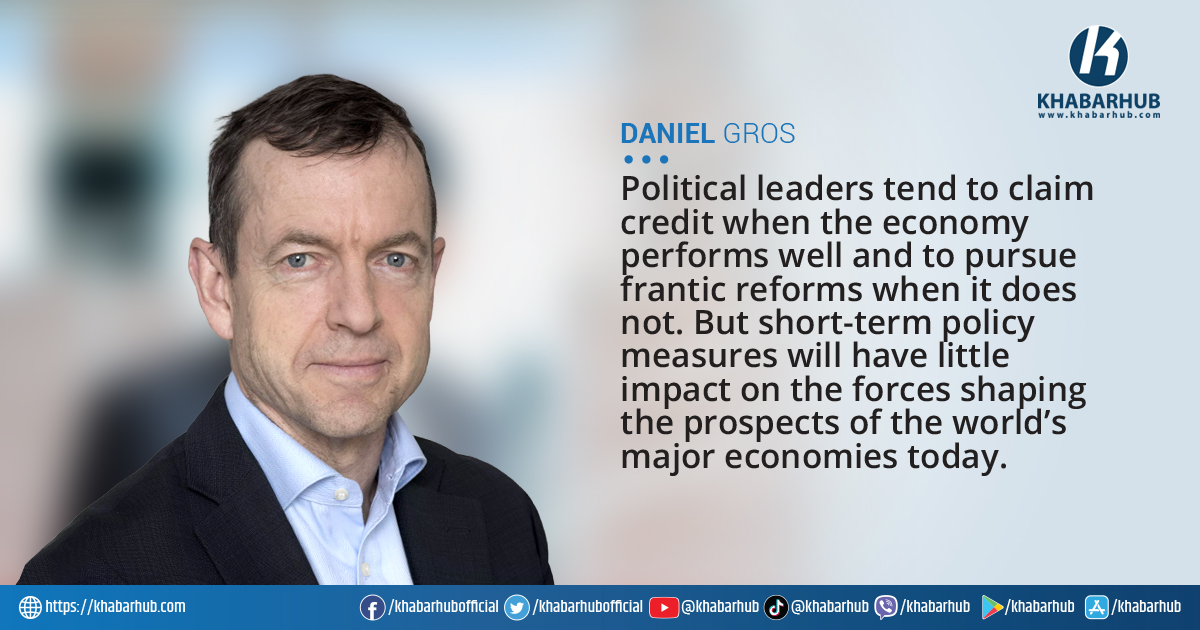
Political leaders tend to claim credit when the economy performs well, and to pursue frantic reforms when it does not. But short-term policy measures will have little impact on the forces shaping the prospects of the world’s major economies today.
They also point out that, when it comes to services, China runs a deficit, resulting in a smaller current-account surplus, now around $650 billion. Criticism of the trade surplus, they argue, reflects anti-Chinese hostility rather than legitimate concerns. It is this perspective that will dictate Chinese policy.
The US economy begins the year with strong growth momentum, having grown at a higher-than-expected rate of 4.3% in the third quarter of 2025. But US growth is also unbalanced: while tech (especially AI) investment is growing at double-digit rates, the manufacturing sector is struggling to adjust to high and unpredictable tariffs. Add to that a widening gap between high- and low-income Americans, and the result is a “K-shaped” economy.
But the US economy’s trajectory is largely outside the control of US President Donald Trump. Yes, he is responsible for the tariffs, and his One Big Beautiful Bill Act will exacerbate inequality by reducing taxes on the wealthiest households and cutting services that benefit the poor and middle class. But the fiscal deficit was already running at about 6% of GDP under Trump’s predecessor, Joe Biden. Trump’s policies merely ensure that high fiscal deficits will continue in the coming years.
America’s ability to maintain high growth, without any new fiscal support, will depend on the continuation of the AI boom. This is not a foregone conclusion: many commentators are questioning the boom’s fundamentals and the math behind it, with some warning that this is a speculative bubble. We will find out soon whether the skeptics are right. Whatever happens, it will be because of a handful of tech companies, not economic policy.
The AI boom has not made its way to Europe, which lacks any large AI firms. This is often blamed on EU regulation, which some – notably, former Italian prime minister and European Central Bank president Mario Draghi in his influential 2024 report on European competitiveness – argue stifles innovation.
The European Commission is now seeking to ease these constraints, under the banner of “simplification.” But the direct impact of its proposed measures will be very small. The Commission itself estimates that its “omnibus package” will reduce administrative costs by a mere €11.9 billion ($13.9 billion) – less than one tenth of 1% of the EU’s GDP.
As Draghi and others have observed, the EU appears to be stuck in a “middle-technology trap”: while industry remains strong, it is mostly based on middle-technology sectors like automobiles and machinery, and little investment goes toward high-tech research and development. Loosening EU regulations might lead to more activity in high-tech sectors, but it will not lead to a surge in growth any time soon. Even in the best-case scenario, it will be a long time before European firms can so much as begin to close the gap with the US “hyperscalers.”
The biggest known unknown in the medium term – in Europe and beyond – remains AI’s impact on productivity and labor markets. But this, again, will have little to do with policy.
Political leaders tend to claim credit when the economy performs well, and to pursue frantic reforms when it does not. But short-term policy measures will have little impact on the forces shaping the prospects of the world’s major economies today.
(Daniel Gros is Director of the Institute for European Policymaking at Bocconi University)
Copyright: Project Syndicate





Comment