




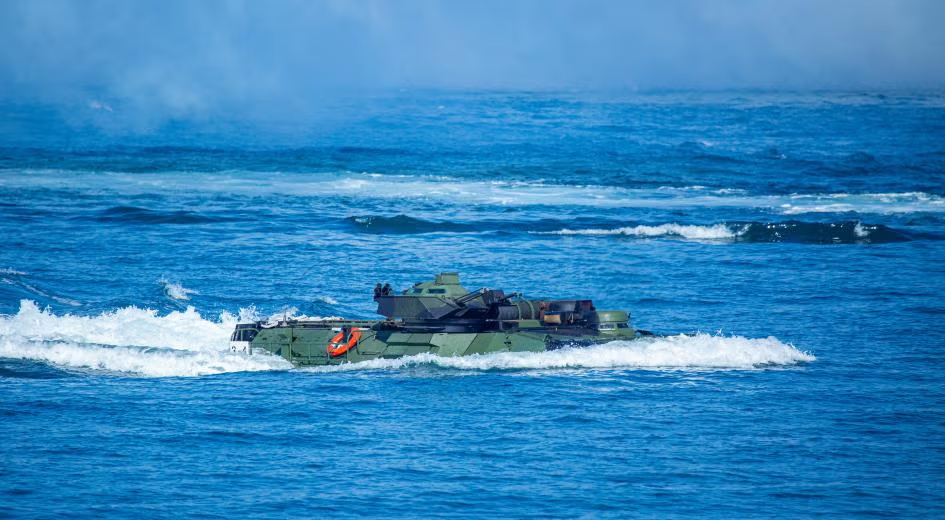
China’s latest military mobilisation around Taiwan brought together two developments that deserve attention. In early November, Taiwan’s Ministry of National Defense detected 49 sorties by Chinese military aircraft in the preceding 24 hours, the highest single-day figure recorded in 2026.
Thirty-one of these sorties crossed the Taiwan Strait median line or entered Taiwan’s central, southwestern and eastern air defence identification zones. At the same time, more than 100 Chinese naval and coastguard vessels were reported operating across the western Pacific, including the Liaoning carrier strike group conducting exercises in the Philippine Sea. The number of aircraft sorties fell to 22 by the following morning, but the wider maritime deployment remained significant.
The episode is important because it demonstrates how Beijing can apply pressure across multiple maritime and aerial fronts without announcing a formal military exercise. It also reflects a broader change in the Taiwan Strait, where frequent PLA deployments have made military activity an increasingly routine feature of the regional security environment. The concern is not that every deployment signals an impending attack. It is that repeated operations are gradually weakening the distinction between peacetime military presence and coercive activity.
From exercises to persistent military pressure
China’s military activity around Taiwan changed significantly after August 2022, when Beijing conducted large-scale exercises following then US House Speaker Nancy Pelosi’s visit to Taipei. The drills included live-fire exercises and operations in waters surrounding the island, demonstrating the PLA’s ability to restrict access to important maritime approaches. What was initially a dramatic show of force gradually developed into a more persistent pattern of aircraft and naval deployments.
The crossing of the Taiwan Strait median line is particularly revealing. Although the line was never formally recognised by Beijing, it had functioned for decades as an informal buffer between the two sides. Repeated PLA crossings have eroded that understanding and increased the frequency with which Taiwan must monitor and respond to Chinese operations.
This is not merely a question of aircraft numbers. Each deployment requires Taiwan’s military to assess the location, composition and purpose of Chinese formations. The cost is operational as well as financial. Aircraft, naval vessels, personnel and surveillance systems must remain available to respond, even when an operation does not develop into a direct confrontation.
The pattern also makes it harder to identify a meaningful change in Chinese military posture. When large deployments become frequent, a sudden increase in activity may be difficult to distinguish from the background noise of routine operations. That creates a particular problem for Taiwan’s military planners, who must remain alert without exhausting resources through constant responses.
The pressure extends beyond the Taiwan Strait
The geographical spread of the latest deployment is equally important. The Liaoning’s presence in the Philippine Sea reflects China’s growing interest in operating beyond the immediate waters surrounding Taiwan. The PLA Navy has invested heavily in developing the capacity to conduct longer-range operations, supported by aircraft carriers, destroyers, replenishment vessels and increasingly sophisticated surveillance capabilities.
Such deployments have implications for Japan and the Philippines as well as Taiwan. Japan has repeatedly tracked Chinese naval vessels operating through strategic passages near its southwestern islands. In October 2026, Tokyo reported tracking Chinese warships and a coastguard vessel passing through the Osumi Strait into the Pacific. The movements came amid a wider Chinese naval deployment stretching from waters near southern Japan to the Philippines and Taiwan. Beijing described the Liaoning’s western Pacific training as a routine exercise intended to test its long-range operational capabilities.
There is no reason to assume that every Chinese naval movement is directed at Taiwan. The PLA has legitimated operational reasons to train in the western Pacific, particularly as it seeks to improve its ability to operate beyond the first island chain. However, the strategic implications cannot be separated from the regional environment in which these deployments take place. The same capabilities that improve China’s ability to protect its maritime interests also give it greater scope to complicate the military calculations of neighbouring countries and external powers.
The expansion of Chinese coastguard operations adds another layer. Unlike conventional naval deployments, coastguard patrols allow Beijing to assert maritime claims through activities presented as law enforcement. In early November, a Chinese coastguard vessel entered restricted waters near the Pratas Islands, administered by Taiwan, prompting a confrontation with a Taiwanese coastguard ship. Taipei described it as the 13th such intrusion near the islands during 2026. Beijing, meanwhile, has maintained that its patrols are conducted in waters under Chinese jurisdiction.
This approach allows China to apply pressure without necessarily creating the immediate appearance of a military confrontation. It also complicates the response. Taiwan must decide whether to treat an encounter as a law enforcement issue, a sovereignty challenge or part of a wider military pattern.
The strategic value of keeping Taiwan under pressure
Beijing’s approach offers an important strategic advantage. It can demonstrate military capabilities, signal its opposition to Taiwan’s political direction and discourage external involvement without committing itself to a military operation. The pressure is directed at several audiences simultaneously. Taipei is reminded of the PLA’s reach, Taiwan’s population is repeatedly exposed to the possibility of conflict, and regional governments are made aware of the military costs that could accompany a crisis.
There is also a gradual operational benefit. Frequent deployments give the PLA opportunities to gather information about Taiwan’s response patterns, test its surveillance systems and familiarise its forces with the island’s surrounding geography. Recent reporting on Chinese maritime research activity has drawn attention to the extensive mapping of waters east of Taiwan, including areas that could become important in a conflict involving submarines, underwater drones or attempts to restrict external military access.
These developments should not automatically be interpreted as evidence of an imminent invasion. Military preparation, operational training and political coercion can overlap without necessarily indicating a decision to go to war. But the accumulation of capabilities and operational experience matters because it can improve China’s options in a future crisis.
The strategy also carries risks for Beijing. The more frequently Chinese and Taiwanese aircraft, naval vessels and coastguard ships operate in close proximity, the greater the possibility of an accident or miscalculation. An encounter at sea or an unexpected aerial manoeuvre could escalate before political leaders have an opportunity to intervene. The presence of other regional militaries makes this problem more complicated, particularly when Chinese operations extend towards Japan and the Philippines.
A regional problem, not just a Taiwan problem
The security implications of this pattern extend beyond the political dispute between Beijing and Taipei. Taiwan sits close to major commercial shipping routes and occupies a central position in global semiconductor manufacturing. Any sustained disruption to its surrounding waters would affect international trade, technology supply chains and regional investment. Japan and the Philippines would also face difficult decisions because of their geographical proximity and security relationships with the United States.
For Taiwan, the immediate challenge is to maintain credible deterrence without allowing Chinese deployments to dictate every military response. This requires investment in surveillance, mobile missile systems, naval capabilities and the ability to sustain operations during a prolonged crisis. For regional governments, it means improving coordination and maintaining communication channels that can prevent routine encounters from becoming larger confrontations.
Beijing, meanwhile, must recognise that military pressure does not necessarily produce political concessions. It may increase the costs of Taiwan’s security planning, but it can also strengthen public support for defence preparedness and encourage closer cooperation between Taipei and its regional partners. The latest mobilisation does not establish that China is preparing to attack Taiwan.
Its significance lies in the increasingly broad geographical reach and frequency of Chinese military activity. The danger is that operations once regarded as exceptional are becoming part of the region’s everyday security calculations. When that happens, the threshold for alarm rises even as the risks of miscalculation remain. Taiwan’s challenge is to ensure that this growing pressure does not become an accepted substitute for stability.





Comment