




When the United Nations General Assembly unanimously adopted Resolution 81/L.8 during its 81st session, deferring the graduation of Nepal and Bangladesh from the Least Developed Country (LDC) category to November 24, 2029, policymakers in Kathmandu and Dhaka breathed a collective sigh of relief.
The decision formally amended the preparatory timeline established under General Assembly Resolution A/RES/76/8, which had originally scheduled both economies for graduation on November 24, 2026, following exceptional pandemic-era reprieves. Yet, treating this postponement as a diplomatic triumph misreads the international landscape.
Nepal has remained on the UN’s LDC list since the group’s creation in 1971—a bloc that began with 25 nations, peaked at 51 in 2003, and has seen only nine countries graduate, leaving 44 today. Lingering in this transitional corridor for more than half a century reflects persistent structural vulnerabilities rather than an earned diplomatic achievement.
The official multilateral narrative framed the three-year extension constructively. General Assembly President and Bangladeshi Foreign Minister Khalilur Rahman emphasised that “this extension is not a retreat, but an investment in lasting progress. Graduation should advance development, not disrupt it.”
They must also push for the institutional adoption of the UN General Assembly’s 2024 Multidimensional Vulnerability Index (MVI), ensuring that eligibility for climate finance is based on structural and environmental vulnerability rather than income metrics alone.
However, the diplomatic reality in New York revealed growing donor fatigue. Speaking on behalf of the European Union, Ireland explicitly cautioned that repeated postponements for countries already meeting objective graduation criteria risk eroding the credibility of the entire process.
Simultaneously, Canada, speaking alongside Australia and New Zealand, called for regular, monitored progress benchmarks. The extension to 2029 is not an open-ended sanctuary; it is an expensive policy overdraft granted by an increasingly exacting international community.
The anatomy of compounded economic vulnerabilities
Nepal’s formal appeal to the UN Committee for Development Policy (CDP), submitted on May 13, 2026, by Foreign Minister Shisir Khanal and confirmed by Foreign Ministry spokesperson Lok Bahadur Poudel Chhetri on May 22, was driven by acute macroeconomic fragility. The country’s road to graduation has been fraught with structural interruptions.
Having satisfied the Human Assets Index (HAI) and Economic and Environmental Vulnerability Index (EVI) criteria in 2015, Nepal deferred its 2018 graduation following the 2015 Gorkha earthquake. A second postponement came in 2021 as COVID-19 battered economic activity.
By 2026, fresh domestic headwinds, including Gen Z political movements and catastrophic flash floods, had collided with external shocks, notably supply chain disruptions caused by hostilities in West Asia and the US-Iran war. With the World Bank projecting Nepal’s economic growth to fall to 2.3% in fiscal year 2025/26 (FY26), down from 4.6% in FY25, alongside mounting pressure on diaspora remittance inflows, the country was fundamentally unprepared to absorb the loss of international support measures.
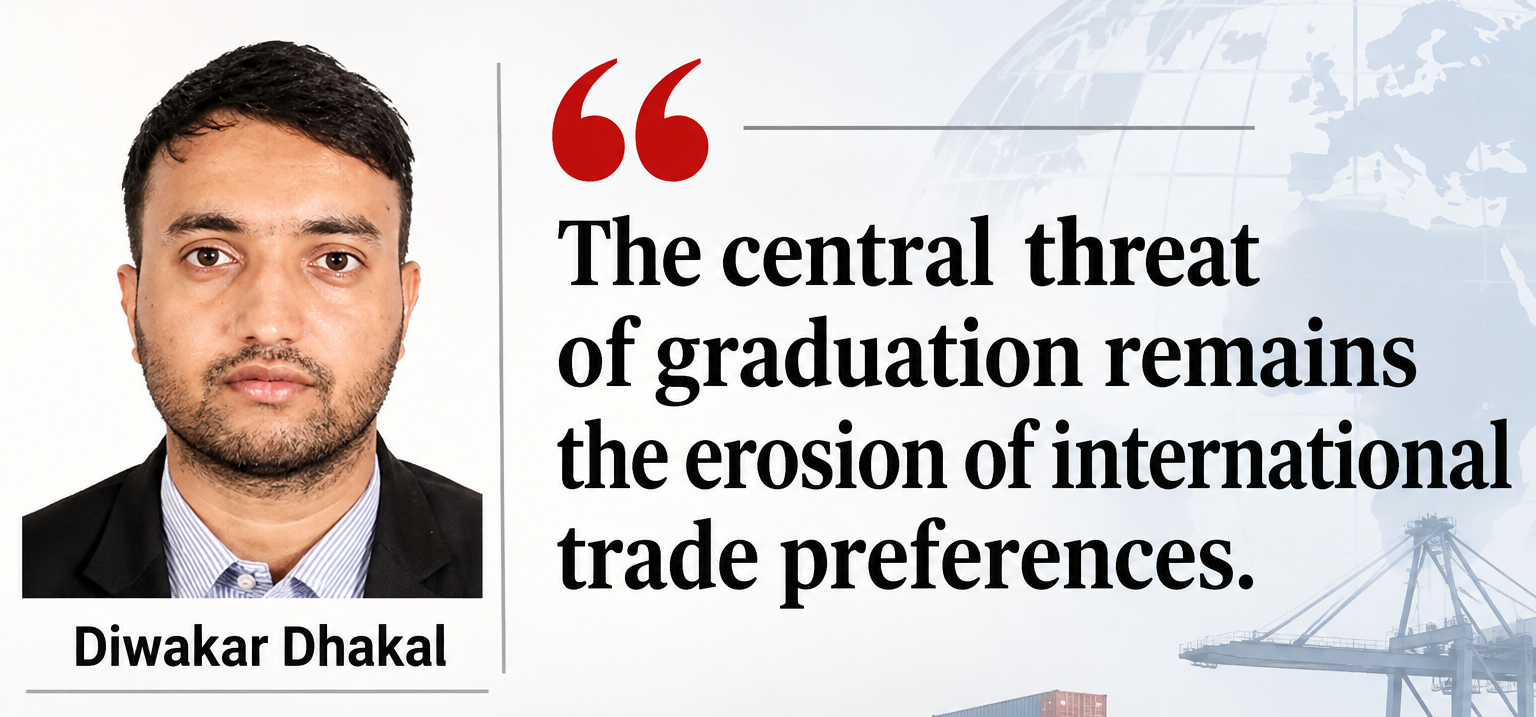
The central threat of graduation remains the erosion of international trade preferences. In Nepal, exports account for just 8.9% of total trade volume, heavily overshadowed by massive import bills—underscoring an underdeveloped manufacturing base constrained by high logistics costs and infrastructure deficits.
The eventual loss of Duty-Free Quota-Free (DFQF) market access and World Trade Organization (WTO) Special and Differential Treatment (SDT) is projected to cause a 4.3% decline in merchandise exports, affecting textiles, carpets and metal goods.
Government-cited studies warn that, without adequate safeguards, employment in key productive sectors could contract by up to 35%. In neighbouring Bangladesh, policymakers face an identical challenge on a much larger scale, as its massive ready-made garment export industry relies heavily on preferential market access to sustain millions of manufacturing jobs.
The mirage of earmarked climate finance
The first international test of this deferred timeline will emerge in Antalya, Türkiye, at COP31, where Australia will preside over negotiations and both nations must participate as beneficiaries of the additional time granted. In climate diplomacy, LDC status directly governs access to dedicated funding windows.
The Least Developed Countries Fund (LDCF), managed by the Global Environment Facility (GEF), caps country allocations at $20 million per four-year cycle, while the Fund for Responding to Loss and Damage (FRLD) reserves at least 50% of its start-up capital for LDCs and Small Island Developing States. While the 2029 deferral keeps both economies within these earmarked funding windows, the available pools of capital are shrinking relative to global demand. The FRLD’s initial capitalisation of $342 million faces 176 applications seeking $2.8 billion, with 41 LDCs alone demanding more than $1 billion.
Furthermore, historical data demonstrate that LDC classification has never guaranteed equitable climate finance disbursements. Since its inception, the LDCF has provided Bangladesh with $48.19 million, lagging behind Nepal’s $55.38 million and Bhutan’s $60.39 million.
During the 2022–2026 cycle, Bangladesh accessed the facility only through its final work programme, securing a $9.8 million coastal adaptation project for the Greater Sundarbans—less than half of its allowable ceiling. More critically, the upcoming GEF-9 replenishment cycle runs from July 2026 to June 2030, meaning that graduation in November 2029 will push both nations into an institutional void midway through the programming cycle.
Donor scrutiny has already intensified. When the FRLD allocated its inaugural $20 million grant to flood-stricken Nepal, developed-country board members, including the European Union, went on record stating that the emergency disbursement must not set a precedent.
Strategic pathways towards irreversible transformation
To avert severe economic shocks in 2029, the next three years must be devoted to aggressively implementing Nepal’s Smooth Transition Strategy (STS), launched by the National Planning Commission (NPC) in February 2024. Aligned with the 16th Five-Year Plan (2024/25–2028/29) and its vision of elevating the country to an upper-middle-income economy by 2043, the strategy prioritises six pillars: macroeconomic stability, trade and investment, economic transformation, productive capacity, climate and disaster risk management, and social inclusion.
The UN has granted three more years; treating 2029 as an absolute, non-negotiable deadline is the only path towards a sustainable economic future.
As the Federation of Nepalese Chambers of Commerce and Industry (FNCCI) has stressed, graduating without upgraded industrial infrastructure, technology adoption and improved cost competitiveness will leave domestic manufacturers defenceless. Crucially, the expiration of WTO TRIPS flexibilities on pharmaceutical patents requires both Nepal and Bangladesh to restructure their intellectual property frameworks to safeguard domestic generic medicine production.
Simultaneously, Dhaka and Kathmandu must replace defensive appeals with proactive, coordinated regional diplomacy. At COP31 and during the GEF-9 negotiations, the two nations should champion a unified graduation clause ensuring that countries exiting the LDC category midway through a replenishment cycle retain dedicated funding floors for at least three years after graduation.
They must also push for the institutional adoption of the UN General Assembly’s 2024 Multidimensional Vulnerability Index (MVI), ensuring that eligibility for climate finance is based on structural and environmental vulnerability rather than income metrics alone.
Bilaterally, expanding the Bangladesh, Bhutan, India and Nepal (BBIN) transit corridors and operationalising the trilateral power trade agreement, which enables Nepal to export clean hydropower to Bangladesh via India, will generate the regional economies of scale necessary to absorb the loss of Western trade preferences.
The UN has granted three more years; treating 2029 as an absolute, non-negotiable deadline is the only path towards a sustainable economic future.
(Dhakal is a law graduate of Kathmandu School of Law.)





Comment