





KATHMANDU: Economic Digest presents a brief yet comprehensive roundup of major business developments in Nepal, delivered in clear and accessible summaries.
Nepal’s latest economic and administrative developments reflect a country balancing immediate disaster management with longer-term efforts to strengthen infrastructure, financial systems and economic resilience. The Bhote Koshi floods remain the dominant concern, with more than Rs 20 billion in road and bridge damage and potential overall losses exceeding Rs 387 billion. The government’s mobilization of nearly Rs 12 billion in relief funds, along with contributions from NRB, NAIMA and Germany, demonstrates growing financial support, while the continued search for missing people highlights the scale of the humanitarian crisis.
The disaster has also disrupted supply chains, particularly through the Prithvi Highway, reducing LPG deliveries to Kathmandu and prompting the diversion of Chinese fruit imports through the Korala border. These developments underscore Nepal’s vulnerability to infrastructure bottlenecks and natural disasters.
At the policy level, authorities are attempting to address structural weaknesses. Public procurement reforms and the termination of stalled road contracts indicate efforts to accelerate infrastructure delivery, while relatively low capital expenditure points to persistent implementation challenges. Capital market reforms similarly seek to restore investor confidence amid declining market activity.
Meanwhile, the expansion of electric vehicles, modernization of postal and driving-license services, and the proposed Gidikhola hydropower project signal progress toward digitalization, cleaner transport and greater energy capacity. Overall, the developments suggest that Nepal’s immediate priorities are disaster recovery, infrastructure resilience and more efficient public-sector implementation, alongside longer-term economic modernization.
NRB directs financial institutions to maintain essential banking services on public holiday
Nepal Rastra Bank (NRB) has instructed all licensed Class A, B, C and D financial institutions to keep essential counter and banking services operational on Tuesday. The directive is intended to facilitate relief distribution, financial transactions and rescue operations for people affected by the recent natural disasters in Rasuwa, Nuwakot and surrounding districts. The instruction overrides the nationwide public holiday announced by the Council of Ministers for Gen Z Martyr’s Day. The central bank said banking counters must remain fully operational to support emergency liquidity management, humanitarian fund disbursements and urgent commercial settlements in disaster-affected areas. Financial institutions have also been directed to deploy designated personnel and maintain reliable digital payment systems to ensure uninterrupted financial services despite the nationwide holiday.
Gold rises to Rs 305,400 per tola, silver to Rs 4,790
Gold and silver prices both increased in Nepal’s domestic market on Tuesday, according to the Federation of Nepal Gold and Silver Dealers’ Association. The price of gold rose by Rs 3,500 per tola, with one tola equivalent to 11.66 grams. Gold was priced at Rs 305,400 per tola on Tuesday, up from Rs 301,900 on Monday. The price of silver also increased by Rs 100 per tola, reaching Rs 4,790 from Rs 4,690 on the previous trading day. The latest market rates therefore represent a daily increase of Rs 3,500 in gold and Rs 100 in silver.
Prime Minister relief fund reaches nearly Rs 12 billion
Approximately Rs 12 billion has been raised through the Prime Minister Disaster Relief Fund and the Prime Minister Relief Fund, with more than Rs 11.776 billion deposited as of 9:00 am Tuesday, according to the Office of the Prime Minister and Council of Ministers. Of the total deposits, more than Rs 8.591 billion is still held in accounts at nine commercial banks. The government has already transferred Rs 1 billion from the relief funds to the National Disaster Risk Reduction and Management Authority (NDRRMA) to support relief efforts for flood victims in Rasuwa. The funds have also been received in foreign currencies. More than $21.1 million has been deposited in dollar accounts maintained by Himalayan Bank and Laxmi Sunrise Bank, the Office said. The contributions are part of ongoing efforts to mobilize financial resources for disaster response and relief operations.
Korala border point records first fruit imports, with 10 containers entering Nepal
At least 10 containers carrying fruit from China have entered Nepal through the northern Korala border point after completing customs clearance and plant quarantine procedures, marking the first fruit imports through the crossing. The shipments were diverted to Korala after the Rasuwa-Kerung and Tatopani border points were closed following the Bhote Koshi flood in Rasuwa on August 26. The fruit was transported from Lizi Port, near Korala, before being transferred into Nepali containers for entry into Nepal. Over two days, Sunday and Monday, quarantine officials inspected 9,450 kg of dragon fruit, 15,400 kg of mangoes, 87,000 kg of apples, 26,100 kg of pears and 8,000 kg of avocados. The chief of the Mustang Customs Office said the diversion has enabled fruit imports through Korala for the first time.
Bhote Koshi flood: authorities report 600 foreign citizens still missing
Around 600 foreign nationals from 35 countries remain missing, along with thousands of Nepali citizens, following the Bhote Koshi River floods that devastated parts of central Nepal two weeks ago, according to an update issued by the Ministry of Foreign Affairs on Tuesday, September 8, 2026. On the 14th day of rescue operations, authorities said 13,583 people, including more than 300 foreign nationals, have been rescued from Rasuwa, Nuwakot and Dhading. However, 5,300 people remain unaccounted for, while 1,357 bodies have been recovered. Specialized tunnel-rescue and forensic teams from India, China, the Republic of Korea, Australia, Malaysia, the United Arab Emirates, Japan and Singapore are assisting the Nepali Army and Nepal Police at hydropower facilities including Upper Trishuli 1, Upper Trishuli 3A, Chilime and Rasuwagadhi. The government has requested advanced rescue equipment and DNA testing supplies and has established a dedicated email address, [email protected], for DNA-related coordination. Authorities have also facilitated the repatriation of more than 700 Nepali citizens through the Tatopani border and are working to restore damaged transportation routes.
Finance minister directs officials to propose legal measures for capital market reform
Finance Minister Swarnim Wagle has directed government officials to recommend legal measures to support the development and reform of the capital market. Wagle issued the directive during a meeting at the Ministry of Finance on Monday attended by senior officials, including Nepal Rastra Bank Governor Biswo Nath Poudel and Securities Board of Nepal Chairman Gopal Bhatta. The move comes amid declining investor confidence, falling transaction volumes and a roughly Rs 700 billion reduction in market capitalization over the past six months. The NEPSE index has remained around the 2,500-point level. The ministry is preparing a plan to strengthen the capital market, with a focus on transparency, market fundamentals and investor protection. Meanwhile, the Securities Board of Nepal has instructed the Nepal Stock Exchange, CDS and Clearing, brokers and listed companies to improve security measures and technology. Market experts have advised investors to base their investment strategies on companies’ financial health and valuations.
Public procurement law amended to accelerate infrastructure projects
The government has amended the Public Procurement Act, 2007, to reduce procedural delays and speed up infrastructure and development projects following the Gen Z protest. Under the Public Procurement (Second Amendment) Act, 2026, the bidding period for national-level tenders has been shortened from 30 days to 21 days, while the period for re-inviting bids has been reduced from 15 days to seven days. For international tenders, the bidding period has been cut from 45 days to 30 days, while the period for re-invitation has been reduced from 21 days to 15 days. Department of Roads Director General Bijaya Jaishi said the revised provisions are construction-friendly, aligned with international practices and designed to reduce practical difficulties in project implementation.
Highway landslide cuts Kathmandu LPG supply to 18,259 cylinders
A landslide at Krishnabhir along the Prithvi Highway has severely disrupted transportation, forcing industry operators to reroute cargo trucks through the alternate Tribhuvan Highway. As a result, only 18,259 LPG cylinders were delivered to the Kathmandu Valley on Tuesday by nine operating gas companies. The volume is far below the valley’s daily demand of around 100,000 cylinders and the standard daily requirement of 35,000 to 40,000 cylinders, according to Diwan Chand, president of the LP Gas Industry Association. Consumers have continued to face lengthy queues outside local distribution depots as transportation disruptions constrain supplies of essential cooking fuel across residential areas of the valley.
Study underway for 50-megawatt reservoir in Jumla at an estimated cost of Rs 15 billion
Adhyanta Investment has advanced a preliminary feasibility study for the proposed Gidikhola Reservoir Hydropower Project in Tatopani Rural Municipality-4 of Jumla. The project is expected to have a capacity of 50 to 60 megawatts and require an estimated investment of around Rs 15 billion. The proposed project will feature a 50-meter-high dam, a 5.5-kilometer tunnel and a 1.6-kilometer penstock pipe. The company is expected to release its detailed technical report on September 30. Company representatives said the project aims to harness the area’s renewable energy potential and contribute to economic growth across Karnali Province. Preliminary hydrological assessments have indicated a reliable water source, raising expectations that the project could support electricity expansion, commercial activity and long-term infrastructure development in the region.
Road Department terminates around 160 stalled project contracts
The Department of Roads has terminated around 160 contracts involving stalled or delayed road projects during the year following the Gen Z protest. Department of Roads Director General Bijaya Jaishi said contracts for projects that have faced prolonged delays are being terminated and re-tendered on a priority basis. Contracts covering road sections such as Dhulikhel-Khawa and Balaju have already been terminated, with new tenders issued, according to the Department. Infrastructure Development Minister Sunil Lamsal has also carried out field inspections to identify stalled contracts and resolve implementation problems. Jaishi said the Department is working to address public complaints related to roads, bridges and other infrastructure while continuing to advance projects through the government’s own infrastructure company.
Bhote Koshi flood causes more than Rs 20 billion in road and bridge damage
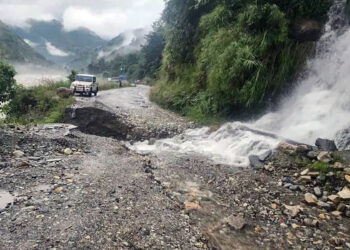
The Bhote Koshi River flood on August 26, 2026, caused preliminary damage exceeding Rs 20 billion to roads, bridges and other infrastructure, according to the Department of Roads. Department of Roads Director General Bijaya Jaishi said the disaster damaged approximately 40 kilometers of roads and 31 bridges, in addition to numerous public and private structures. The flood affected parts of Rasuwa, Nuwakot, Dhading and Gorkha, causing widespread physical destruction and loss of life. Meanwhile, the National Disaster Risk Reduction and Management Authority (NDRRMA) has estimated that the total damage and economic losses caused by the Bhote Koshi and surrounding floods could exceed Rs 387 billion. The extensive destruction has created a major additional challenge for the reconstruction and restoration of critical infrastructure.
Capital spending reaches 46.79% despite infrastructure push
The government spent Rs 190.841 billion, equivalent to 46.79% of its Rs 407.888 billion capital expenditure budget, during fiscal year 2025/26, according to the Financial Comptroller General Office. Overall capital expenditure remained significantly below the amount allocated for infrastructure and development activities. The Department of Roads was allocated Rs 120 billion for capital spending and utilized approximately 60% of the amount. Department of Roads Director General Bijaya Jaishi attributed the relatively low expenditure partly to an initial freeze on budget implementation by the Ministry of Finance, which delayed the contracting process. He also pointed to rising construction material costs, particularly bitumen, amid the conflict in the Middle East. According to Jaishi, some contractors postponed construction activities in anticipation of lower material prices.
More than 2.7 million delayed driving licenses dispatched
The Department of Transport Management has dispatched 2,747,253 driving licenses that had remained unprinted for as long as four years. Department Director Keshav Khatiwada said the licenses were mailed to the respective transport offices by July 23, 2026. The delayed documents were printed by the Security Printing Center under an agreement signed with the Department on October 29, 2025. The Department has also upgraded its system for issuing new licenses and processing renewals. Under the revised system, applicants’ details can be retrieved using their National Identity Card numbers, while government revenue payments can be completed online. The changes are expected to eliminate the prolonged dependence on revenue receipt slips among applicants who have been waiting for their physical driving licenses.
Nepal Postal Services receives innovation award from Asia Pacific Postal Union
Nepal Postal Services has received the Innovation Award in the Service in Remote Areas category at the 14th Asia Pacific Postal Union (APPU) Congress in Bangkok, Thailand. The congress was held from August 31 to September 4, recognizing Nepal’s efforts to transform its postal system into a government-run courier service capable of delivering important documents, including passports, driving licenses and academic certificates, directly to citizens. The service has also expanded postal coverage across remote and difficult-to-access areas. Department Director General Manmaya Bhattarai Pangeni led the three-member Nepali delegation at the international event. The award highlights the impact of administrative reforms aimed at modernizing traditional postal services and improving logistics for citizens in geographically isolated communities. The department has also been working to strengthen cross-border e-commerce services and develop postal systems capable of supporting communities during disasters.
Electric vehicles gain ground as Nepal promotes green transport
The number of electric vehicles (EVs) registered in Nepal has reached 63,280 as the government steps up efforts to establish a greener and more climate-resilient transportation system. The National Transport Policy, 2026 has identified EVs and the expansion of charging infrastructure as priorities while emphasizing energy efficiency and environmentally sustainable transportation. By mid-February of fiscal year 2025/26, at least 6,249,732 vehicles had been registered nationwide
Study underway for 50-megawatt reservoir in Jumla at an estimated cost of Rs 15 billion
Adhyanta Investment has moved forward with a preliminary feasibility study for the proposed Gidikhola Reservoir Hydropower Project in Tatopani Rural Municipality-4 of Jumla, with an estimated generation capacity of 50 to 60 megawatts and a projected investment requirement of around Rs 15 billion. The proposed project will include a 50-meter-high dam, a 5.5-kilometer-long tunnel and a 1.6-kilometer penstock pipe. The company is scheduled to release its detailed technical report on September 30. Representatives of the company said the project is intended to harness the region’s renewable energy potential and turn it into a foundation for economic growth across Karnali Province. Initial hydrological assessments have indicated that the project’s water source is sufficiently reliable. The company said the project could significantly contribute to expanding electricity access, supporting commercial activities and promoting long-term infrastructure development across the rugged Himalayan region.
Capital spending reaches 46.79% despite infrastructure push
The government spent Rs 190.841 billion, or 46.79% of its total capital expenditure allocation of Rs 407.888 billion, during fiscal year 2025/26, according to the Financial Comptroller General Office. Overall capital expenditure remained below the amount allocated for infrastructure and development programs. The Department of Roads had been allocated Rs 120 billion in capital expenditure and utilized around 60% of its budget. Department of Roads Director General Bijaya Jaishi said the relatively low expenditure was partly caused by an initial freeze on budget implementation by the Ministry of Finance, which delayed the contracting process. Jaishi also cited a sharp rise in construction material prices, particularly bitumen, amid the conflict in the Middle East. He said some contractors delayed construction work in the hope that material prices would decline.
Nepal Postal Services receives innovation award from Asia Pacific Postal Union
Nepal Postal Services has received the Innovation Award in the Service in Remote Areas category at the 14th Asia Pacific Postal Union (APPU) Congress held in Bangkok, Thailand, from August 31 to September 4. The award recognizes the postal service’s transformation into a government-operated courier service that delivers important documents, including passports, driving licenses and academic certificates, directly to citizens’ doorsteps. Nepal Postal Services has also expanded its network to improve the reliability of postal services in remote and geographically challenging areas. Department Director General Manmaya Bhattarai Pangeni led the three-member Nepali delegation at the international congress. The delegation highlighted the administrative and operational reforms that have helped modernize the country’s traditional postal system. The international recognition reflects the department’s efforts to overcome geographical isolation by providing dependable logistics services to communities in remote areas. It has also been working to integrate cross-border e-commerce services and develop postal systems that can remain functional during disasters. The department’s expanded services are expected to strengthen access to essential government documents and other deliveries for vulnerable rural communities across Nepal.
Electric vehicles gain ground as Nepal promotes green transport
The number of electric vehicles (EVs) in Nepal has reached 63,280 as the government promotes a cleaner and more climate-resilient transportation system. The National Transport Policy, 2026 has identified EVs and the expansion of charging stations as key priorities while emphasizing the development of an energy-efficient and environmentally friendly transport system. By mid-February of fiscal year 2025/26, at least 6,249,732 vehicles had been registered across Nepal. More than 5 million of those vehicles were motorcycles, accounting for over 80% of the country’s total registered vehicles. The government has connected the shift toward cleaner transportation with Nepal’s commitments under the Paris Agreement. It aims to develop a green, sustainable and climate-resilient transportation system while reducing the environmental impact of the country’s growing vehicle fleet.
Germany announces €8 million relief package for Bhote Koshi flood victims
The German Embassy in Kathmandu announced a comprehensive humanitarian assistance package worth €8 million, equivalent to approximately Rs 1.40 billion, on Tuesday to support rescue, relief and long-term rehabilitation efforts for communities affected by the Bhote Koshi floods. More than €500,000 from the package will be used to provide immediate emergency supplies through the European Union’s civil protection mechanism. Another €200,000 has been allocated to support maternal and newborn healthcare through civil society organizations. The remaining €7.3 million will be implemented through GIZ to support sustainable reconstruction and disaster risk management in the affected areas. German diplomatic representatives reaffirmed Germany’s solidarity with the Nepali people during the crisis. They emphasized that continued bilateral cooperation would help accelerate the reconstruction of damaged infrastructure and strengthen Nepal’s long-term resilience to climate-related and natural disasters.
NRB contributes more than Rs 13.8 million to flood relief fund
Nepal Rastra Bank (NRB) has deposited more than Rs 13.8 million into the Prime Minister Disaster Relief Fund to support rescue and relief operations for people affected by the Bhote Koshi River flood in Rasuwa. The contribution was collected from officials and employees of the central bank and deposited into the relief fund on Tuesday. According to a press release issued by the Governor’s Office, the amount was contributed by the NRB Governor, Deputy Governor and permanent and contract employees working at the bank. The contribution was made to assist people affected by the flood that struck Rasuwa on August 26.
NAIMA provides Rs 5 million for Bhote Koshi flood victims
The Nepal Automobile Importers and Manufacturers Association (NAIMA) has donated Rs 5 million to support rescue, relief and rehabilitation efforts for people affected by the Bhote Koshi flood in Rasuwa. The association made the contribution in accordance with a decision taken earlier by its leadership. A delegation led by NAIMA President Ritu Singh Vaidya handed over the funds to Finance Minister Dr. Swarnim Wagle. The handover ceremony was attended by NAIMA board members Yamuna Shrestha and Hemant Golchha, Simex Inc. CEO Sahil Shrestha, NAIMA Executive Director Rajkumar Dulal, Program Coordinator Gyanu Adhikari and Utsav Karki from digital agency Digipal. During the ceremony, Vaidya said the contribution was made on behalf of NAIMA’s member companies as well as automobile importers and manufacturers operating across Nepal. She acknowledged that the amount was relatively modest but said the donation’s main purpose was to express solidarity with communities affected by the disaster and demonstrate support during the ongoing crisis.
Banks and financial institutions begin announcing dividends
Several banks, financial institutions and microfinance companies have begun announcing dividends from their profits for fiscal year 2025/26. Kamana Sewa Development Bank has proposed a 15% cash dividend and a 9% proportional dividend for preference shareholders. Garima Development Bank has proposed the highest total dividend announced so far, at 20%, comprising 10% bonus shares and 10% cash dividend, including taxes. Financial institutions across the banking sector are preparing to distribute returns ahead of the upcoming festive season, although the proposed dividends remain subject to formal approval from the relevant financial regulators. The early dividend announcements come as financial institutions seek to distribute returns to shareholders following the close of the fiscal year. Industry analysts say the announcements could indicate improving profitability among some institutions while also helping strengthen institutional investor confidence and liquidity in the secondary market.
More than 2.7 million delayed driving licenses dispatched
The Department of Transport Management has dispatched 2,747,253 driving licenses that had remained unprinted for periods of up to four years. Department Director Keshav Khatiwada said the licenses were sent by post to the respective transport offices by July 23, 2026. The long-delayed licenses were printed by the Security Printing Center under an agreement signed between the Department and the center on October 29, 2025. The Department has also upgraded its system for issuing new driving licenses and processing renewals. Under the revised system, applicants’ information can be retrieved using their National Identity Card numbers, while revenue payments can be made online. Officials expect the improved system to end applicants’ prolonged reliance on revenue payment receipt slips while waiting for their physical driving licenses.





Comment